

A Space of Your Own: What Matters When Setting Up Your First Home
First Space, Your Way · Part 1 of 5
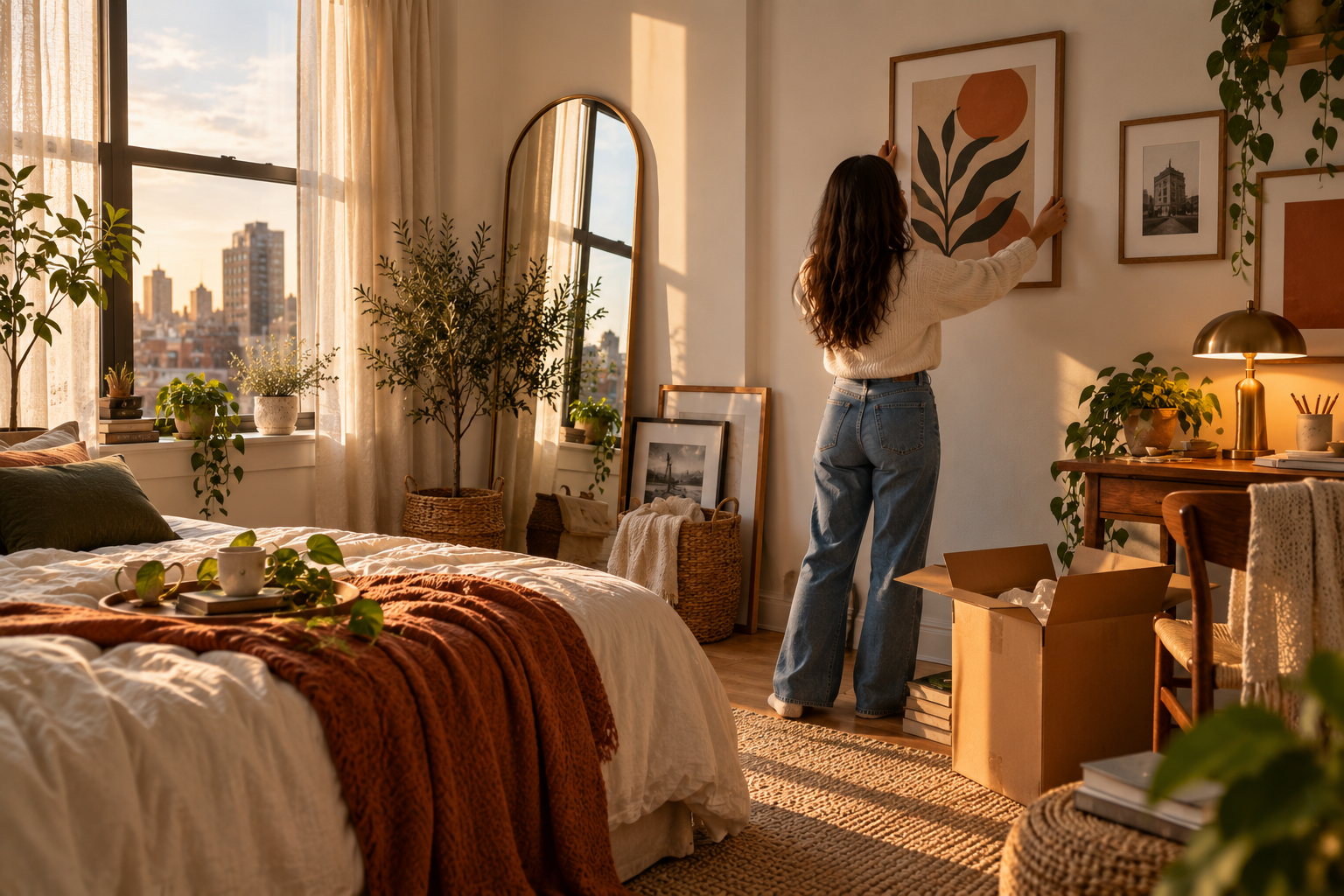
A first home can take many forms
The walls are blank, the boxes are half-unpacked, and for the first time, the choices in the room belong entirely to the person living there. It might be a bedroom carved out of a parent’s basement in Mississauga, a rental split three ways near Kitchener-Waterloo, or a first apartment leased entirely alone in Ottawa.
None of these counts more than the others. What matters when setting up a first home has surprisingly little to do with any single decorating trend, and much more to do with what the space is allowed to say about the person living in it.
If you are setting up your first home, this guide is a starting point. It covers how to prioritize the essentials, choose a decorating direction, build comfort into everyday routines, pick furniture that can adapt, and decorate within a budget, with a deeper guide in the series for each step.
Statistics Canada’s 2021 Census shows how varied that starting point is. Among adults aged 20 to 34 living in private households, 35.1% lived with at least one parent and 39.4% with a spouse, partner or children. Another 14.8% lived with other relatives or non-relatives such as roommates, and 10.7% lived alone.
- 35.1%
- With at least one parent
- 39.4%
- With a spouse, partner, and/or children
- 14.8%
- With other relatives or non-relatives, such as roommates
- 10.7%
- Living alone
A first home, in other words, is just as likely to be one room as a full apartment. Housing circumstances, family structure, and where in the country someone lives all shape what “a first home” actually looks like. Psychologists sometimes call this stretch of life emerging adulthood. A 2006 American Psychological Association feature on US research describes the years after high school as marked by repeated changes of address, with frequent moves usually tapering off in a person’s thirties. The label matters less than what it points to: a lot of people setting up a first home aren’t settling in for good, and that shapes the choices that follow.
Rent takes up a larger share of income in some cities than others, and that changes what a first home tends to be. In places with high housing costs, it might mean one room with shared common areas for years; elsewhere, a full basement suite or a first purchased condo is more common. Income, culture, disability, and family circumstances all shape what “independent” means here too — a bedroom someone fully controls inside a multigenerational home counts as much as a studio apartment does.
Having a say in your space
What shows up consistently in the research isn’t a colour palette — it’s a sense of control. Choosing what stays visible on a shelf, which door stays shut, or when a space gets tidied gives someone a genuine say over their surroundings.
The IKEA Life at Home Report 2026, global research from the furniture retailer, names control, comfort and security as the three needs that rise to the top across ages and living situations. IKEA describes control as spaces that work for real life, the ability to plan ahead and a sense of order. Nearly three-quarters of respondents say feeling in control at home is important, yet fewer than six in ten feel it regularly.
For someone setting up a first room, that sense of order can matter more than any single design choice. It’s worth remembering before reaching for a paint chip.
Control doesn’t come from a colour palette. It comes from choosing, finally, what stays and what goes.
Making room for personal meaning
Rooms at this stage often don’t commit to one look, and that’s frequently by design rather than compromise. A family heirloom might sit next to a thrifted lamp and a print from an independent artist’s shop, gathered rather than purchased as a set.
Pinterest’s 2026 trend report found that, globally, nearly a quarter of Gen Z and Millennial consumers who engage with trends say they avoid trend fatigue by putting their own spin on them. That finding is about trends broadly, not interiors specifically, but it fits what often shows up in first apartments.
If you aren’t sure which pieces and colours are really yours, start with our guide on how to find your home decor style, which walks through spotting patterns in what you already love. Your room should look like you made a decision is a familiar idea at NestDigest, and it applies here: the goal isn’t a matching set from one collection, it’s a room that reflects real choices. For a walkthrough on building that kind of layered, personal-object-led room, our guide to artisan home decor ideas is worth a look before the next thrift-store trip.
Comfort that fits everyday life
Comfort does real work in these spaces. The IKEA research found that 86% of people say comfort matters at home, but only 66% say they experience it regularly.
Among adults aged 18 to 29 in that same research, 36% named mental health as a concern shaping how they live at home, and 32% named screen time. Those numbers read less like decorating notes and more like a wellbeing brief.
Warm, adjustable lighting is one of the simplest ways to change how a room feels to sit in. Our guide to layering light through a Canadian winter goes deeper on this, which matters even more in a room with one window and a landlord who won’t approve new fixtures.
A single armchair angled away from a desk, reserved for nothing but reading, does real work in a room that otherwise runs on notifications.
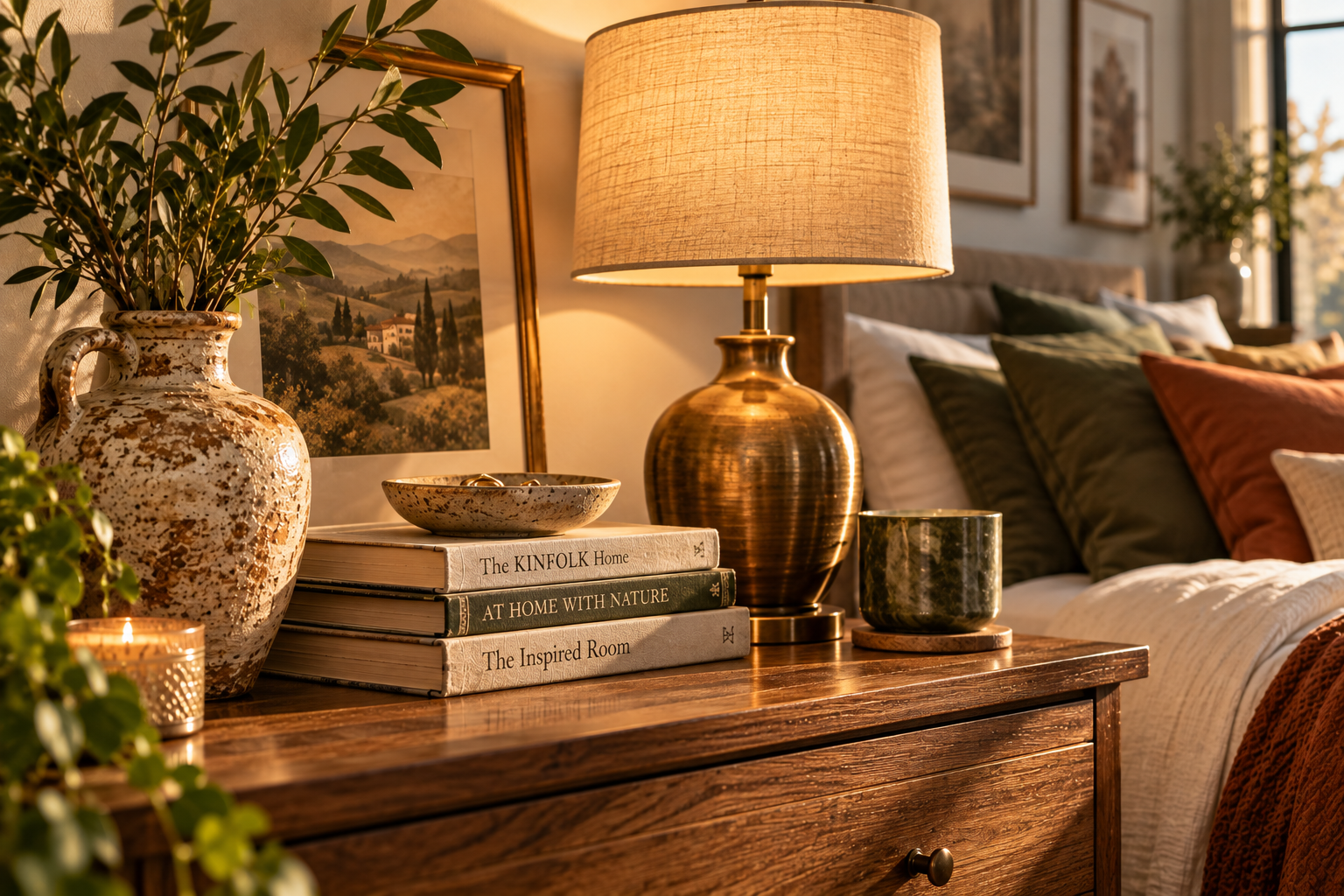
Choosing Flexible Furniture for Your First Home
For many first homes, one room has to be bedroom, office, gym, and social space, sometimes within the same evening. That’s less a design problem than a scheduling one, and it rewards furniture that changes jobs — a daybed that works as seating until late, a desk that folds flat on weekends, a storage ottoman that holds a yoga mat between uses. Our small-space layout ideas show how to place pieces like these so the room still works on an ordinary Tuesday.
Our guide to carving a real home office nook covers how to build a genuine work zone out of a space that wasn’t originally meant to hold one. A closet, a landing corner, or a hallway nook can all do more than expected once they’re properly zoned.
Because many first homes aren’t meant to be permanent, the furniture inside them often needs to survive a move that hasn’t been scheduled yet. Modular shelving, a lightweight table and plug-in lamps rather than hardwired fixtures suit a first space for the same reason: permanence may be wanted eventually, but it hasn’t been decided yet.
This is also where a repaired lamp or a secondhand dresser tends to fit in naturally. In the same IKEA research, saving money was the top motivator for taking climate action, cited by 54% of respondents. That lines up with what often fills a first apartment anyway — a grandparent’s dresser instead of flat-pack, a repaired lamp instead of a replaced one — even when the environmental upside is more of a bonus than the starting point.
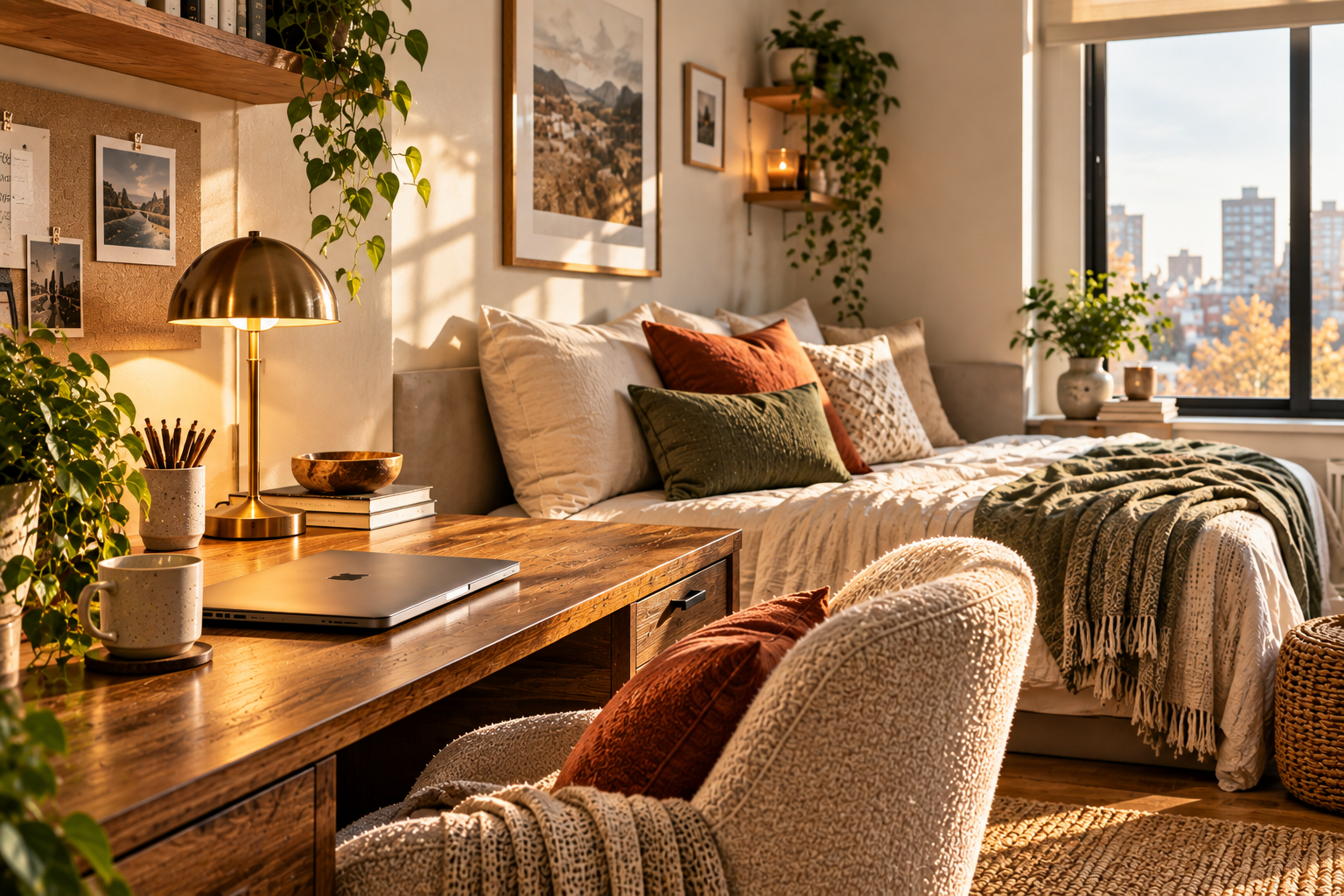
Decorating gradually within your budget
Money shapes the pace more than it shapes the style. A first home is usually put together in stages, and that pattern can reflect a limited budget, a wait-and-see approach to a space that might not be permanent, or both at once.
Some changes travel with you; others need someone else’s say-so. Lamps, rugs, curtains on existing hardware, textiles, plants, and art on a console or shelf are portable. Painting, swapping cabinet hardware, mounting shelves or mirrors, applying adhesive wallpaper or tile, and anything involving wiring or fixtures may require your landlord’s permission, even when a product is marketed as renter-friendly. If you rent, read your lease, check the tenancy rules that apply in your province, and get approval in writing before you start.
US research from Zillow and Thumbtack looked at affordable, non-permanent updates for rentals, including open shelving, paint, cabinet hardware, lighting and peel-and-stick finishes. Even there, Zillow’s rental expert advises renters to review their lease and check with their landlord before major changes, and the release notes that landlords who allow painting often expect it to be repainted before move-out. That’s American data about American listings, not Canadian legal or pricing guidance, but the pattern holds: small, reversible changes first, and permission before anything permanent.
If you rent, portable changes are usually the safest place to begin. Our guide to renter-friendly decorating ideas explains what to check before you buy anything, from lease wording to adhesive products. Our breakdown of the economics of small decor upgrades looks at how gradual spending tends to play out and where the money is often best spent first.
Finding inspiration and making it your own
Social platforms are still where a lot of people start — pulling colours, layouts, and ideas from a mood board before anything gets bought. Pinterest’s 2026 trend report frames the year around curating rather than copying, with many people treating trends as a prompt for personal expression instead of a rulebook.
That pattern isn’t universal, and plenty of first apartments still borrow closely from whatever’s trending that month — budget and housing circumstances probably explain as much of that as anything else. But treating inspiration as a starting point, rather than a finished blueprint, tends to make a space feel more like it belongs to the person living in it. Once you know what you like, our guide to mixing different interior design styles shows how to combine those influences so the room feels cohesive instead of random.
Where to start when setting up your first home
With so many options, it helps to settle a handful of decisions in a sensible order before buying anything. These five cover most of what matters in the first few weeks.
- Decide what the room must do every day. Sleeping, working, eating, hosting: list what happens there and how often.
- Sort out the essentials you need right away. A comfortable place to sleep, a light you can read by and somewhere to put your clothes come before anything decorative.
- Choose a decorating direction. Pick two or three words for how you want the room to feel, then use them as a filter for what comes home.
- Understand your rental and budget limits. Know what your lease allows, what you would need permission to change or restore, and what you can realistically spend this month.
- Arrange the space before buying more. Move what you already own, live with the layout for a week, and only then fill the gaps.
Before moving anything around, it’s also worth sitting with a few questions: What needs to work better in your everyday routine? Which belongings already make this space feel personal? And what should move with you if your circumstances change?
There’s no fixed answer to any of them, and the answers will likely shift within the first year. The rest of this series takes the decisions above one at a time, starting with finding your style.
A home doesn’t have to be finished to be real. It just has to be chosen.
— NestDigest
‘A home doesn’t have to be finished to be real — it just has to be chosen’ is a lovely line, and honestly the most useful advice in the piece. The pressure to furnish everything at once is real, and decorating gradually is how you end up with a place that actually feels like you. Looking forward to the rest of the series.