Canadian Rents Are Falling. What Does That Mean for First-Time Buyers?
Twenty-three straight months of year-over-year rent declines haven’t touched Toronto the way they’ve touched the rest of the country — and August’s small national dip actually followed four straight months of gains, a reminder that this isn’t a one-way slide.
Canadian asking rents have now fallen year-over-year for 23 straight months. In August 2026 the national average was down 4.8%, while Toronto’s decline was far smaller at 1.4%. For GTA renters saving toward a first home, that gap between the national headline and the local number is the real story.
The national figure comes from the latest National Rent Report from Rentals.ca and Urbanation, published September 9, 2026: the average asking rent for all property types in the country was $2,035 in August, down 4.8% year-over-year — the 23rd consecutive month of annual decline, and the steepest since March 2026. On a month-over-month basis, though, rents actually dipped only 0.1% from July, following four consecutive monthly increases through the spring and summer — so “23 straight months” describes the year-over-year trend, not an unbroken monthly slide. Toronto’s own average asking rent for apartments and condominiums was $2,570 in August, down 1.4% year-over-year, making it one of the most resilient of Canada’s six largest rental markets.
Why Are Rents Falling in Canada?
Three forces show up consistently in the data. The first is supply: a record run of purpose-built rental and condo completions has been landing across the country, according to CMHC’s 2025 Rental Market Report and its 2026 mid-year update. The second is demand, which has softened alongside a shrinking population. Statistics Canada estimated the population at 41,417,056 as of April 1, 2026, down 55,025 people (-0.1%) from January 1 — the third consecutive quarterly decline — driven mainly by a 20.2% drop in permanent immigrant admissions and a sharp pullback in non-permanent residents, per the agency’s Q1 2026 release. The third is vacancy: CMHC’s October 2025 Rental Market Survey put the national purpose-built vacancy rate at 3.1%, up from 2.2% a year earlier and above the 10-year average. In the Toronto CMA specifically, vacancy reached 3.0% — the highest level since before the pandemic. More empty units chasing fewer new renters is a straightforward recipe for landlords competing harder on price to fill them.

How Does Toronto Compare With Other Canadian Cities?
Toronto's smaller decline fits a broader pattern. Markets that saw the sharpest run-ups from 2021 to 2023 — Vancouver, Calgary — are now seeing the sharpest corrections, while already-expensive, more built-out markets like Toronto and Montreal are cooling more gradually. One wrinkle worth flagging: even as Toronto's overall average fell, two- and three-bedroom units moved the other way, up 0.3% and 3.5% year-over-year respectively. Family-sized units haven't loosened the way studios and one-bedrooms have. It's also worth remembering these are averages built from whichever mix of units happened to list that month — a falling city-wide average doesn't mean every individual comparable unit got cheaper; it can just as easily reflect more smaller or lower-priced units coming onto the market.
| City | Avg. asking rent (Aug. 2026) | YoY change | MoM change |
|---|---|---|---|
| Toronto | $2,570 | -1.4% | -0.3% |
| Montreal | $1,955 | -1.1% | +0.8% |
| Ottawa | $2,168 | -1.6% | +1.1% |
| Vancouver | $2,704 | -4.1% | +1.0% |
| Edmonton | $1,520 | -4.1% | +0.7% |
| Calgary | $1,825 | -4.5% | -0.2% |
Note: this apartment-and-condo figure is a narrower property-type slice than the $2,035 national headline above, which covers all property types including houses and townhomes — the two numbers aren't directly comparable.
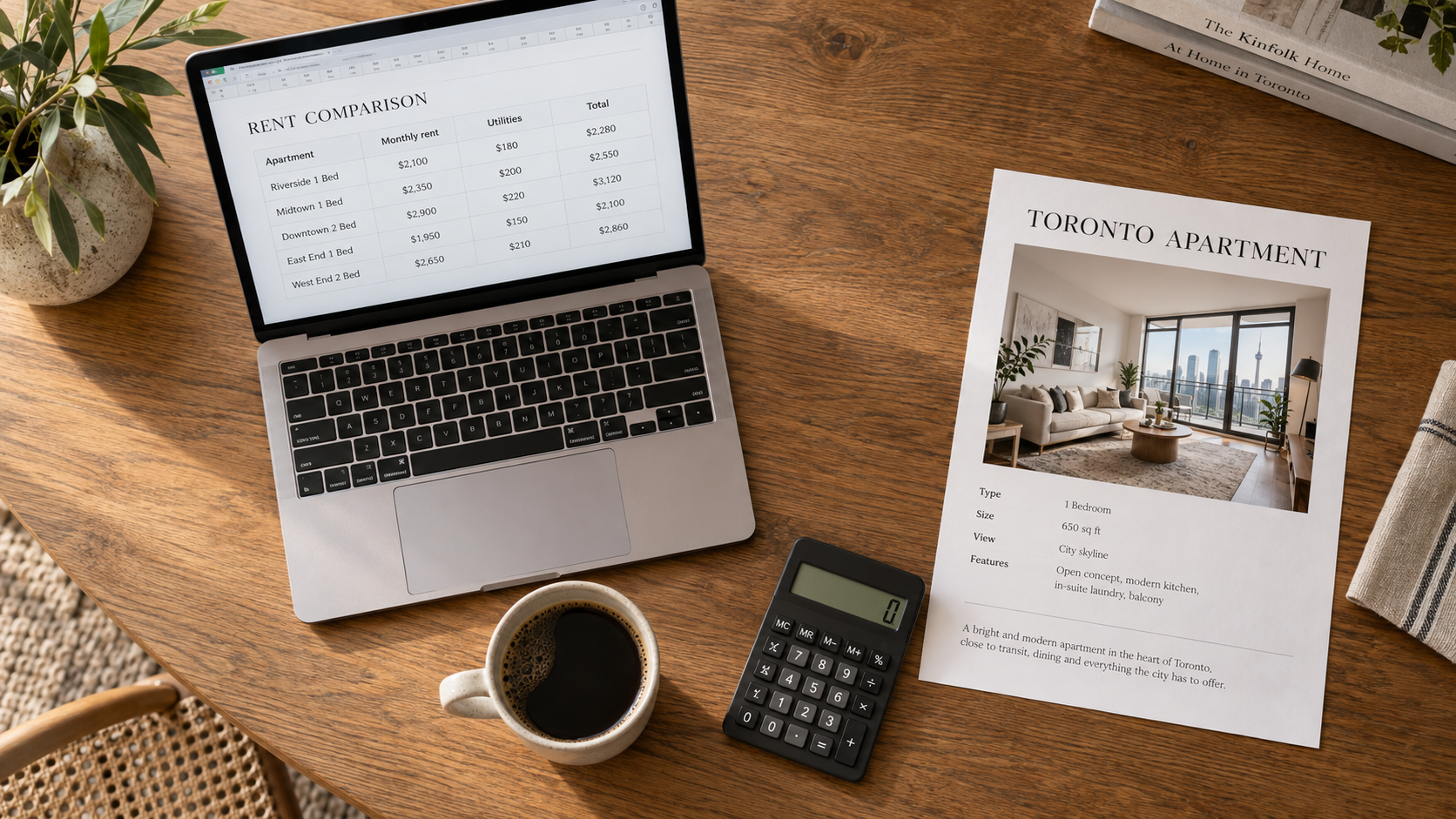
Is Your Rent Actually Falling, or Just the Asking Price?
This distinction trips up a lot of renters. Rentals.ca's asking-rent data tracks what's advertised on vacant units hitting the market right now — it says nothing about what a sitting tenant is currently paying. CMHC's Rental Market Survey measures the other side: average rent actually paid across occupied purpose-built units, including long-standing tenancies. In the Toronto CMA, CMHC's October 2025 survey put that figure at $1,917 a month — up 3.2% from a year earlier. Existing tenants, particularly those protected by Ontario's rent increase guideline, are largely insulated from the swings making headlines. The relief in this year's data is mostly available to people actively shopping for a new unit — which, for a renter deciding whether to keep renting or start buying, happens to be exactly the group that matters.
Two different measures, two different windows: Toronto's advertised rent on vacant apartments and condos fell 1.4% year-over-year to August 2026 (Rentals.ca/Urbanation, vs. August 2025). CMHC's separate survey of rent actually paid across occupied purpose-built units in the Toronto CMA — a different property scope and a different annual window (October 2025 vs. October 2024) — found paid rent up 3.2% over that period. These aren't tracking the same units or the same year; the point is simply that asking-rent and paid-rent trends can move in opposite directions at once.
What Does This Mean for Your Down Payment Savings?
For someone renting and saving toward a down payment, a softer rental market has two practical effects. First, if your lease is up or you're shopping for a new place, you may genuinely be able to negotiate a lower rent than a year ago, freeing up more of your monthly budget for savings. An illustrative $100 monthly saving adds up to roughly $1,200 over a year, before accounting for the cost of actually moving to capture it. Second, landlords facing higher vacancy are more often offering incentives — a free month, waived parking or amenity fees — that function the same way a lower headline rent would for your budget, even when they don't show up as a rent cut on paper. Neither effect changes your down payment target, since that's driven by home prices rather than rents. But a smaller monthly outlay shortens the runway to reach it, provided the savings are actually redirected rather than absorbed into everyday spending.
Renting vs. Buying in Toronto Right Now: An Illustrative Example
To make the trade-off concrete, here's one illustrative comparison — not a recommendation, and not representative of every unit or every buyer's situation. All figures below are stated assumptions, not forecasts, and the mortgage math retains the assumed interest rate below without verifying that a specific lender quote is still available today.
- Purchase price: $667,916 — the City of Toronto average condominium apartment selling price for Q2 2026, per TRREB's Condo Market Report
- Comparable rent: $2,273/month — the GTA average one-bedroom condominium apartment rent for Q2 2026, per TRREB's own Rental Market Report. This is the same publisher and the same quarter as the purchase price above, and it's matched by unit type (a one-bedroom condo) rather than blended across every bedroom count — though the rent figure is GTA-wide while the price figure is City-of-Toronto-specific, so it's still an approximation, not a matched listing
- Down payment: 10% ($66,800), financed with an insured mortgage
- Mortgage rate: 5-year fixed at 4.29%, the lowest advertised insured rate reported by Ratehub.ca as of September 8, 2026 — a snapshot, not a verified live quote or a prediction
- Amortization: we assume a 25-year amortization (insured mortgages up to 30 years are also available to eligible first-time buyers, at a higher premium tier — 25 years is simply the assumption used throughout this example)
- Mortgage math: calculated using the standard Canadian convention of semi-annual compounding on the nominal rate, converted to an effective monthly rate
- CMHC mortgage default insurance: 3.10% of the loan amount at this down-payment tier (not 4.00%, which applies only at 5–9.99% down), added to the mortgage principal; 8% Ontario PST on that premium is payable in cash at closing, separately
- Property tax: estimated at 0.7% of purchase price annually — confirm the current rate with the City of Toronto or MPAC before relying on it
- Condo fees: $550/month, a mid-range estimate for a one-bedroom Toronto condo (fees vary widely by building age and amenities)
- Owner's condo insurance: $45/month (contents plus unit improvements)
- Tenant insurance, for the renting side of the comparison: $25/month, a separate explicit assumption for a one-bedroom rental policy
- Personal maintenance contingency: $50/month, covering in-suite items only — building-level maintenance is already funded through the condo fee, so it isn't counted twice
- Land transfer tax: Ontario provincial and Toronto municipal LTT, net of the combined $8,475 in first-time buyer rebates (up to $4,000 provincial, up to $4,475 municipal)
- Legal fees, title insurance and a home inspection: an estimated $2,500 combined
| Line item | Renting | Owning |
|---|---|---|
| Monthly rent (GTA avg. one-bedroom condo rent, Q2 2026) | $2,273 | — |
| Tenant insurance / owner's condo insurance | $25 | $45 |
| Mortgage payment (P&I, 5-yr fixed 4.29%, 25-yr amortization, semi-annual compounding) | — | $3,358 |
| — of which interest (month 1) | — | $2,196 |
| — of which principal (month 1) | — | $1,162 |
| Property tax (est. 0.7%/year) | — | $390 |
| Condo fees (mid-range estimate) | — | $550 |
| Maintenance contingency (in-suite only) | — | $50 |
| Total monthly cash outlay | $2,298 | $4,393 |
| Selected ongoing ownership costs, excluding principal | $2,298 | $3,231 |
| Cash needed at closing (down payment + closing costs) | — | ~$82,000 |
| Illustrative monthly opportunity cost of that cash (4%/yr, hypothetical, not a forecast) | — | ~$273 |
The mortgage payment splits into two very different things. In the first month, roughly $2,196 of the $3,358 payment is interest — gone, the same as rent. The remaining $1,162 pays down principal, which is the owner's own money moving into an asset rather than a landlord's account. Add property tax, condo fees, insurance and the maintenance contingency, and the selected ongoing ownership costs in this example — deliberately excluding the principal portion, and not a complete accounting of every acquisition or exit cost — come to roughly $3,231 a month, against $2,298 for renting including tenant insurance.
Then there's the money tied up before move-in day. Between the down payment and closing costs — land transfer tax after rebates, PST on the mortgage insurance premium, and legal and inspection fees — this buyer needs roughly $82,000 in cash to reach the closing table. That money stops earning whatever it might have earned elsewhere. As an illustrative opportunity cost only — not a forecast, and not a certain outcome — if it had instead been invested at a hypothetical 4% annual return, the forgone return would run about $273 a month.
None of this settles whether buying beats renting in any particular situation, and it doesn't calculate a break-even holding period — that depends on the specific price, rate, and closing costs any real buyer is quoted, which will differ from the assumptions here. What it does show is what actually deserves comparing: not rent against a mortgage payment, but rent against the ownership costs that don't build equity, weighed against how much equity is building and how long someone expects to stay. Anyone running these numbers for real should also read our breakdown on whether to wait to buy in Ontario before deciding.
When Does Renting Still Make Sense, and When Does Buying?
Two variables do most of the work: how long you plan to stay, and how much financial cushion you're carrying. Buying involves closing costs that only get recouped over time through mortgage paydown — and any price appreciation, which is never guaranteed. How long that actually takes depends entirely on the specific price, rate, and closing costs a real buyer is quoted; the illustrative example above doesn't calculate a break-even holding period, so treat any generic online rule of thumb with the same caution you'd apply to a market forecast. Plans to relocate for work, a growing family that might need a different layout, or genuine uncertainty about which neighbourhood fits are all reasons to lean toward renting a while longer. Financial resilience matters just as much. Owning means absorbing surprise costs directly — a special assessment on a condo building, a mortgage renewal at a materially different rate, a repair a landlord would otherwise have covered. Renters hand that risk to someone else in exchange for a rent cheque that, as this year's data shows, isn't guaranteed to keep climbing either. Buyers weighing a condo specifically should also see our Ontario condo market buyer's guide for what to check before making an offer.
What Could Change This Picture?
Three releases are worth watching. Statistics Canada updates its population estimates in September 2026, which could meaningfully revise the non-permanent resident figures behind this year's demand slowdown. CMHC's fall 2026 Rental Market Survey, typically fielded in October and published in December, will show whether Toronto's vacancy rate kept climbing past 3.0% or started to plateau as new supply gets absorbed. And Toronto's resale market, tracked through TRREB's autumn Market Watch reports, is itself sending mixed signals: months of supply rose from 4.4 in July to 4.8 in August 2026 — a loosening on a month-over-month basis — even as active listings remained down 11.3% year-over-year, meaning the market has fewer homes listed than a year ago but slightly more breathing room relative to the current pace of sales. Whether that combination tightens or loosens further into the fall could start pushing home prices in the opposite direction from rents.
Will Canadian rents keep falling for the rest of 2026?
No one publishing this data is promising that. CMHC's own outlook expects vacancy rates to stay elevated as the current construction pipeline gets delivered, and Rentals.ca has flagged trade-related uncertainty as a wildcard for the rental market's outlook. Treat any specific prediction of where rents land by year-end as speculation rather than data.
Is now a good time to buy in Toronto?
There's no single answer — it depends on how long you plan to stay, how much of a cash cushion you're keeping in reserve, and whether the ongoing cost of ownership fits your budget once you run the numbers with the actual rate and price you're quoted. TRREB's August data shows prices still below year-ago levels and active listings down year-over-year, while months of supply loosened slightly month-over-month — a mixed signal worth watching over the fall rather than reading as a clean trend in either direction.
Does a lower asking rent mean my landlord has to lower my rent at renewal?
Usually not, but it depends on the unit. Ontario's rent increase guideline caps renewal increases for most existing tenants regardless of what's happening to asking rents on vacant units elsewhere in the city — but units first occupied for residential use after November 15, 2018 are exempt from that cap entirely, per Ontario's own guidance, meaning a landlord in an exempt unit can raise rent by any amount with proper notice. If you're not sure which category your unit falls into, that's worth confirming before assuming the guideline protects you.
The number that matters most here isn't the national headline — it's the gap between what's happening to advertised rents and what's happening to your own lease, your own savings rate, and your own timeline. Falling asking rents make the wait a little more comfortable. They don't make the decision for you.