How to Deep Clean Baseboards, Trim and Light Switches: The Fall Reset Nobody Does
Dust settles, and the narrow ledge along the top of a baseboard is one of the places it settles and stays, undisturbed until a vacuum brushes past or a furnace fan starts up for the season. The door casings above those baseboards keep ledges of their own, and the light switches beside them keep a summer of fingerprints. None of it belongs to the weekly clean. That is the case for a fall reset: deep clean baseboards, trim and light switches in one pass, before the heating season begins.
Here is the short version of how to deep clean baseboards this fall, and it comes down to order. Dust the switches and casings first, vacuum the top ledge of the baseboard and the seam where it meets the floor, then wash the boards with warm water and a drop of dish soap on a cloth that is damp rather than wet, drying each section as you go. Test somewhere hidden first, because flat and eggshell paint marks more easily than satin or semi-gloss. Never spray liquid onto a light switch; dampen the cloth instead, and turn off the breaker before removing any plate. Allow two to three hours per floor of a typical house. In a home built before 1960, wipe wet and gently, and leave flaking trim paint alone until you know what is in it.
Fall suits the job for practical reasons. Through September and much of October you can still open windows while you work, which helps a damp cloth dry and lets the dust you disturb leave the room. The furnace has not yet begun its long run of moving your home’s air through registers and returns. And Canadian Thanksgiving, on the second Monday of October, gives the job a deadline. In the United States, where Thanksgiving falls on the fourth Thursday of November, the same sequence works with a longer runway. The timing also matches the season’s other chores: Ontario’s new-home warranty body, Tarion, runs its fall home-maintenance checklist from September through November. Two related jobs fit the same weekend: cleaning the dryer vent and working through a wider preventative home maintenance checklist.
There is a health reason beneath the aesthetic one. Health Canada notes that household dust is among the main sources of lead exposure for children under six, and it recommends dusting, vacuuming and wet-mopping to keep dust down. The same page says a home built before 1960 probably contains lead-based paint, that interior paint from 1960 to 1990 may hold smaller amounts, and that houses built after 1990 should not contain lead paint. Old trim is the surface where that history sits at a child’s height, and the agency warns against sanders and heat guns on it because they create dust and fumes that carry lead. Public Health Sudbury & Districts gives the practical rhythm for an older Ontario home: clean floors, window frames and sills weekly with warm water and an all-purpose cleaner. The method below follows from all of that: wipe wet, wipe gently, and do not scrape.
Supplies
- Four to six microfibre cloths
- Mild dish soap
- A bucket, plus a second cloth for rinsing
- Soft brush or old toothbrush, and cotton swabs
- Melamine sponge (optional, for scuffs)
- Old towels for the floor
Tools
- Vacuum with brush and crevice attachments
- Step stool
- Screwdriver, for switch plates
- Non-contact voltage tester, if you plan to remove plates
- Phone flashlight or headlamp
-
01
Clear the wall line and read the surfaces
Pull furniture about 30 centimetres (a foot) from the wall, lift the rugs, and take stock before anything gets wet. Press a damp corner of cloth against a hidden stretch of baseboard to see what you are dealing with. Satin and semi-gloss paint tolerates washing; flat and eggshell need a lighter hand, and Benjamin Moore’s cleaning guidance puts the rule plainly: the higher the sheen, the easier the surface is to clean. Unfinished or stained wood needs a nearly dry approach. While the furniture is out, check that no sofa or cabinet is blocking a return-air grille or heating vent, which Natural Resources Canada advises keeping clear.
-
02
Dust from the top down, and dry
Start high and stay dry. Run a dry microfibre cloth or the vacuum brush over the tops of door and window casings, then down the wall toward the floor, and finish with the switch plates, wiped dry for now. Dust lifted while dry leaves the room; dust met by a wet cloth turns into a grey smear you then have to chase. The ledges matter most: the tops of casings, the sills and the upper edge of the baseboard hold nearly everything you can see.
-
03
Vacuum the baseboards
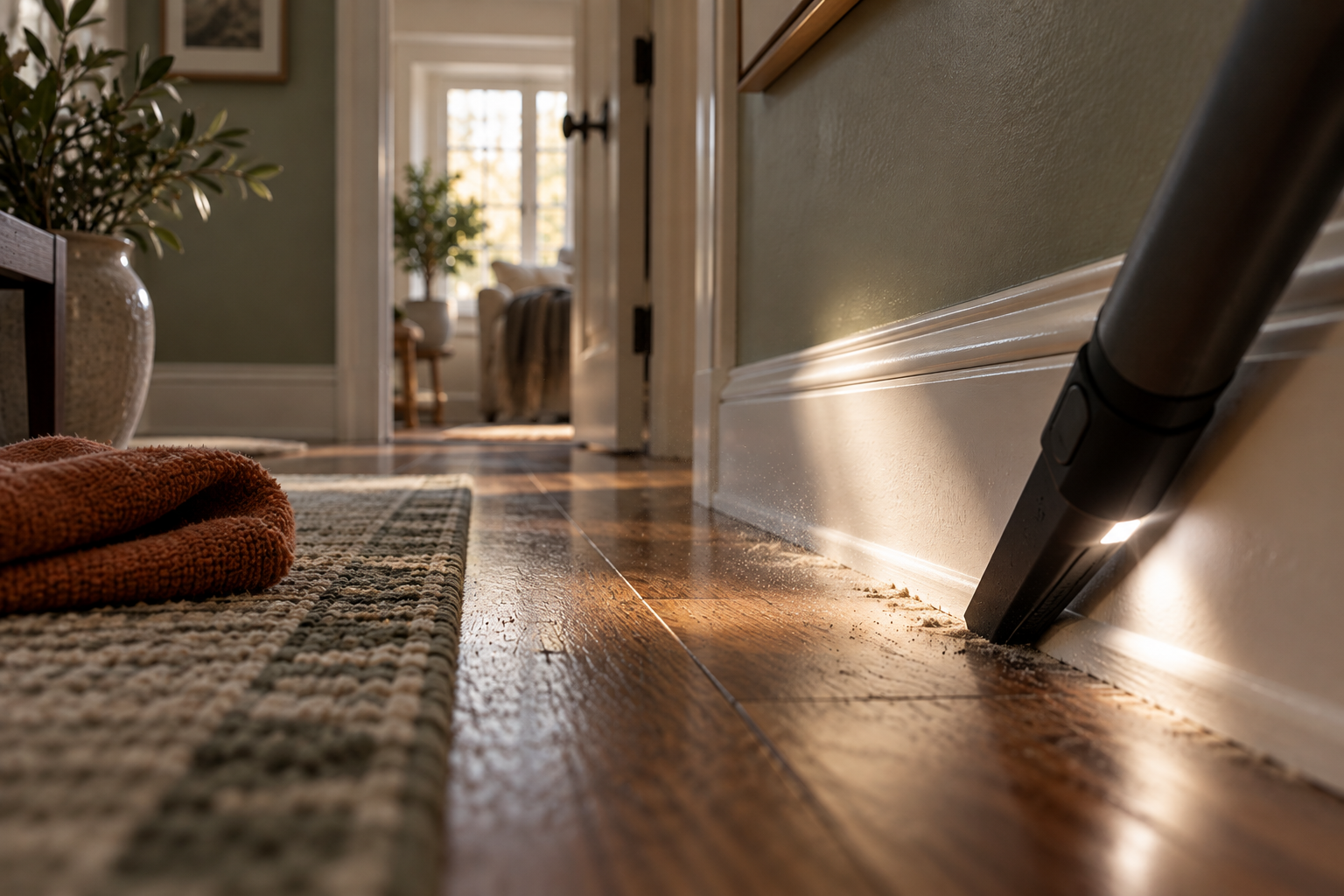
Use the brush attachment along the top ledge and across the face of the board, then switch to the crevice tool for the seam where board meets floor and for the corners, where lint packs tight. Go slowly. Suction takes up what a cloth would drag into the paint. Work around the registers in the same pass, since a clear floor edge beside them is what the heating season will be blowing across.
-
04
Wash the boards, a section at a time
Fill a bucket with warm water and one or two drops of dish soap, and keep a second cloth for rinsing. Wring the washing cloth until it is damp, not wet, and work about a metre at a time: top ledge first, then the face, then the bottom edge. Rinse with plain water, then dry with a towel. Drying is the step people skip, and it matters most on MDF, the pressed-fibre board behind many modern baseboards, which swells if water sits on its bottom edge or cut ends. If a scuff resists, a melamine sponge can lift it from semi-gloss paint but may dull lower sheens, so test first.
-
05
Wash the trim, from the top of the casing down
Door and window casings get the same treatment, with one addition: the places hands land. Look at the door edge and the casing beside the latch, around hip height, where skin oils build fastest. Clean the sills last, since they collect whatever the rest of the trim shed. Trim often wears semi-gloss, the most washable sheen in a house, so this is where you can press a little harder than you did on the walls. Rinse and dry as you go.
-
06
Clean the light switches: dampen the cloth, never the switch
This is the one job on the list where method outranks effort. Wiring-device maker Eaton’s cleaning instructions say never to spray fluid into the device, to put mild liquid detergent on a damp cloth, to wring out the excess and to dry the surface afterward. Any wipe you use must be free of bleach, ammonia and highly alkaline or concentrated-acid ingredients. For a heavily soiled plate, switch off the circuit at the breaker, confirm the switch is dead with a non-contact voltage tester, unscrew the plate and wash it on its own, then let it dry completely before it goes back on.
If someone in the house is sick, the Public Health Agency of Canada advises cleaning first and then disinfecting with a product that carries a DIN; check that the label suits electrical devices before it goes anywhere near a switch.
-
07
Inspect while you are close enough to see
With a cloth in your hand you are nearer to the lower wall than you will be all year. Look for caulk that has cracked or pulled away along the top of the baseboard, gaps at mitred corners, dark spotting on the wall just above the board (persistent condensation is a common cause, and our guide to maintaining humidity levels in your home covers keeping it in check), and swelling along the bottom edge near tubs, entrances and the dishwasher. Photograph what you find and keep a short list; gaps along exterior walls belong on your draft-proofing before winter list. Swelling and staining mean water has been there, and the water is the problem worth solving; the trim is only reporting it.
-
08
Finish on the floor and the filter
Vacuum the floor last, so everything that fell during the job leaves with it, then return the furniture. Wash the cloths without fabric softener, which coats microfibre and dulls its grip on dust. Then look at your furnace filter, one of the jobs on our fall furnace tune-up checklist. A job that moves this much dust is a good prompt: Tarion’s fall checklist lists a furnace-filter clean or replacement in both October and November, though the schedule that counts is the one in your furnace’s manual.
| Surface | Moisture | Pressure | Notes |
|---|---|---|---|
| Flat or matte paint | Barely damp | Light, single pass | No melamine sponge; touch up with paint if a mark stays |
| Eggshell paint | Damp | Light | Test any melamine sponge in a hidden spot first |
| Satin or semi-gloss trim | Damp, not wet | Moderate | Most forgiving; melamine can lift scuffs after a test |
| Painted MDF baseboard | Damp, dried at once | Light | Keep water off the bottom edge and cut ends |
| Stained or unfinished wood | Nearly dry | Light | Wood-specific cleaner, applied sparingly |
| Switch plate and switch | Damp cloth, never sprayed | Light | Breaker off before removing a plate; dry fully |
Water and electricity do not mix, so every switch-plate step here starts at the breaker panel, not at the switch. In a home built before 1990, do not use sanders, heat guns or blowlamps on old paint, and if the paint is cracking, chipping or peeling, have it tested before anyone scrubs it. Keep children and anyone who is pregnant out of the room while you work on old, damaged trim.
Hold a phone flashlight low and flat against the wall, almost parallel to it. Raking light throws every streak, missed patch and scuff into relief, so you catch them while the cloth is still in your hand rather than at dusk, from the sofa.
Some findings on this job belong to someone else. Peeling or flaking paint in a home built before 1990 should be tested before anyone disturbs it, and removal is work for a lead-safe contractor. A baseboard that is soft, swollen or stained along its length points to a leak or chronic moisture, and a plumber or restoration company should trace it before any trim is replaced. For the wider picture, see our piece on the cost of delaying home repairs. On mould, Health Canada’s guide treats a patch of one square metre or less as small enough to clean with detergent and water, and calls a single patch larger than three square metres large, the point at which it does not recommend that an unqualified person do the cleanup; a patch that keeps returning after cleaning belongs with a professional too. The City of Toronto draws the same one-square-metre line for small patches and adds that the moisture source must be fixed or the mould will return, and Health Canada’s mould page says water and dish detergent are enough, with no need for bleach. A switch plate that is discoloured, warm to the touch, cracked or buzzing needs a licensed electrician, not a cloth.
If you would rather hand the whole reset to a cleaner, HomeStars puts typical Canadian rates at $65 to $125 an hour for the visit, or $35 to $65 per cleaner when a team attends. A deep clean is the service that includes baseboards, so ask whether trim and switches are in the quote.

Clean baseboards go unnoticed; dirty ones announce themselves, usually when the light is low. That is the quiet economics of the job: an hour or two in September buys the absence of a small irritation you would otherwise carry through winter. Writing on wellness at home, our guide to timeless, wellness-minded interiors included, tends to dwell on natural materials and comfort. The upkeep of surfaces is where a healthy home is actually kept: the edge where wall meets floor, the plate a hand finds in the dark. Attend to those before the windows close and the rooms hold up a little better all season.
The best care a house receives is the kind nobody sees.
— NestDigest