Patio Furniture Storage: What to Cover, Stack, or Bring Indoors
Patio furniture doesn’t fail because of the cold. It fails because of what happens between the cold snaps — the freeze, the thaw, and the freeze again, sometimes a dozen times before real winter settles in for good. That cycling, not the temperature itself, is the real argument for sorting out patio furniture storage before the first hard frost. It’s the part most winterizing checklists skip entirely, in favour of a generic “clean it and cover it” line.
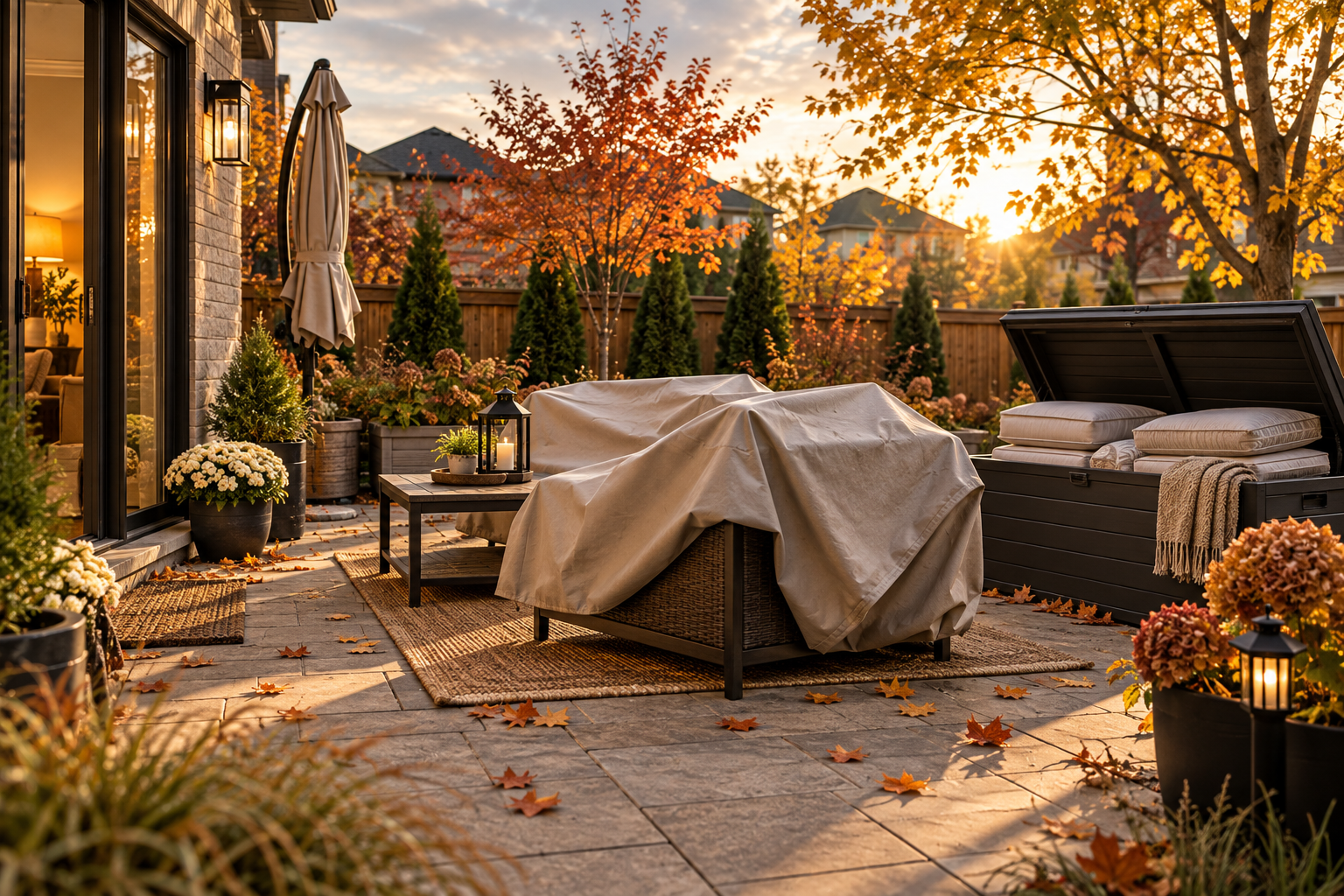
In practical terms: cushions, natural wood, and molded plastic always come inside; aluminum, powder-coated steel, and resin wicker can stay outside under a fully dry, vented cover; chairs and small tables get stacked and covered as a single unit rather than piece by piece. The material matters less than one thing — whatever stays outside has to go under cover completely dry, because trapped moisture combined with Ontario’s freeze-thaw swings is what actually wrecks patio furniture, not the cold by itself.
Where you live in Ontario changes the calendar more than most checklists let on. Toronto, Mississauga, and Brampton typically see their first fall frost in the first ten days of October. Move north to Barrie, or further into cottage country around Bracebridge and Haliburton, and frost can show up by the last week of September instead. The safest target across the GTA–Kitchener-Waterloo corridor is to have cushions inside and frames dealt with by the second week of October — roughly the same window most of a broader fall home maintenance checklist is built around. That’s ahead of the stretch of back-and-forth freezing that tends to peak through October and November across southern Ontario. As one Environment and Climate Change Canada meteorologist explained to CBC News, that kind of swing has grown more frequent in recent winters. It’s the real stress test for anything left outdoors — not the deep-freeze weeks that get all the attention.
The same three-tier logic holds south of the border; only the calendar shifts. Furniture-industry guidance for the Upper Midwest and northern New England — climates that track closely with southern Ontario — points to the same late-September-to-mid-October window. The trigger is simple: the first night temperatures dip into the 30s Fahrenheit. Milder regions get more runway. The Pacific Northwest and the mid-Atlantic states can usually push storage into November, since the bigger threat there is sustained rain rather than a hard freeze. Wherever the line falls locally, the decision tree by material stays identical.
Cushions and any fabric come inside regardless of what the rest of the set is made of. Left outside even under a cover, fabric pulls in enough condensation over a Canadian winter to grow mildew by spring. Real wood — teak, eucalyptus, cedar — should come in too, or at minimum move under a fully enclosed roofline. Natural rattan and wicker belong indoors as well; the woven fibres dry out and split in a way that no amount of oiling in spring fully reverses. Molded plastic and glass-top tables round out this list. Plastic gets brittle below roughly −10°C, and a stack that looked fine going into December can crack the first time someone leans on it in February. A glass top left in place carries its own risk: the frame contracts around it faster than the glass does, and that mismatch is what causes the hairline crack.
Aluminum, powder-coated steel, and the resin wicker sets that now dominate Canadian patio departments can generally stay outside if they’re covered properly. A cover is a stopgap, though, not a strategy. Thrown over a frame that wasn’t fully dry, it traps moisture against the surface instead of keeping it out. That’s exactly the setup that cracks the resin-to-frame bond at a wicker set’s weave joints — a failure that has more to do with what got sealed in underneath than with how cold it got. Vent the cover, or leave a gap at the bottom so air can still move.
Nest and stack chairs and small tables before covering them together rather than piece by piece. This cuts the exposed surface area by more than half and gives the whole stack a single seam to keep sealed, instead of four or five separate ones working against each other all winter.
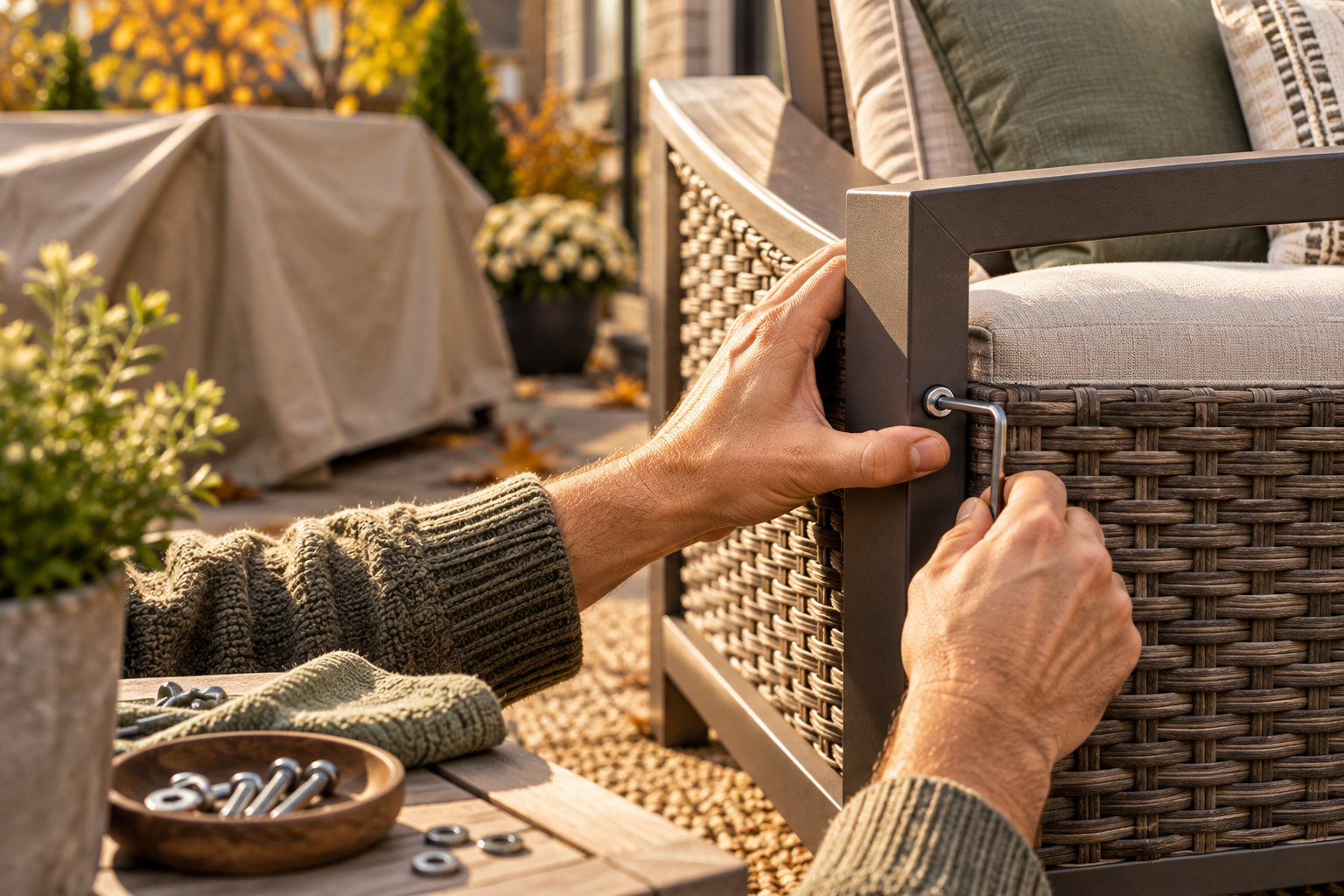
A few five-minute habits pay off more than people expect. Tighten any loose bolts or screws before storage — a joint that rattles all winter under a cover wears faster than one that’s snug. On steel and wrought iron, a thin coat of car wax or a rust-inhibiting spray over any exposed metal adds real protection a cover alone can’t fully deliver. And check for gaps before furniture goes under a tarp for the season. Mice and other small pests treat a covered patio set as a ready-made winter shelter, and a bag of cushions is exactly the nesting material they’re after — the same reason it’s worth being careful how you store garden tools for winter in the same shed or garage corner.
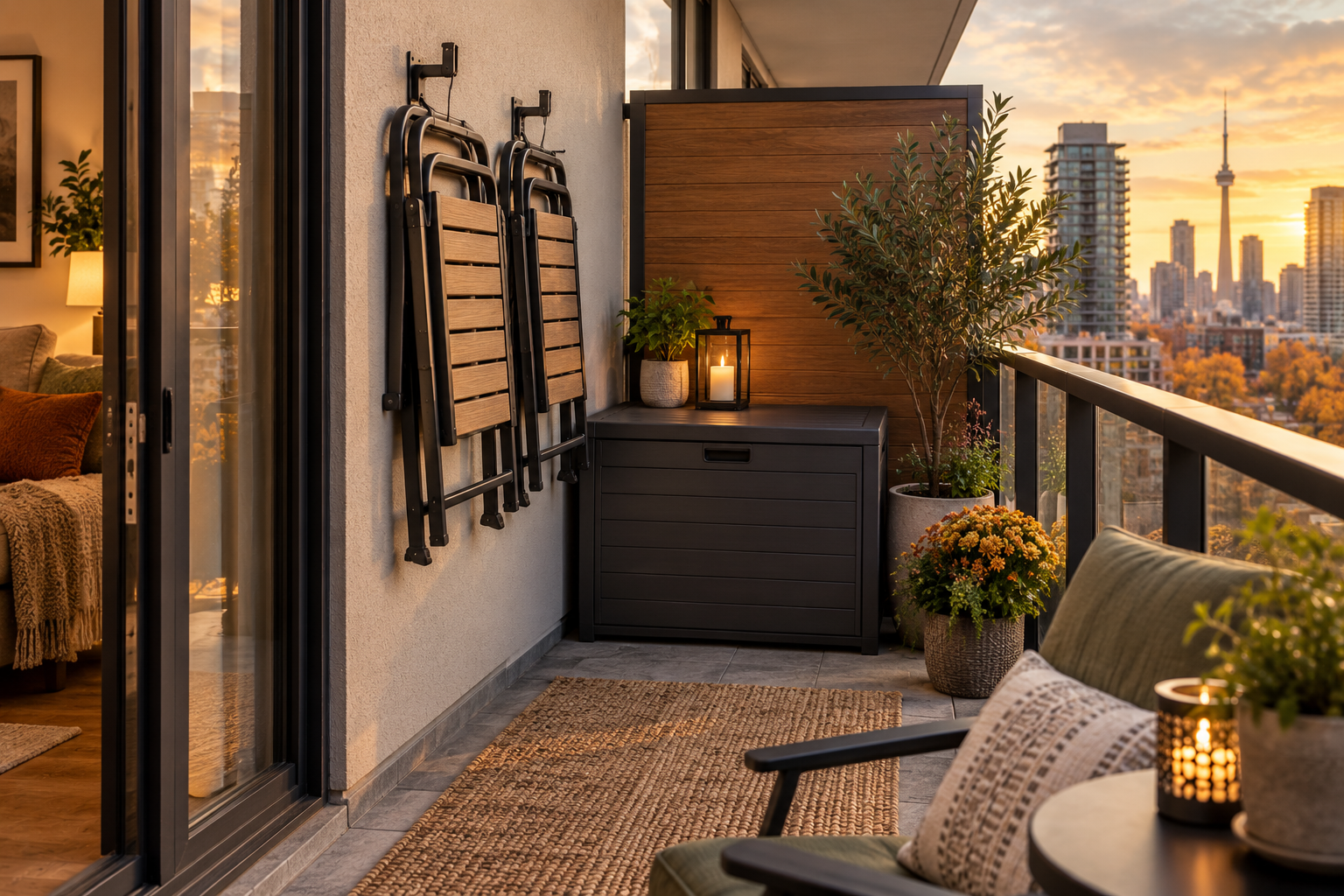
None of this assumes a shed, and that’s worth saying directly, because a lot of winterizing advice does. A large share of Ontario’s patio furniture owners are working with a condo balcony, a small patio, or a garage that’s already full — no basement drop zone, no detached storage. If a garage is the bottleneck, it’s usually worth tackling that space on its own terms first; a quick pass to organize the garage for winter often frees up exactly enough floor space for a folded set. For anyone without a garage at all, the fix isn’t finding more space; it’s shrinking the footprint, which is the same logic behind most of these small-space storage strategies. Cushions and small accessories go into a compact deck box rather than a bag in the corner of a closet. A basic 30-gallon box runs about $55 to $75 CAD, a mid-size option with a lid that doubles as extra seating lands around $120 to $180, and the largest lockable boxes built for a full cushion set run $250 to $330. For balconies with no floor space to spare, a set of vertical wall hooks or a slim over-the-railing rack keeps folding chairs and side tables off the ground entirely — a detail most winterizing guides, written for suburban backyards, never mention. Against the cost of replacing a $1,500 to $2,500 patio set that spent a winter exposed, a deck box isn’t the line item to cut. Renters with genuinely nowhere to put anything — not even a balcony deck box — are usually better off looking at a small self-storage locker for the cold months. It beats gambling an expensive set on a Canadian winter with zero cover at all. A 5-by-5 unit runs roughly $60 to $100 a month in most Ontario cities, and split across five or six months, that still lands well under the cost of replacing cracked resin or a mildewed cushion set every couple of years.
The instinct is to treat patio furniture storage as a race against the cold. It isn’t. Furniture sitting dry, still, and unstressed can handle a genuinely brutal Canadian winter with almost nothing to show for it come spring. What actually causes the damage is moisture that never gets the chance to leave, cycling across the freezing mark over and over through a shoulder season that, in most of Ontario, runs longer than people expect. Sort furniture by that standard rather than by material alone, and the whole job shrinks from a fall weekend project into something closer to a twenty-minute walk around the patio.
The things we take care of are the things that come back to us.
NestDigest