The Room-by-Room Indoor Season Playbook
Micro Renovation Ideas for Fall and Winter 2026: The Room-by-Room Indoor Season Playbook
Most homeowners treat September through December as the season renovation stops. It is actually the season it gets cheaper, faster and easier to book — and the four months when the rooms you neglect all summer become the rooms you cannot avoid.
There is a moment in early September, usually the first morning you close a window you have not closed since May, when the geography of your house quietly changes. The backyard stops being a room. The entryway starts absorbing wet boots. This is the case for seasonal micro renovation ideas: the projects worth doing between now and the new year are the ones in the rooms your household is about to start using four times as hard.
This is not a list ranked by return on investment. It is a calendar — eight small projects assigned to specific months, in an order that keeps the house livable while you work through it.
Why September Through December Is the Best Renovation Window Most Homeowners Waste
Renovation demand in Canada is violently seasonal, and the seasonality has almost nothing to do with what is easier to build. Kitchens, millwork, painting, flooring, lighting — all indoor work that does not care whether it is nine degrees outside. Yet contractors’ phones go quiet from mid-November, because homeowners have taken a rule that belongs to roofers and applied it to everybody.
The Canadian Home Builders’ Association published the country’s first Renovation Market Index in March 2026, covering the second half of 2025. Current conditions scored 48.3 out of 100; the forward-looking half came in at 35.2, with more than seven in ten renovators concerned about their 2026 prospects and sentiment weakest in Ontario and B.C. It lines up with what the broader renovation activity data has been showing all year.
Pessimistic contractors in a soft market are, from your side of the table, an opportunity. Quotes come back faster, start dates are closer, and a small job stops being something a good firm declines in order to hold capacity for a $90,000 kitchen. There is a non-financial argument too: fall home renovation projects happen while you are inside supervising them. Renovate in July and you are at the cottage when the compromises get made.
What Counts as a Micro Renovation (And What Quietly Isn’t One)
The term gets stretched until it means nothing, so here is a definition with teeth: a micro renovation changes how a room functions without changing the room. No walls move. No plumbing gets relocated. No new openings are cut into the envelope. The footprint you start with is the footprint you end with.
That boundary is regulatory, not aesthetic, and in Ontario it is unusually clean. The City of Toronto’s permit guidance is explicit that installing cabinetry and millwork requires no permit, and neither does repairing or replacing plumbing fixtures. A mudroom bench, a laundry counter, built-in shelves, a swapped vanity, a new toilet — none of it triggers a permit.
Cross the line and it changes immediately. Adding or removing a wall requires a permit, as does creating or enlarging a window or door opening — which is why a basement egress window is a permit job and a basement paint job is not. Modifying plumbing requires one too, meaning the laundry sink you want in a room that has never had one is a different category of project than the countertop above the machines.
Electrical runs on a separate track. The Electrical Safety Authority requires a notification of work — filed before the job starts — at a minimum residential fee of $88. Replacing a fixture or a switch may be exempt; running a new circuit for sconces or hardwired under-cabinet lighting is not. That $88 floor is the real dividing line between hardwired and plug-in.
The 2026 Cost Reality: What Small Projects Actually Run in Canada Right Now
The expected story is that everything costs more and you should hurry. The official data does not support that in Ontario. Statistics Canada’s Building Construction Price Index showed residential construction costs rising 2.3 per cent year over year in Q2 2026 — below the 3.5 per cent on the non-residential side — while in the Toronto census metropolitan area, residential prices actually fell 0.8 per cent quarter over quarter. CHBA’s finding that inflation-adjusted renovation investment has dropped to levels last seen in 2013 points the same way, and it is the strongest argument yet for the improve-don’t-move calculation.
Where costs are genuinely climbing is in specific materials. StatCan singled out metal and steel products as leading residential increases in both quarters, citing retaliatory tariffs. Industry compilations put a 50 per cent tariff on imported kitchen cabinets as of January 1, 2026 — verify that with your supplier, but it matters if your project involves cabinetry.
What has changed most sharply is what the government will pay you. Enbridge’s Home Efficiency Rebate Plus stopped accepting applications in February 2024; under it, air sealing was worth up to $1,300. Under Ontario’s current Home Renovation Savings Program, it is worth up to $250. The federal Canada Greener Homes Affordability Program is delivered province by province and currently lists B.C., Manitoba, Nova Scotia, P.E.I. and Quebec. Ontario is not among them.
Ontario homeowners have materially less energy retrofit support in 2026 than they had two years ago. Which makes the seventeen-dollar door sweep a more interesting purchase, not a less interesting one.
The Room-by-Room Playbook
Eight projects, in order. Costs are Canadian dollars weighted toward Ontario and the GTA. Contractor-published ranges are labelled as such — get three local quotes before planning around any of them.

The Mudroom
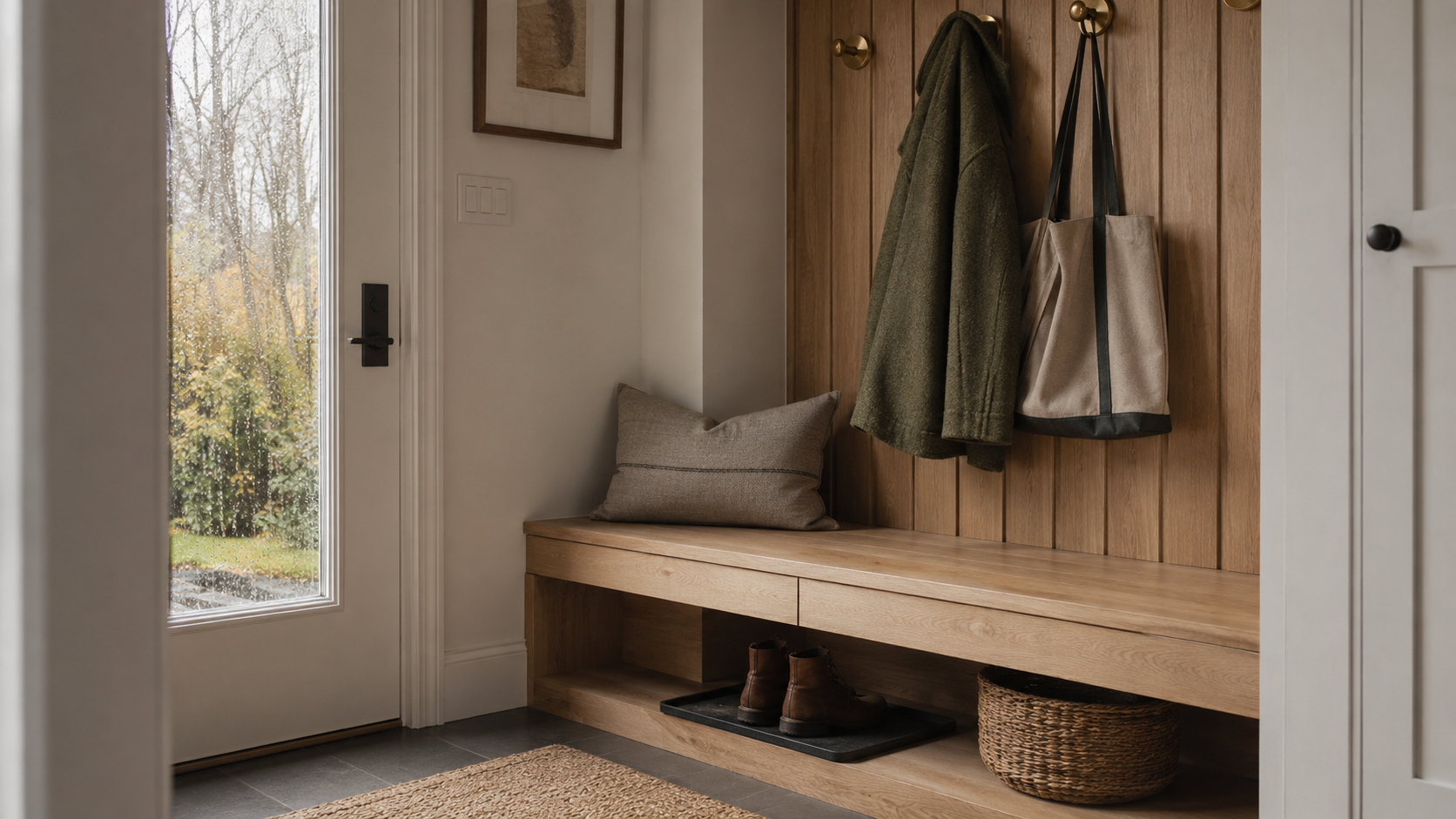
First, because it fails first. The entryway’s workload roughly triples on a single day in October, and it is usually built for a household that no longer exists — hooks at the wrong height, no bench, nowhere for wet boots to drain but the floor. It is also the room where putting a fix off another year costs the most in daily friction.
The spread is enormous: contractor guides put prefabricated bench-and-hook systems at $500 to $1,500 and full custom lockers at $4,000 to $12,000 — eightfold, for the same four feet of wall. Custom millwork is quoted by the linear foot, at $500 to $750 basic and $750 to $1,200 mid-range. The semi-custom middle near $2,000 to $5,000 is where most of these should land, and our honest entryway budget breakdown walks the line item by line item.
The Laundry Room
Laundry volume climbs the moment layers come back — coats, wool, base layers, the towels by the back door. The room handling it is almost always the least-designed room in the house.
The highest-value move is a continuous counter over front-loaders: four to six feet of quartz at $600 to $1,400, butcher block at $300 to $800, stock cabinets at $800 to $2,200. A utility sink fixture is $200 to $700 — but the labour to install one where no drain exists is $700 to $1,800, rising to $2,000 to $4,500 if the drain has to move, and it crosses into permit territory as new plumbing. Counter and cabinets: a weekend. Add the sink and it is a different job.
Draft-Proofing and Thermal Comfort
The best ratio of cost to consequence on this list, and the one most likely to be skipped because nobody photographs it. Natural Resources Canada puts windows and doors at up to 25 per cent of a home’s total heat loss, and the U.S. EPA’s ENERGY STAR program estimates air sealing plus added insulation saves an average of 15 per cent on heating and cooling — a figure that bundles both measures.
The materials are startlingly cheap. At Home Depot Canada this month a door sweep is $10.48, an adjustable threshold $35.54, twenty feet of silicone gasket $28.92, and an 84-inch window film kit $29.97. Sweeps for two doors, film for three windows, caulk and foam tape comes to roughly $120 to $180 — my arithmetic on shelf prices, not a quoted figure. Do it in October: caulk and adhesive strip both want temperatures above roughly five degrees.
The Home Office Nook
A built-in desk is millwork and prices like millwork — the same $500 to $1,200 per linear foot that governs the mudroom, not the furniture pricing people expect. If the nook has to come out of a room that is already tight, the small-space layout rules matter more than the millwork spec.
The upgrade most people skip and later wish they had not is acoustic. Materials alone run $1 to $10 per square foot, installed treatment $15 to $25. In a house where the furnace runs constantly and every window is shut for five months, a nook that was tolerable in July becomes a room where you hear the dishwasher through a call. Order in October — millwork lead times of four to eight weeks are common.
The Staircase and Upstairs Hallway
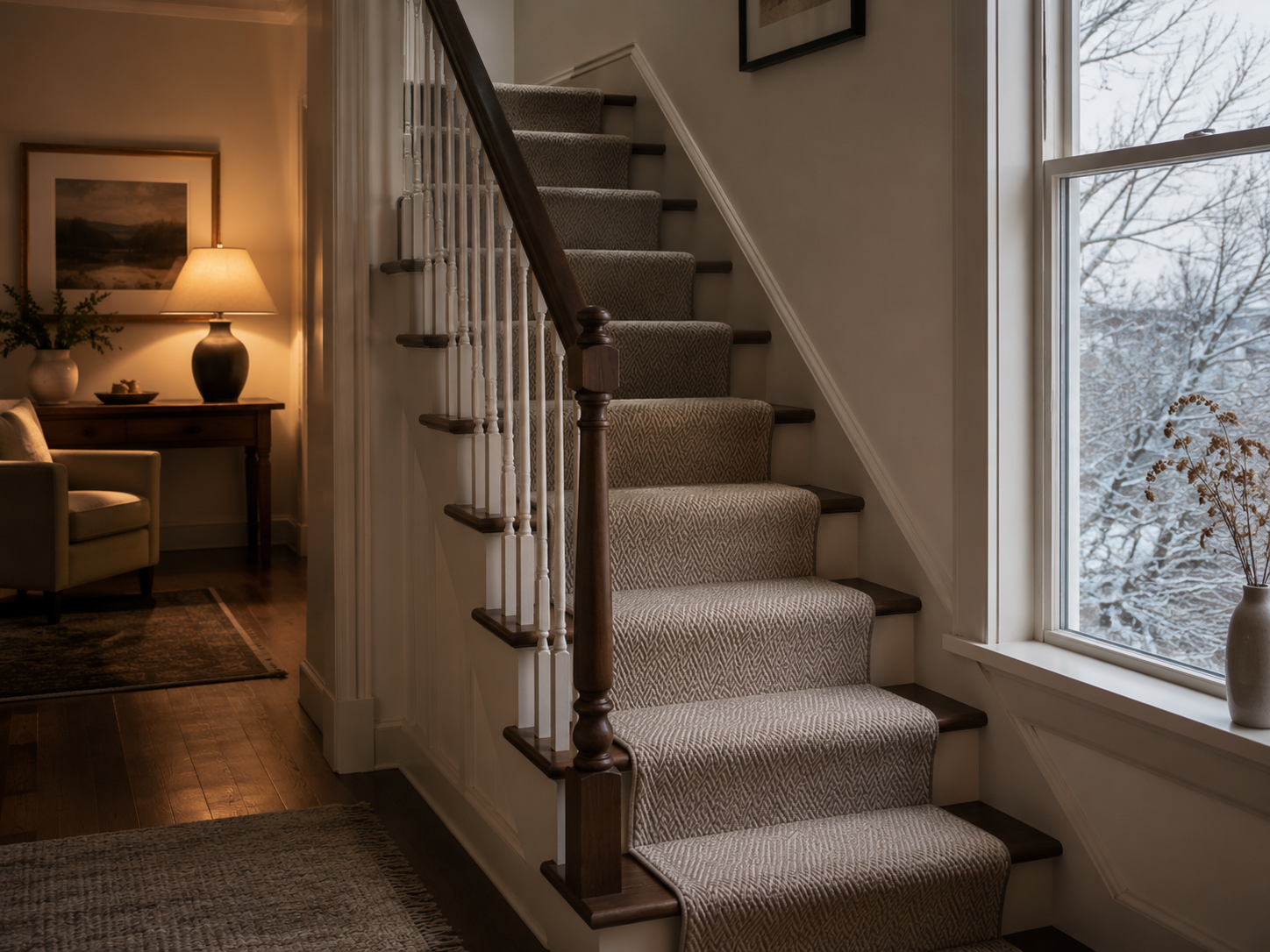
A stair runner is the most underrated of the small renovation ideas 2026 has to offer. Ontario suppliers publish runner material at $15 to $65 per linear foot — a full flight at $400 to $550 in budget Berber, $600 to $850 in a designer nylon, past $1,000 in wool. Installation starts near $400 for a straight flight and passes $1,000 once landings or winders are involved.
Set that against refinishing treads at $50 to $90 per step, recapping with new solid oak and upgrading railings from $5,500, or a full rebuild at $10,000 to $25,000. The runner also solves what the expensive options do not: hardwood stairs in wool socks are the most reliably hazardous surface in a Canadian house between November and March.
The Powder Room
Published Canadian ranges look contradictory until you notice what separates them. HomeStars puts a powder room renovation at $2,000 to $5,000; a Toronto contractor quotes $8,500 to $12,000. Both are accurate, and the entire difference is tile — a split our bathroom micro renovation budget takes apart in detail.
The $8,500 version strips the room to studs and runs mid-range floor and wall tile. The $2,000 to $5,000 version swaps the vanity ($450 to $750 installed) and toilet ($150 to $400 for the unit, $300 to $600 to install), replaces the light fixture ($280 to $480), and puts paint or wallpaper on the walls. No permit — replacing a fixture in place is exempt. Do it in early November: anyone hosting in December is showing people this room.
Lighting Layers
Toronto loses roughly seven hours of daylight between the September equinox and the December solstice. November is when a single overhead fixture per room stops being adequate — and the right month to fix it, because a lighting decision made in June is a guess.
The sharpest cross-border difference in this research sits here. GTA electricians quote $150 to $300 to install a dimmer; the U.S. equivalent is roughly US$80 to US$200. Even before exchange the Canadian floor is nearly double, driven by call-out minimums of $150 to $300 against US$75 to US$125, plus the $88 ESA notification. Which is the case for plug-in: sconces, cord-covered picture lights and lamps on smart plugs deliver most of the layering with no electrician at all. Batch anything hardwired into one visit — you pay that minimum once whether it is one dimmer or nine.
The Basement
The basement closes the sequence because it has no deadline attached — nobody is coming to see it — and because it absorbs whatever time the holidays leave over.
A full Toronto rec room finish runs roughly $33 to $60 per square foot, or $25,000 to $45,000. The micro version is a fraction: painted concrete floors, insulation on the rim joists, better lighting, a rug, a defined zone rather than a finished room. Ontario’s Building Code sets minimum ceiling height at seven feet, dropping to 6’11” under beams and ducts — measure before you plan. The two things that convert this into a major project are a bathroom at $12,000 to $22,000 and an egress window at $1,500 to $6,500. Both require permits.
How to Sequence Four Months of Projects Without Living in a Construction Zone
The order follows three rules. Circulation before destination — the mudroom and staircase are spaces everyone moves through constantly, so finishing them early means every later project happens around an entryway that already works. Comfort before cosmetics — draft-proofing is dull and it comes before the powder room, because a warm house with a dated half-bath beats a beautiful half-bath in a cold one. And never run two wet projects at once, which is why laundry and powder room sit ten weeks apart.
| Month | Project | Why Here |
|---|---|---|
| September | Mudroom, laundry room | Both fail the week the weather turns |
| October | Draft-proofing, home office | Sealants need warmth; millwork needs runway |
| Late October | Staircase | Disruption lands before holiday traffic |
| Early November | Powder room | Highest-visibility room, December deadline |
| November | Lighting | Darkest evaluation conditions of the year |
| Nov → Dec | Basement | No deadline; absorbs leftover time |
One constraint catches people out: a winter house is a sealed house. Paint and adhesives that off-gas harmlessly through open windows in July have nowhere to go in January, and the same airtightness is what makes indoor humidity so hard to hold steady once the furnace takes over. Stage the finishing work early, and choose low-VOC products for anything applied after the storm windows go on.
Hiring in the Off-Season: What Changes Between November and February
Contractor marketing will tell you winter brings 5 to 25 per cent discounts. I would not budget around it — every source making a specific percentage claim is a firm with an incentive to fill its own winter calendar.
What is documented is better anyway. StatCan has Toronto residential construction prices falling in Q2 2026; CHBA has renovators pessimistic about the year ahead. That produces something more valuable than a percentage off: responsiveness. Quotes in days instead of weeks. Senior people on small jobs, because the big jobs are not there to absorb them — which is exactly the condition that makes an improve-don’t-move strategy work this year.
Use the leverage on terms rather than price. Ask for a firm start date in writing, ask who is actually on site, and ask for a fixed-price quote rather than time and materials. One caution specific to winter home improvement projects in Canada: mid-December through the first week of January is genuinely dead. Suppliers close, trades take time off, and inspection scheduling slows.
The Weekend Test: How to Tell If a Project Is Actually a Weekend Project
Weekend renovation projects fail for predictable reasons, and almost none of them are about difficulty. They are about drying, waiting, and one missing part.
Four questions sort them. Does it require a cure or dry cycle longer than overnight — a stain-and-poly staircase is a four-day job pretending to be a two-day one. Does it take a room out of service? A powder room your household can route around is a weekend job; your only bathroom is not. Does it need a part you do not physically have — not ordered, have? And does it require a trade whose calendar you do not control?
The single most common cause of a stalled weekend project is a trip to a store that closes at five on Sunday for the one bracket, fitting or dimmer plate nobody thought to buy.
An Amazon Prime membership is the cheapest insurance against that particular failure mode — next-day delivery on small hardware costs less than the wasted Saturday does.
By that test, the true weekend projects here are draft-proofing, the laundry counter and shelving, plug-in lighting, and the painted-floor basement. The mudroom is a weekend if prefab and a two-week job if custom.
One technical detail, because the conventional wisdom has it backwards: drywall compound dries faster in dry heated air, not slower. The Drywall Finishing Council identifies relative humidity as the dominant factor. The winter risk is cold — and finishing a room in conditions that do not match how it will actually be lived in, which is what produces cracking months later.
What to Skip Until Spring
Anything that opens the building envelope. New window and door openings, egress windows, exterior door replacements — all of it means a hole in your wall in a Canadian winter, and all of it requires a permit. The U.S. Cost vs. Value report has entry door replacement recouping 216 per cent of its cost, second only to garage doors among the projects it tracks, so it belongs on the spring list rather than the never list. That figure is U.S. resale data and does not transfer directly to Canadian valuations — for the domestic version of that maths, see our breakdown of high-impact upgrades ranked by return per dollar.
Anything requiring exterior access or curing: masonry, exterior caulking, deck work, exterior painting. Anything structural, because permit review and inspections both slow through the holidays. And any large-scale flooring, which needs days of acclimatisation and disrupts every room at once. Park those alongside the rest of your spring maintenance list. The pattern: winter is for the interior of the shell you have. Spring is for the shell.
A sequence works better than a list because a list invites you to pick the most exciting project and start there, which is how people end up with a beautiful powder room in a house where the back door lets in a visible draft. Four months is enough for eight small projects if they happen in an order that respects how you actually live in the house while they are happening. Start with the door everyone walks through.
Frequently Asked Questions
Is it actually cheaper to renovate in winter in Canada?
Cheaper is not well documented — the 5 to 25 per cent off-season figure circulating online traces to contractor marketing, not independent data. What is documented is favourable conditions: StatCan recorded a 0.8 per cent quarterly decline in Toronto residential construction prices in Q2 2026, and CHBA’s Renovation Market Index shows renovators pessimistic heading into the year. Expect availability and negotiating room rather than a headline discount.
Which micro renovation ideas require a building permit in Ontario?
Very few in this playbook. Toronto exempts cabinetry and millwork installation and the repair or replacement of plumbing fixtures. Permits are required for adding or removing walls, creating or enlarging window and door openings, and modifying plumbing and heating systems. Finishing a basement is exempt only with no structural alteration, no new dwelling unit and no new plumbing. Electrical is separate — the Electrical Safety Authority requires a notification of work at an $88 minimum.
What is the cheapest micro renovation with the biggest impact?
Draft-proofing. Current Home Depot Canada shelf prices put door sweeps at $10.48 to $35.54, window film kits at $29.97 and twenty feet of silicone gasket at $28.92 — roughly $120 to $180 to seal a typical house. Natural Resources Canada attributes up to 25 per cent of total heat loss to windows and doors.
Can I paint indoors during a Canadian winter?
Yes, with ventilation planning. The problem is not temperature but that a sealed winter house gives off-gassing nowhere to go. Choose low-VOC products, run bathroom and range hood fans during and after application, and schedule painting earlier in the fall while brief window ventilation is still tolerable.
Are there still rebates for home energy upgrades in Ontario in 2026?
Fewer than there were. Enbridge’s Home Efficiency Rebate Plus closed to new applications in February 2024, taking air sealing rebates of up to $1,300 with it. Ontario’s Home Renovation Savings Program currently offers up to $250 for air sealing, $1,250 for attic insulation and $100 for a smart thermostat with no assessment required. The federal Canada Greener Homes Affordability Program does not currently list Ontario.
How much should a small renovation project cost in 2026?
These span roughly $120 for a draft-proofing kit to $12,000 for full custom mudroom millwork. Common landing zones: a laundry refresh at $4,500 to $8,500, a powder room without tile at $2,000 to $5,000, a stair runner installed at $800 to $1,250. GTA labour runs $95 to $160 an hour for a licensed electrician and $110 to $145 for a plumber.