
Closet & Storage Deep-Clean: Swapping Summer Gear for Fall
Two passes, one clean-first rule, and the storage mistakes that cost Canadian closets the most.

A cold morning in late September is useful information: it tells you the closet is about to stop matching the weather. The shorts are still front and centre, the sweaters are folded somewhere behind a suitcase, and the parka is in a basement bin nobody has opened since April. Good seasonal closet swap organization has less to do with attractive bins than with three unglamorous decisions. One is when you swap. Another is how clean everything is before it goes away. The third is where it spends the next six months. Those decisions determine whether the linen comes out next spring smelling of nothing, or of the basement.
Here is the short answer. Wait until overnight lows settle into the single digits, then move out only the clothes you will not wear for the next six months. Wash or dry-clean every piece first, including things worn once, because body oils and sweat are what clothes moths and mildew go after. Pack flat or loosely folded into lidded polyethylene bins or cotton bags. Keep them in a cool, dry room inside the heated part of the house, not a damp basement or an unheated garage. Treat cedar as a pleasant smell rather than a defence, and skip mothballs. Bring the fall clothes out, check each piece, and donate anything that did not get worn last year, because textiles do not belong in the Blue Bin. Keep six to eight layering pieces on a bridge rail for the weeks when the weather cannot decide.
The bridge rail matters because a typical Ontario fall can put a warm afternoon and a frosty morning inside the same fortnight, and any seasonal closet swap organization plan has to survive that. A one-weekend swap means either sweating in wool in early October or digging through bins for a cardigan. Split the job into two passes instead. The first, once the evenings turn properly cool, sends out the clearly summer things (swimwear, shorts, linen, sandals) and brings in sweaters and long sleeves. The second, before the first snowfall, is the heavy one: parkas, snow pants, boots, mitts and toques come out, and the lightest jackets go in. Done this way, no single weekend is a marathon, and the closet is never committed to a season that has not arrived.
Going out
Swimwear, shorts, linen, sandals
Bridge rail
Light cardigans, a denim jacket, long-sleeved tees
Coming in
Sweaters and wool now, the parka in pass two
Put pass one and pass two in the calendar, and schedule the wash two days before each, so everything going into storage is clean and completely dry.
Sort into three piles: wear this season, store, and leave. Anything you did not reach for last year, and could not name an occasion for, goes in the last pile.
Clean every piece in the store pile, remove the dry-cleaner film, empty the pockets, and sew the loose button now rather than next spring.
With the rail bare, vacuum the floor, shelf edges, corners and baseboards, and wipe the shelves. Nothing goes back onto a dusty shelf.
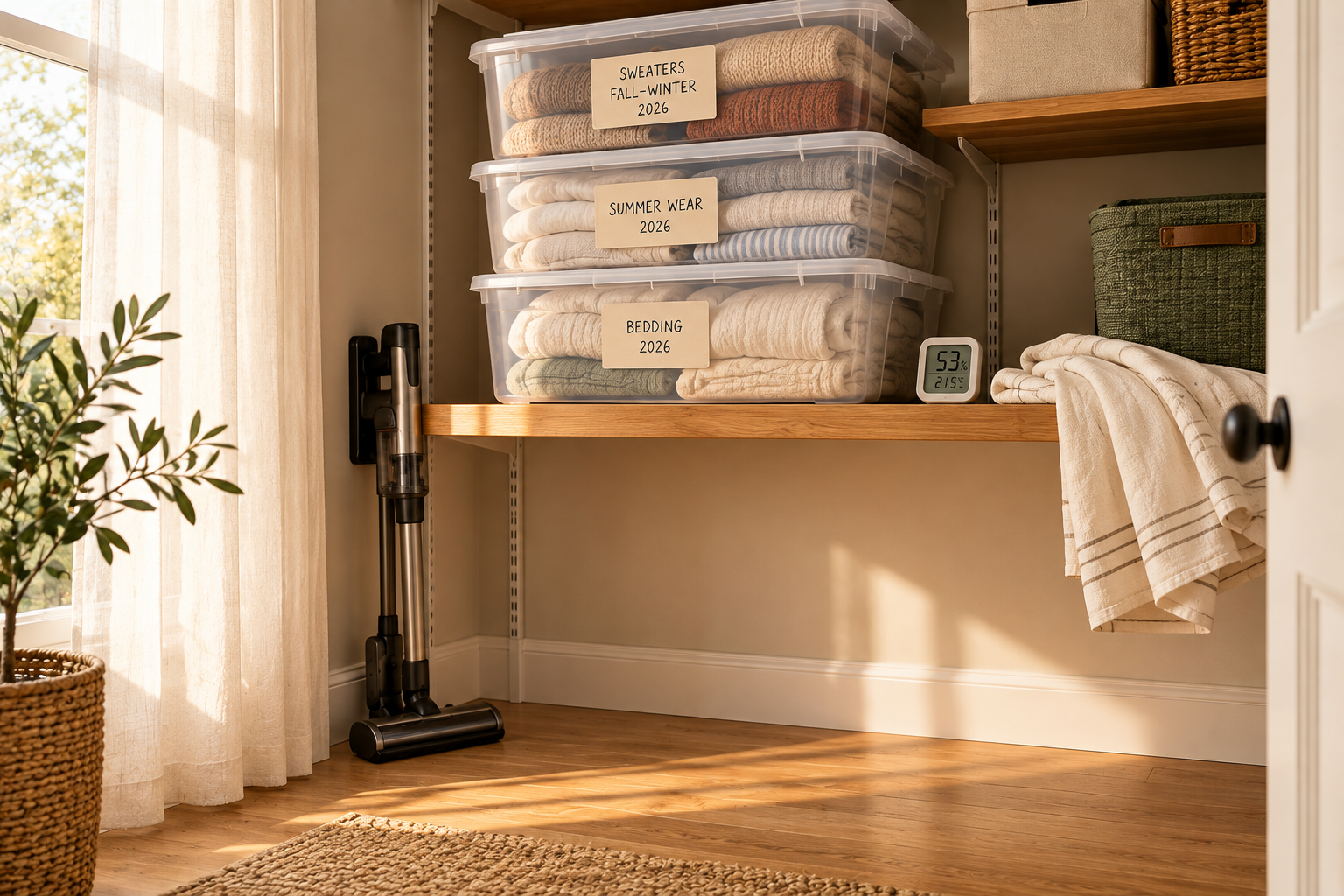
Fold knits into lidded bins, heaviest at the bottom, and write the contents and the year on the outside. Keep the bins up on a shelf, not on the floor.
Air them, steam the creases, try things on, and put anything that no longer fits or looks tired straight into a donation bag by the door.
A closet swap is really a cleaning job with a storage job attached, and clean first is the rule everything else depends on. The damage comes from clothes moth larvae rather than the adult moths, which Utah State University’s extension service describes as harmless. The larvae favour fabric stained with sweat, oil and spilled drinks. Oregon State’s extension specialists point out that it is animal-fibre clothing (wool, cashmere, silk) that is most at risk. A sweater that looks spotless after one wear still carries skin oil, which is exactly what a larva wants. So wash or dry-clean it, dry it completely, and take the thin plastic film off anything that comes back from the cleaner. The Canadian Conservation Institute advises against those garment bags because they allow no air circulation, which encourages moisture to build up, and they do nothing about light.
Where the bins live is the decision Canadian homes get wrong most often, and the basement is the usual culprit. Nova Scotia’s environmental health guidance says indoor humidity should stay at or below 50 per cent in summer. It adds that fabrics, paper and wood should not be stored in damp areas such as basements, since mould can grow on anything that holds moisture. Health Canada likewise recommends controlling dampness indoors in the first place. An unfinished basement in August is often exactly that kind of space.
An unheated garage, shed or attic fails for the opposite reason. The Canadian Conservation Institute notes that swings in humidity and temperature make textiles expand and contract, and that mice are drawn to fabric as nesting material. Keep the garage for skates, tools and shovels, which is the job organizing the garage for winter is really about. The winners are unglamorous: a spare-room closet, the top shelf of a bedroom closet, or the space under a bed. If the basement is your only option, use shelving that lifts the bins off the floor. Add an inexpensive hygrometer, and run a dehumidifier through the humid months. Read how to maintain humidity levels in your home before you commit.
| Location | Verdict | Why |
|---|---|---|
| Spare-room closet, under the bed, top shelf of a bedroom closet | Best | Inside the heated, stable part of the house, and easy to reach during the bridge weeks. |
| Finished, dehumidified basement with shelving | Acceptable | Only if summer humidity stays at or below 50%; check with a hygrometer and keep bins off the floor. |
| Unfinished basement | Avoid | Damp air and condensation, and mould can grow on fabrics stored there. |
| Unheated garage, shed or attic | Avoid | Big swings in temperature and humidity, and rodents nest in stored fabric. |
| Cedar chest or bare wooden drawer | Line it or skip it | Wood gives off acidic vapour that can yellow fabric, and cedar does not stop moths. |
Containers are the least important part of seasonal closet swap organization, and simpler than the shopping aisle suggests. The Institute’s textile guidance was written for museum collections, so it is more cautious than a household needs to be, but the principles carry over. It considers polyethylene boxes fine for storage. It warns against ordinary cardboard, wood and anything that emits acids, which is why a raw wooden drawer or blanket chest can yellow the fabric it holds. So buy clear totes with snap-on lids. They run roughly $7 to $24 CAD each in the 40 to 80 litre range at Canadian home-improvement stores, depending on size and sale timing. Line them with unbleached cotton muslin or a clean cotton sheet for anything precious.
Lay knits flat, since flat storage supports the whole garment, and put the heaviest pieces at the bottom. A household of two rarely needs more than four to six bins. Label each with its contents and the year; it costs a minute and saves half an hour of opening lids in April.
Cedar and mothballs need a direct answer, because the advice on them is the most confidently wrong. Oregon State’s extension service states that cedar chips and balls do nothing to repel clothes moths, however good they smell. The Canadian Conservation Institute is only slightly kinder. It says cedar’s vapour has limited effectiveness, and that mothballs discourage larvae but are not a repellent and are a suspected carcinogen. Mothballs are pesticides. Health Canada announced new labelling rules for naphthalene mothballs in 2012, limiting them to indoor use in airtight containers, and lists headaches, nausea, dizziness and vomiting among the effects of the vapours.
What actually protects wool is dull: clean garments, sealed containers, and a look inside every few weeks for holes, webbing or small silk cases. Oregon State also notes that lint and hair left undisturbed for long stretches are prime breeding grounds, which is why the vacuuming in step four extends to the baseboards and trim. If you do find an infestation, the Institute’s home method is to seal the item in polyethylene, freeze it for a week, let it thaw unopened, and repeat. The freezer needs to hold -20°C (-4°F). The usual home setting of -18°C sits just short of that, so for anything valuable, call a professional.
A closet swap is really a cleaning job with a storage job attached.
The leave pile is where the swap turns into a deep clean, and it is where Ontario households get tripped up. The City of Toronto says old clothes, shoes, blankets and curtains do not belong in the Blue Bin, because they tangle sorting machines and injure workers. It asks residents to donate items in good condition to non-profit agencies or bring them to Community Environment Days. What cannot be donated goes in the garbage. Other Ontario municipalities run their own textile programs, so check your city’s waste tool before assuming.
The scale is worth knowing. The City reports that the average Toronto household throws out about 17 kilograms of clothing and other textiles a year, and a University of Waterloo and Seneca College study estimated that Canadians discard close to 500 million kilograms of fabric annually.
A swap is one of the rare moments when every garment passes through your hands in a single afternoon, so use it. A workable rule: a piece that has not left its hanger since last October, and is not a genuine occasion outfit, goes into a bag that day. The bag goes into the car before you can reconsider.
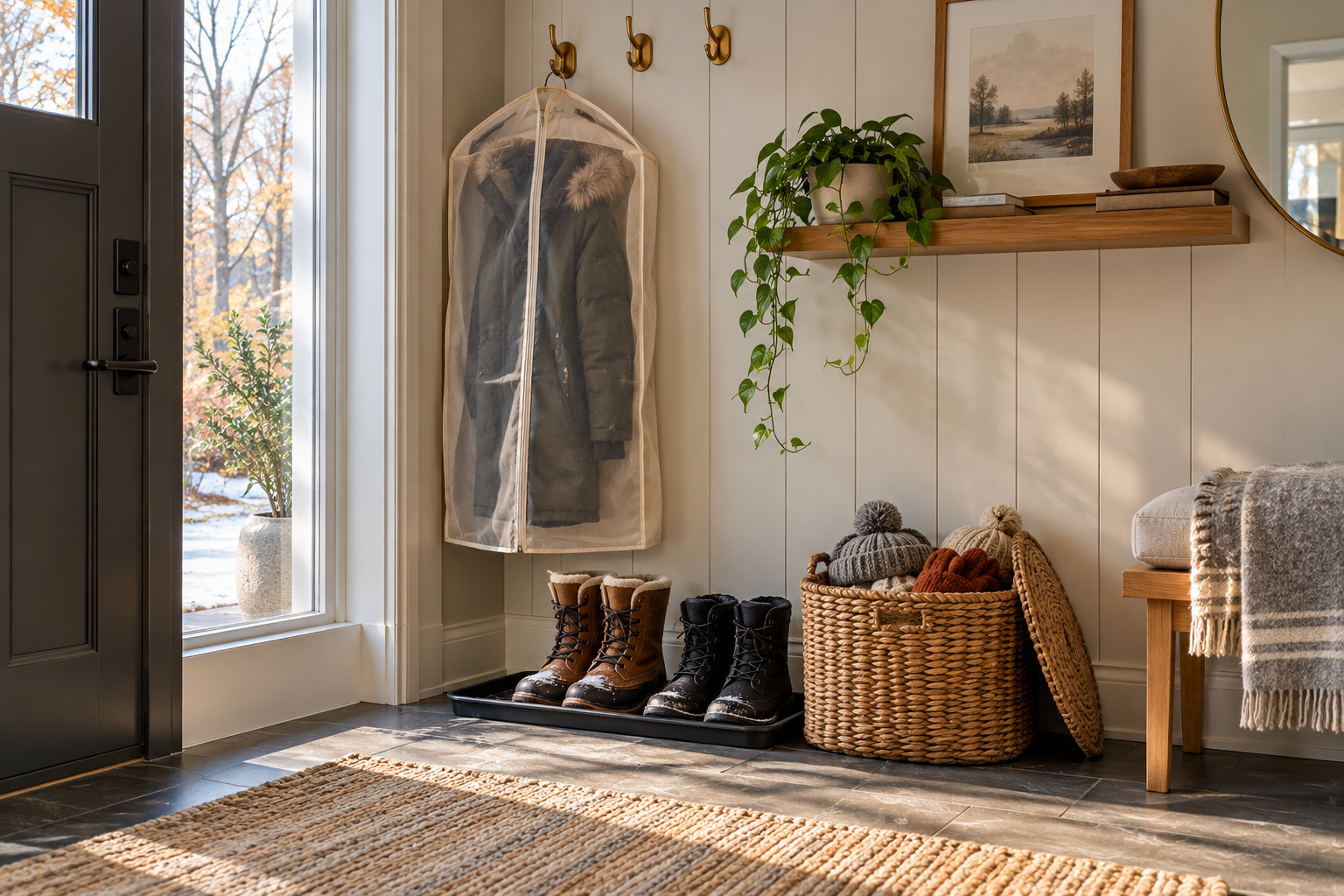
The second pass has its own small rules, because winter gear brings road salt with it. Wipe boots with a cloth dampened in diluted white vinegar to lift the white salt lines (test a hidden patch on leather). Then dry them at room temperature rather than on a heat register, which can crack leather. Parkas and shells can hang, but in a breathable cotton bag on a wide, shaped hanger, for the same reason the dry-cleaner film is out. Mitts, toques and scarves live better in one lidded basket by the door than scattered through four coat pockets. If the entry is tight, a mudroom that can survive boots shows how to make room without a renovation.
Small closets change the logistics of seasonal closet swap organization rather than the rules. For tighter square footage, this guide to making a small home feel bigger and brighter is a useful companion. The logic of taking things out of circulation, cleaning the space, and returning only what earns its place is the same one behind the fall pantry reset. Readers south of the border, in Michigan, upstate New York or the Pacific Northwest, can use all of this as written. The extension services at Oregon State and Utah State reach the same conclusions about cleanliness, sealed storage and cedar. A damp basement is a damp basement on either side of the line.
The real test of a closet swap arrives in April, on the first morning warm enough for bare arms. You lift a lid and everything inside smells of nothing at all: no cedar, no mothballs, no cold concrete. That is the whole aim. It is decided now, by washing the sweater you thought was clean, by choosing a shelf over a floor, and by finally letting go of the shirt you have been meaning to wear for three summers.
Order is a kindness you do for a future morning.
— NestDigest