How to Organize Your Garage for Winter: Tools, Salt, and Snow Gear
Ontario’s first real snowfall doesn’t wait for you to find the shovel. Organizing your garage for winter comes down to solving one problem: everything you’ll need in the next five minutes — shovel, scraper, salt, the snowblower — has to be reachable with the car already parked in its spot. Most garage advice stops at labelled bins and a row of hooks. That handles storage. It skips the part that actually matters on a Tuesday morning at 6:40 a.m.: can you open the door, grab the shovel, and get to the driveway without stepping over a bike or a mower that’s still sitting where it sat in July? The fix is a short sequence. Clear out what belongs in seasonal storage. Map the walking route with the car parked. Station your tools and salt along that route. Give wet gear somewhere to dry before it goes back in a bin. None of it requires new shelving. It requires using what’s already on the wall correctly.

Take Inventory Before You Buy Anything
Pull everything currently on the garage floor and shelves out into the driveway before you decide what to buy. Sort into three piles: keep out for winter, move to seasonal storage, and gone for good. Patio furniture, garden hoses, the mower, and anything that lived outside all summer should come off the floor entirely. A corner of the basement or a set of ceiling-mounted racks clears more usable space than any bin system layered on top of clutter that’s still there. If a cordless mower or trimmer has a removable battery, pull it and bring it somewhere closer to room temperature. Lithium-ion cells lose usable capacity fast once a garage sits below freezing for weeks at a stretch, and a battery that reads full in October can disappoint you in January. This is also the moment to run a quick condition check on what you’re keeping. A shovel with a hairline crack in the handle, a scraper with a worn edge, or a snowblower that struggled through last year’s storms should get replaced or serviced now, not discovered mid-storm. If you haven’t already worked through a broader seasonal pass on the rest of the house, the same walk-through logic carries over from a full preventative home maintenance checklist — inspect first, then organize around what’s actually staying.
This is also a sensible point to reassess the snowblower itself, not just its storage spot. A machine that was undersized for last year’s driveway won’t get better with age, and matching the machine to your actual snowfall and surface is worth ten minutes before the first flurries — this guide to choosing a snow blower for Canadian winters breaks down single-stage versus two-stage machines by driveway size and typical regional snowfall.
The First-Snowfall Sequence
Pull everything out, sort into keep/store/gone, and check condition on what stays.
Patio furniture, hoses, and the mower go up on racks or into the basement — off the floor, off the route.
Park the car where it actually lives and trace the path to the shovel with a tape measure, not a guess.
Mount tools along the walking route, at a height you can reach without ducking under the car’s mirror.
One sealed container, one scoop, kept off the floor and out of reach of kids and pets.
Boots and gloves get a drying stop before storage. Then walk the whole sequence once, car included.

Winter Garage Setup: Salt Storage, Snow Gear, and the Final Walkthrough
Test the Route With the Car Actually Parked
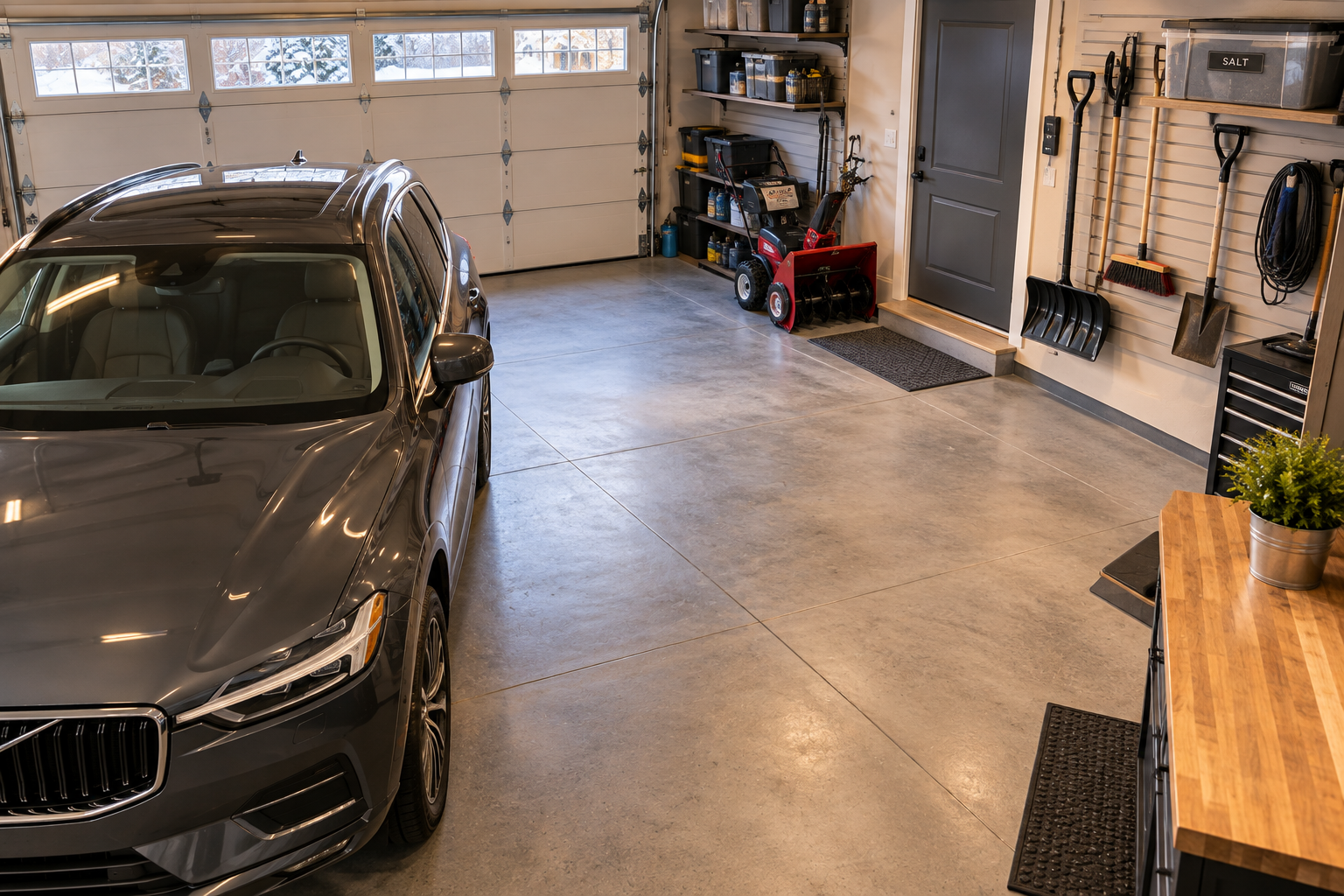
Park the car in its real spot before deciding where anything goes. Walk from the driver’s door to wherever you’re planning to hang the shovel. Pay attention to what’s actually in the way. A mid-size SUV runs close to 4.7 metres nose to bumper, and that length eats more of a standard two-car garage than most people picture until they measure it. Six inches is the difference between a shovel you can grab in three seconds and one that means squeezing past the hood every time. Check the garage door’s swing path and any side door you’d use in a hurry. If a snowblower lives in the garage, physically walk it out of its parking spot with the car in place — not in theory, but the actual machine, the actual turn radius, the actual doorway. If it catches on a shelf bracket or a bike pedal on the way out, that’s the moment to find out. Better now than during the first real storm, when you’re already fifteen minutes behind getting to work.
Build a Salt Station That Doesn’t Turn Into a Brick
Sidewalk salt left in an open bag on a garage floor absorbs moisture from the concrete and the air. By February you’re chipping at a single fused block instead of scooping. A lidded, airtight container solves most of that on its own — a $15 to $25 tote with a snap-seal lid does the job, kept up on a shelf rather than directly on the concrete. It’s the swing between damp and freezing that ruins loose salt, and Southern Ontario garages move through that swing constantly. Store the scoop inside the container or clipped to the outside so it’s never a separate search. Label the lid clearly, and keep the whole station somewhere a small child or a curious dog can’t reach it. Ice melter is genuinely unpleasant to ingest and worth treating with the same caution as any other household chemical.
Worth knowing before you reach for salt at all: the Region of Waterloo’s snow-clearing guidance points out that salt stops working below about -10°C, which is common enough across a Canadian winter that it’s worth keeping sand or non-clumping grit alongside the salt, not instead of it — a sand-and-salt mix gives you traction and some melting power on the coldest days when salt alone does nothing.
Give Wet Gear Somewhere to Go Besides the Floor
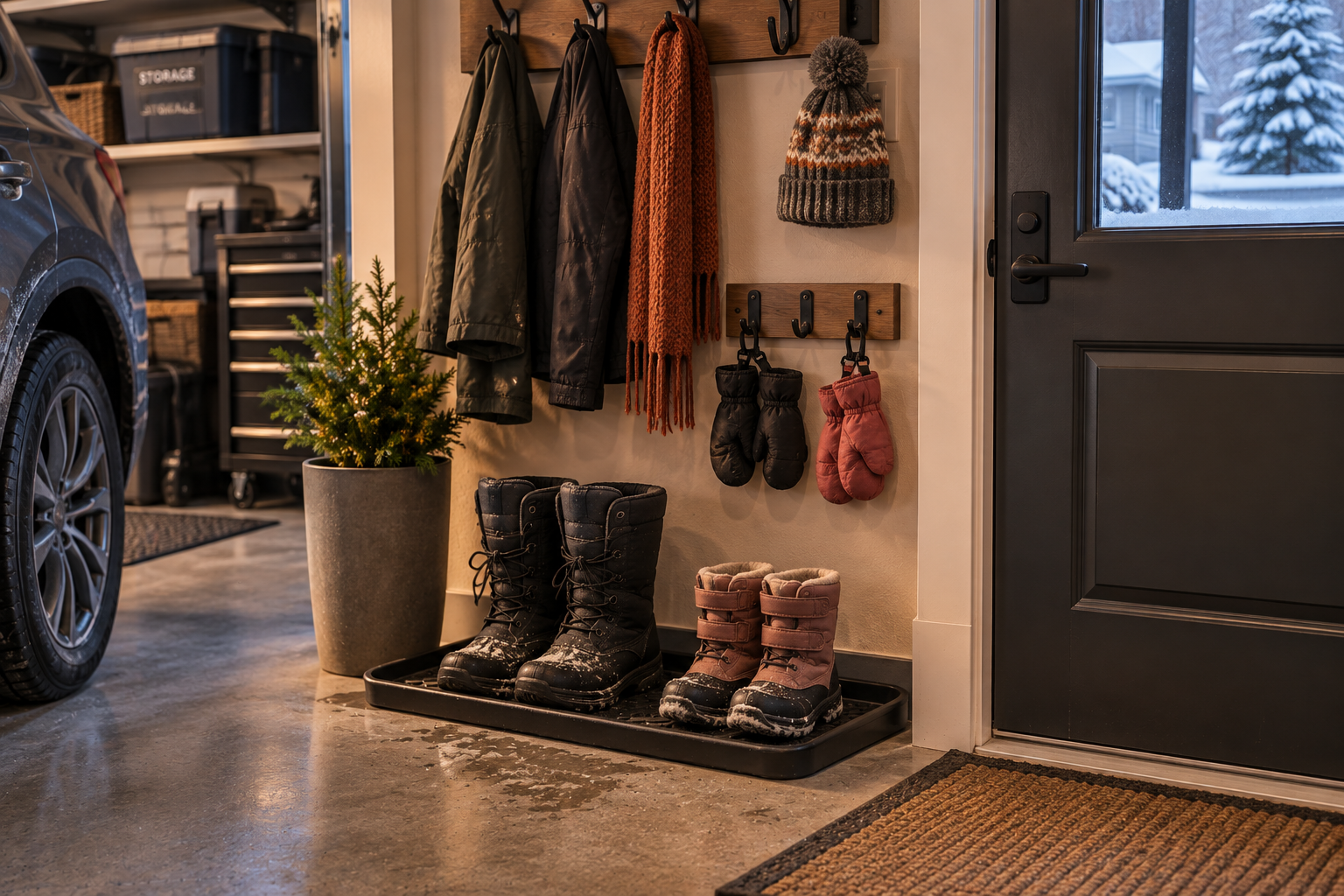
“Put winter gear in bins” only works if the gear is dry when it goes in. Wet boots and gloves stuffed straight into a sealed container mildew, and a bin of damp mitts by March is worse than no system at all. The sequence that actually holds up: a boot tray or mat catches the initial drip right inside the door, a set of wall hooks or a small rack lets boots and gloves air out for a few hours, and only then do they move into long-term storage. If the garage doubles as your household’s actual entry point, the same layering that makes a small mudroom survive boot season applies here almost directly: a catch tray, a hook at a height kids can reach, and bins that only get used once things are genuinely dry, not just cold.
Know What Actually Needs to Come Inside
Don’t assume a cabinet against the house wall keeps anything meaningfully warmer than the rest of the garage. In most unheated attached garages, the temperature tracks close to outdoor within a few hours, and a detached garage tracks it almost immediately. That matters for anything with a stated storage temperature range. Cordless tool batteries, chargers, some paints and aerosols, and certain adhesives all list a minimum temperature on the label or in the manual, and it’s worth actually reading it rather than guessing. If you’ve already worked through a full draft-proofing pass on the house, bring the same scrutiny to the garage. A space that feels sheltered isn’t the same as a space that’s controlled, and the products most likely to be damaged by cold are rarely the ones people think to check.
Quick Answers for a Small Garage
Where should I store snow shovels in a small garage?
As close to the door you’ll actually leave from as physical space allows, mounted on a hook or slat-wall bracket rather than leaned in a corner where it can slide or block a walking path. If you use both a garage door and a side door depending on the weather, a shovel at each is worth the small extra cost.
How do I store sidewalk salt so it doesn’t clump?
In a sealed, airtight container kept off the concrete floor, in a spot that isn’t next to a garage door draft. Moisture is the cause of clumping, not cold on its own, so the goal is keeping humidity out more than keeping temperature stable.
How do I fit a snowblower and a car in my garage?
Park the car first, then measure the actual remaining width before deciding where the blower sits. Most single-stage blowers fit along a side wall if the car is centred correctly; the more common problem is a car parked slightly off-centre eating the clearance a blower needs to be walked straight out rather than wrestled around a bumper.
What should I move out of an unheated garage before winter?
Anything with a printed minimum storage temperature — batteries, some paints, aerosols, certain adhesives and caulks — along with houseplants, canned goods that can freeze and expand, and bottled liquids in glass. When in doubt, check the label rather than assuming the garage counts as “inside.”
Where should wet boots and snow gear go after use?
A drip tray or boot mat first, then a hook or rack to air dry, and only then into a storage bin. Skipping the drying step is the single most common reason garage gear storage stops working by midwinter.
None of this is complicated once it’s set up, which is exactly the point. A garage that’s organized for winter isn’t the one with the nicest bins — it’s the one where you can walk in half-asleep, grab the right thing without thinking, and get the car out before the coffee’s finished brewing. Set the sequence up once, in daylight, with the car parked where it actually lives, and the whole system runs itself through every storm that follows.
The tools that save you are the ones you can find in the dark.
— NestDigest