
How to Style Flower Arrangements at Home Like a Designer
Fresh, faux, or dried — the way you place flowers in a room says almost as much as the blooms themselves.
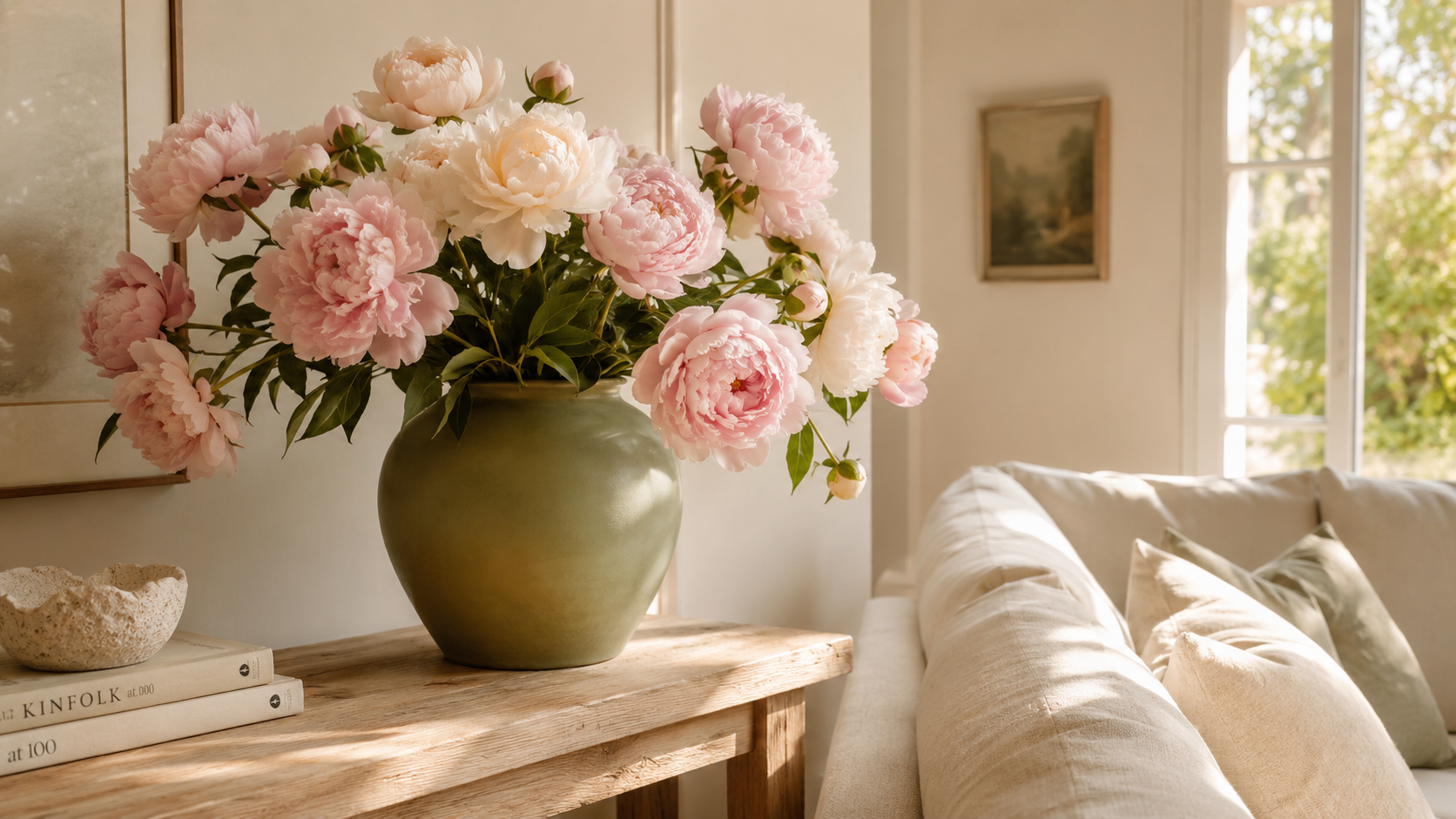
There is a particular kind of satisfaction in walking into a room and immediately feeling that something is right. Often, the source of that feeling is a vase of flowers — a cluster of peonies on a console, a single stem in a bud vase on a windowsill, a generous arrangement of dried grasses on a dining table. Flowers do something to a space that furniture and paint alone cannot quite replicate. They bring it to life, subtly and without effort, in a way that registers before you consciously notice them.
But not all flower arrangements are created equal. A bunch of supermarket stems dropped into a vase too wide for them, or a stiff artificial spray that looks like it wandered in from a hotel lobby, can sit in a room for years and never actually contribute anything. Styling flowers well — whether you’re working with fresh blooms, high-quality faux arrangements, or sculptural dried botanicals — is a skill with a few consistent principles behind it, and once you understand them, the results come naturally.
The first thing to get right is placement, which is really about understanding sightlines. A flower arrangement earns its place when it lands in your field of view at a natural resting point — the end of a hallway, the centre of a dining table, the corner of a bathroom vanity. The mistake most people make is clustering all their greenery in one room and leaving the rest of the house botanically bare. A single stem in a narrow glass bottle on a kitchen shelf does more work than a dozen roses on a coffee table that nobody circles. Spread the presence of flowers throughout the home, and let them be small where the space is small.
A single stem in a narrow glass bottle does more work than a dozen roses in a vase nobody walks past.
Scale matters enormously, and it cuts in both directions. An arrangement that is too small for its surface looks accidental. One that overwhelms the surface looks like a statement it hasn’t earned. The classic guide — that an arrangement should be roughly one and a half times the height of its container — is a reliable starting point, but the more intuitive rule is to let the arrangement feel proportional to the furniture beneath it. A low, wide bowl of flowers suits a long dining table. A tall, architectural arrangement in a cylinder vase suits a narrow console. A loose, abundant cluster in an earthenware vessel suits a kitchen island. The vessel and the flowers should feel like they belong to the same world.
Colour is where most people overthink. The instinct is to match — to find flowers that mirror the tones already in the room, to coordinate cushions and blooms and artwork in one coherent palette. This can work, but it often produces results that feel finished in the wrong way, like a room that has been art directed within an inch of its life. A far more interesting approach is to let one floral element introduce the room’s most unexpected colour — a vase of rust-orange dahlias in a room of grey-greens, a bunch of blush ranunculus on a dark wood table. Flowers can carry the one note a room is missing without the room needing to be repainted for it.
The case for faux and dried arrangements is stronger than it has ever been. The quality of high-end artificial flowers — particularly silk peonies, cotton stems, and botanically accurate dried seed heads — has improved to the point where the distinction between real and very good faux is genuinely hard to make across a room. For anyone who travels regularly, rents their home, or simply doesn’t want to be managing fresh water and dying petals every week, a well-chosen faux arrangement is a legitimate design decision, not a compromise. The key is to resist anything that looks plasticky or uniform, which tends to mean looking for arrangements with natural variation in petal texture and stem weight, and avoiding any bloom that appears to have been manufactured in exactly the same mood as every other bloom in the cluster.
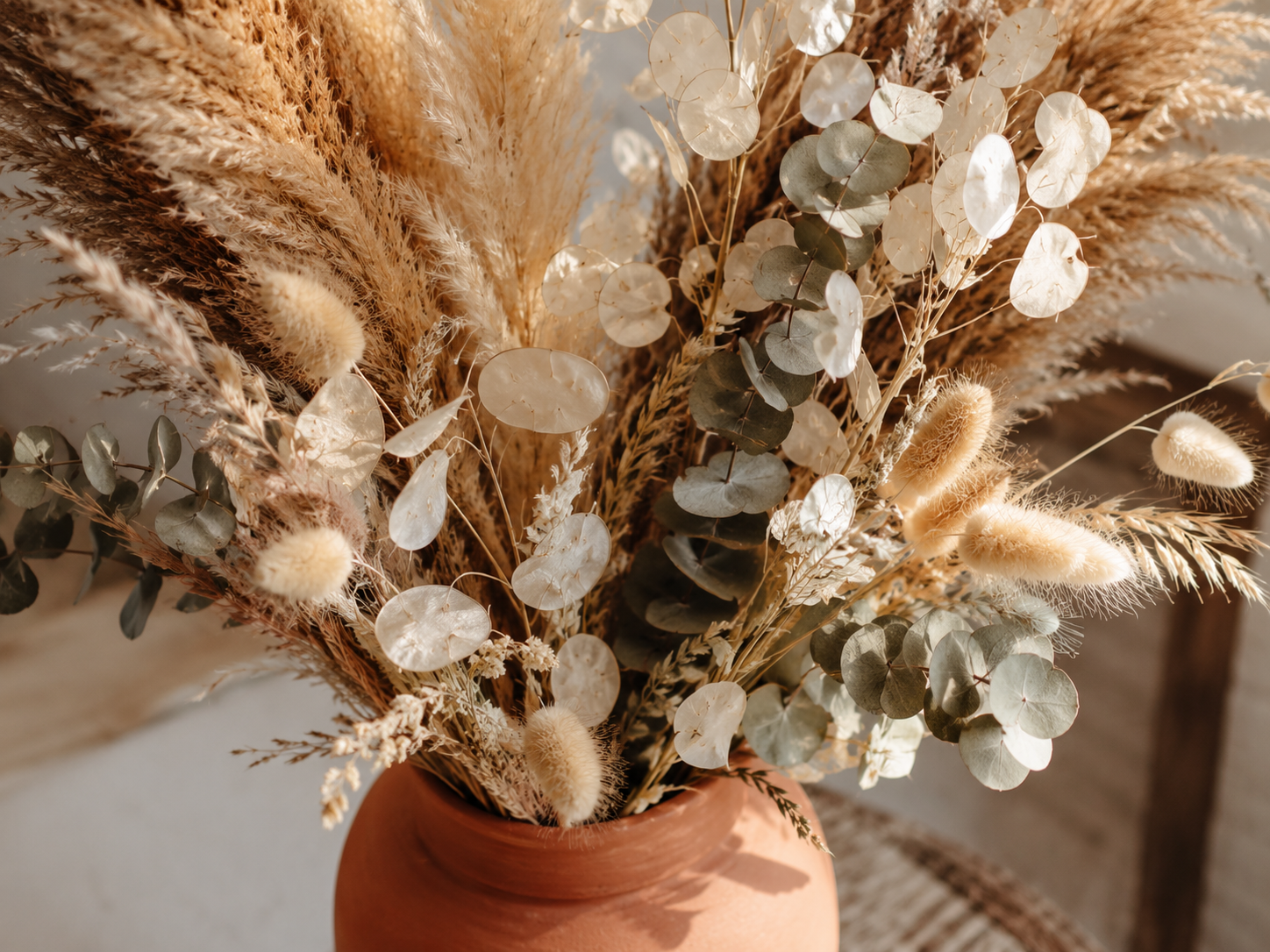
Dried botanicals occupy a different register entirely. Pampas grass, preserved eucalyptus, bunny tail grasses, lunaria, and dried citrus slices have moved from occasional curiosity to genuine design staple over the past few years, and for good reason — they photograph beautifully, hold their shape over months, and bring a warmth and texture to a space that fresh flowers sometimes lack. A tall dried arrangement in a matte ceramic vase on a living room floor is one of the most effortlessly editorial things you can do to a room without touching a single piece of furniture.
The last element that separates a flower arrangement that reads as designed from one that reads as accidental is the vessel itself. A beautiful bloom in an ugly or mismatched container is a wasted opportunity. Conversely, a considered vessel — a vintage cut-glass vase, a matte stoneware jug, a fluted column in aged brass — can elevate even a simple bunch of grocery-store stems into something that looks deliberate. Collect vessels over time the way you collect other objects for the home, with an eye for material, proportion, and character. They are the part of the arrangement that stays.
To create a little flower is the labour of ages.
— William Blake