
Gutter Cleaning Before the Leaves Drop: A Homeowner’s Checklist
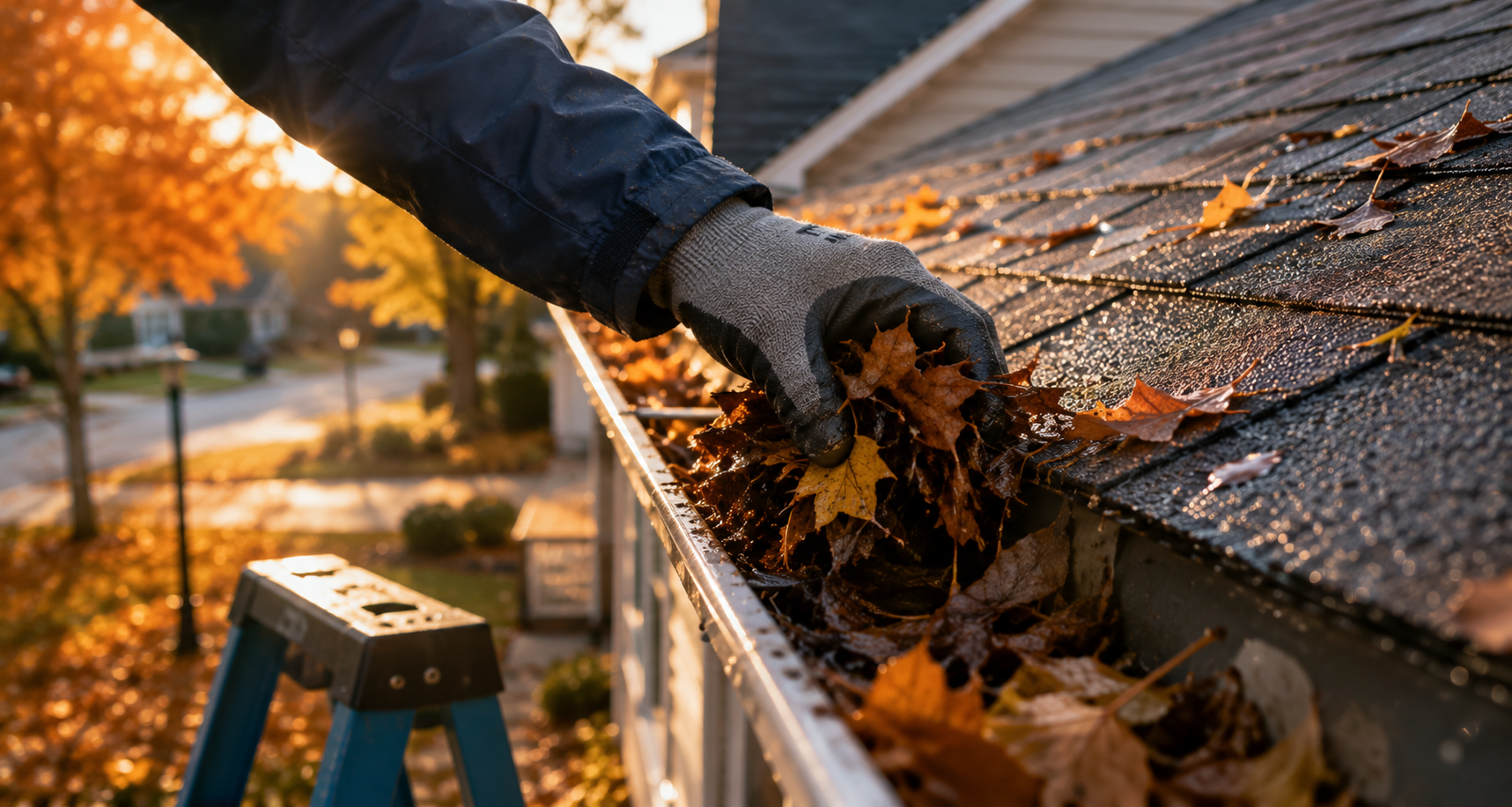
The average maple doesn’t drop its leaves all at once — across most of Canada it sheds over six or seven weeks, which is exactly long enough to fool a homeowner into cleaning the gutters two weekends too early. That’s the first mistake this fall gutter cleaning checklist is built to fix: timing beats effort. Clear the troughs out on Thanksgiving weekend while half the canopy is still holding leaves, and you’ll be back up the ladder by early December — except now it’s happening in near-freezing temperatures instead of a mild October afternoon.
Here’s the short version, if you only read one paragraph of this fall gutter cleaning checklist: clean your gutters once 80 to 90 percent of the leaves in your area have already come down, not at the first hint of fall colour, and finish before your region’s real deadline hits — the first hard freeze across most of the country, or the start of the heaviest rain on the BC coast. In the Great Lakes corridor, Ontario, and Quebec, that usually lands in the first two weeks of November. Prairie homeowners should move earlier, mid-to-late October, ahead of the season’s first hard freeze. Atlantic Canada typically has a bit more runway before nor’easter season sets in. Clean too early and you’ll be redoing it in December cold. Clean too late, and a blocked, frozen gutter may already be backing water under your shingles as an ice dam.
Here’s what’s actually at stake. A clogged gutter doesn’t just overflow. In the freeze-thaw climates that cover most of the country — the Great Lakes corridor, Quebec, Atlantic Canada — standing water in a blocked trough freezes solid within days of the first hard frost. That ice backs up under the shingle line as what roofers call an ice dam. Even on the West Coast, where hard freezes are rare, a clogged gutter fails a different way: it can’t keep up with the atmospheric-river rain that defines a BC winter. Either way, the overflow ends up behind the fascia and soffit. Repairs for that kind of hidden water damage typically run $3,000 to $8,000, more once framing or insulation gets involved. Compare that to $150–$400 for a professional eavestrough cleaning on a typical two-storey home in most Canadian markets, or roughly $20–$40 in supplies if you do it yourself. The math isn’t close.
This particular fall gives the checklist a bit more urgency than usual almost everywhere in the country. The Old Farmer’s Almanac’s 2026 fall forecast calls for above-average precipitation across most of Canada this season — including a cooler, wetter stretch through southern Ontario — with the Pacific Coast the one notable exception. More rain moving through a system that’s still half-blocked with leaves means more chances for overflow to find the one weak spot in your foundation grading you’ve been meaning to deal with. If you haven’t already, this is also the natural week to knock out the rest of the seasonal list: aerating and overseeding the lawn and sealing drafts before the furnace kicks on for good both compete for the same two or three good-weather weekends, wherever you are in Canada.
So here’s the actual fall gutter cleaning checklist, in order, once 80–90% of the leaves on your property — and your neighbours’ overhanging trees — are down:
-
01
Time it right
Wait for the last real leaf drop, not the first one. Through Ontario, Quebec, and the Great Lakes corridor, that’s typically the first two weeks of November. Prairie homeowners should move earlier, mid-to-late October, ahead of the first hard freeze. Atlantic Canada usually has a bit more runway before nor’easter season sets in, and on the BC coast the ground rarely freezes at all — the deadline there is the start of the heaviest November rains, not the cold.
-
02
Gear up before you climb
A properly rated extension ladder, a ladder stabilizer or standoff, non-slip shoes, gloves, safety glasses, and a gutter scoop or trowel. Skip the ladder rungs of the actual gutter trough entirely.
-
03
Set the ladder on solid ground
Follow the 4-to-1 rule — one foot of base offset for every four feet of height — and never lean the ladder against the gutter itself; it’s not rated to hold your weight.
-
04
Clear debris by hand
Scoop leaves and grit into a bucket or tarp as you go, working away from the downspout toward the far end of each run.
-
05
Flush with a hose
Run water from the far end toward the downspout and watch where it actually goes. Slow drainage or backup means the clog isn’t fully cleared yet.
-
06
Flush the downspouts separately
Downspouts clog first and most often. Detach the elbow if you can and run the hose straight down — a slow trickle out the bottom means there’s a blockage further down the pipe.
-
07
Check where the water lands
Downspout extensions should carry water at least six feet from the foundation. If it’s pooling closer than that, add or reposition an extension before winter.
-
08
Inspect while you’re already up there
Look for sagging sections, rust spots, pulled fasteners, and small seam leaks. These are far cheaper to fix in November than after a winter of ice load.
-
09
Trim back overhanging branches
Anything hanging directly over the roofline is next year’s clog. A few cuts now buy you a lighter spring cleaning.
-
10
Log the date
Note what you found and when you did it. It’s the easiest way to know whether your property actually needs a mid-winter check or a quarterly schedule next year.

Every one of those steps assumes stable footing on a single-storey roofline. The math changes once you’re above two storeys, working a steep pitch, or dealing with a gutter that hasn’t been touched in a couple of years. That’s when hiring it out stops being a luxury and starts being the cheaper option. Ladder falls account for the large majority of DIY gutter-cleaning injuries, according to the U.S. Consumer Product Safety Commission, and the recovery cost of even a routine fracture dwarfs a professional cleaning bill many times over. A local eavestrough company charging a few hundred dollars for a two-storey home isn’t the expensive option here — the emergency room is. It’s the same logic that applies to every other deferred repair on a home maintenance list: the bill only grows while you wait.
Gutters are one line on a longer seasonal maintenance checklist, but they’re the line most likely to turn into a five-figure repair if it gets skipped two years running. This fall gutter cleaning checklist doesn’t end with the last downspout flush. It ends with the date logged and a plan for spring, because the homes that never seem to have gutter problems aren’t the ones with better gutters. They’re the ones on a schedule.

Homeowners tend to think of gutter cleaning as a chore they’re doing for the gutters. It’s really a chore you’re doing for the foundation, the fascia, and the framing behind the fascia — none of which announce a problem until the repair bill already has a number on it. Clear them once, at the right week, and you’ve bought the whole house a quieter winter.
The house that ages well isn’t the one that’s never touched — it’s the one that’s tended before it has to be.
— NestDigest