
Aerating vs. Dethatching: Which Fall Lawn Treatment Does Your Yard Need?
By the time September rolls around, most Canadian lawns are wearing the evidence of a hard summer — thin patches, a spongy give underfoot, water that pools instead of soaking in. The instinct is to reach for whatever lawn treatment shows up first in a search. But aerating and dethatching solve two completely different problems, and using the wrong one wastes a weekend and, often, real money.
The short version: dethatching removes the dead organic layer sitting on top of the soil, while aeration relieves compaction underneath it — the two treatments solve different problems, and most Canadian lawns only need one of them in a given year. If a cut-out wedge shows more than half an inch of dead material between the grass and the soil, or the lawn feels spongy underfoot, dethatch. If a screwdriver won’t sink ten centimetres into moist soil and water pools instead of soaking in, aerate instead. Fall — specifically late August through mid-September across most of the country — is the best window for either job, since cool-season grasses recover fastest while the air is cooling but the soil is still warm enough to support root growth before winter.
Thatch or Compaction: How to Tell the Difference
Thatch is the tangle of dead grass, roots and stems that builds up between the soil surface and the living blades above it. A little of it — under half an inch — actually protects the crown of the grass and helps hold moisture. Problems start once that layer thickens past half an inch: it starts acting like a mat instead of mulch, blocking water, air and fertilizer from ever reaching the roots. The test takes thirty seconds: cut a small wedge out of the lawn with a spade, about two inches deep, and look at the layer between the green blades and the soil. If it’s thicker than a pencil, or the lawn feels spongy and bounces back slowly underfoot, thatch is the problem, not compaction.
Compaction shows up differently. It’s caused by foot traffic, riding mowers, clay-heavy soil, or simply years of the same routine. It squeezes the air pockets out of the ground until roots can’t push down, and water just runs off the surface instead of soaking in. Push a screwdriver into moist soil — if it stops before it’s gone ten centimetres deep, the ground underneath is too tight for grass roots to do their job properly. Clay-heavy soil, common across large parts of Canada, compacts faster than sandy or loamy ground and often needs aeration every single year rather than every two or three.
Slice out a small triangle of turf, roughly two inches deep, with a spade or trowel and look at the layer sitting between the green blades and the bare soil.
Thicker than a pencil, or the lawn feels spongy and slow to spring back when you walk on it — that’s thatch. Firm and shallow-rooted with no spongy give — that points to compaction instead.
Push a screwdriver into moist soil nearby. Resistance before ten centimetres confirms compaction; smooth entry with a thick surface mat confirms thatch is the real issue.
What Aerating and Dethatching Actually Do
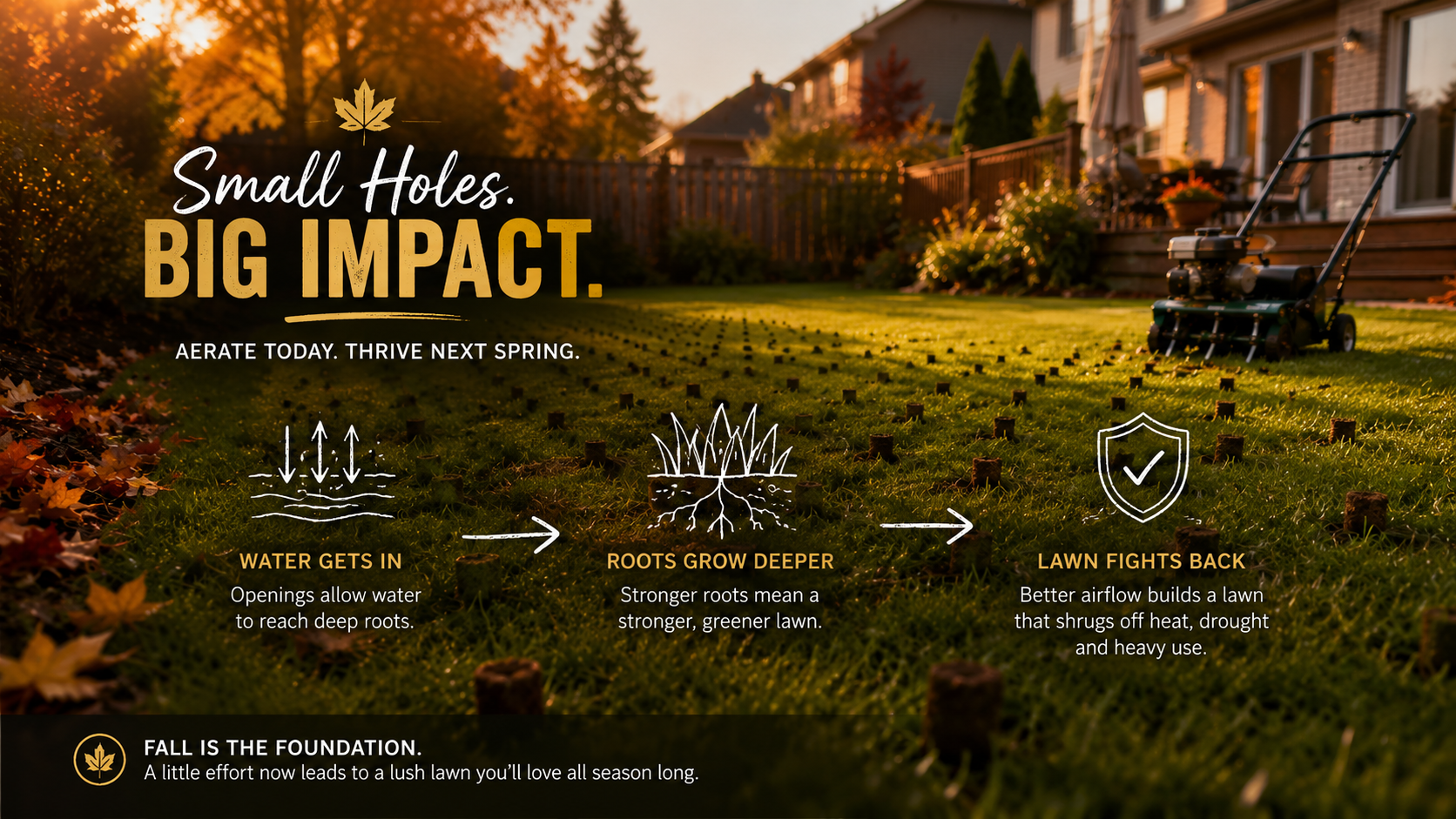
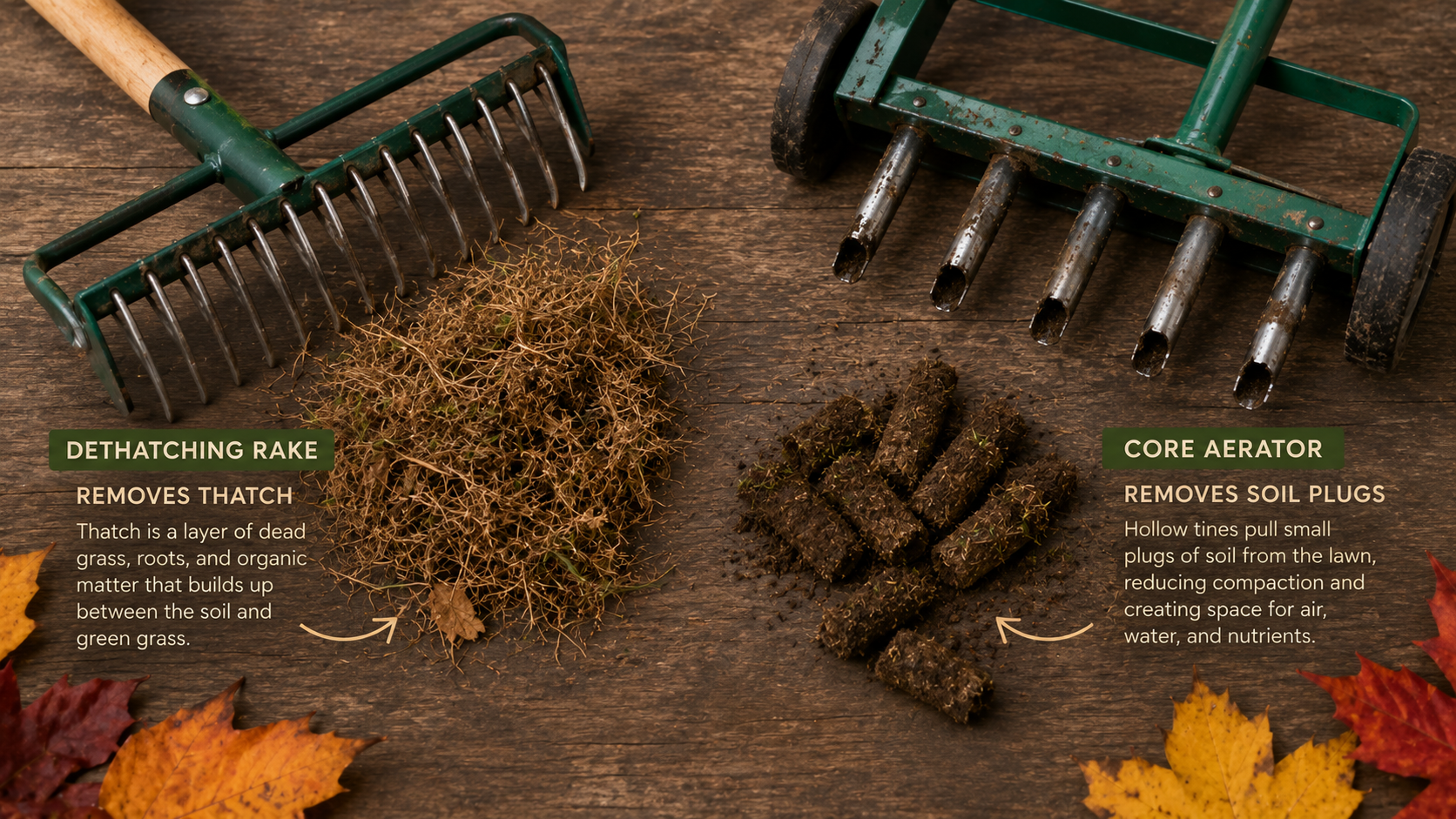
Dethatching pulls that dead layer out mechanically, using a power rake or a set of curved steel tines that comb through the turf and drag the debris to the surface for bagging. Aeration does the opposite kind of work: a core aerator punches out small plugs of soil, roughly two to three inches deep, and leaves the holes open so air, water and nutrients can travel straight down to the root zone. Leave the plugs where they land — they break down naturally over two to four weeks and return nutrients to the lawn instead of ending up in a yard-waste bag.
When Your Lawn Needs Both — and in What Order
Both jobs matter for the same underlying reason. A lawn that’s choking on thatch or locked in compacted soil can’t hold onto fertilizer. It can’t recover from drought either, and it won’t respond to much else you try around it — including any other landscaping investment planned for the yard. It’s also the most cost-effective step toward the kind of exterior polish homeowners chase with pricier upgrades. The same instinct that drives interest in curb-appeal plantings applies just as much to what’s underfoot as to what’s in the beds.
Here’s the part most homeowners get backwards: dethatching is the more aggressive of the two treatments, not the gentler one. A power rake with the tines set too deep can tear out living grass along with the dead material, leaving a lawn that looks worse for weeks before it looks better. Aeration, by comparison, causes almost no visible damage and starts showing results — deeper green, tighter turf — within two to three weeks. If you’re not sure which one your lawn actually needs, aeration is the safer default to reach for first.
When a lawn genuinely needs both, order matters. Dethatch first to clear the surface debris, then aerate into the newly exposed soil — pulling a core aerator through a thick mat of thatch does very little, since the tines can’t reach the compacted layer underneath it. Most Canadian lawns don’t actually need both treatments every year, though. Ontario’s turfgrass guidance treats annual core aeration as the workhorse maintenance task. The healthier, more oxygenated soil it creates lets natural microbial activity break down moderate thatch faster than an untreated lawn ever could on its own. Save a standalone dethatching pass for the years when the thatch layer has genuinely gotten away from you — past three-quarters of an inch — rather than doing it as a reflexive annual chore.
The Best Time to Aerate or Dethatch in Canada
Fall is the right season for both treatments across nearly all of Canada. The window is narrower than most people assume, though: late August through mid-September in most regions, stretching into early October along the milder coasts of British Columbia, and closing earlier — by the first week of September — across the Prairies. It’s worth adding to whatever fall home maintenance checklist you’re already running, since this timing window is easy to miss once cooler weather starts pulling other outdoor jobs to the front of the list. Cool-season grasses — the Kentucky bluegrass, fescue and ryegrass blends common on Canadian lawns — hit a second growth surge once summer heat breaks. That gives roots six to eight weeks to establish before the ground freezes. Push either job into late October in a colder region and the grass won’t have time to recover before dormancy sets in.
Grass type shapes the calculus too. The vast majority of lawns across Canada are seeded with cool-season varieties, from the Maritimes through Ontario and Quebec to the Prairies and most of British Columbia’s Lower Mainland. Kentucky bluegrass brings density and cold tolerance, fine or tall fescue handles shade and drought, and perennial ryegrass germinates fast when overseeding. All three respond well to fall aeration and dethatching alike. Warm-season grasses like Bermuda or zoysia only turn up in a handful of sheltered coastal pockets. Where they do appear, they’re treated in late spring instead — aerating or dethatching a warm-season lawn in fall interrupts dormancy rather than supporting recovery.
Overseeding, Aftercare, and What It Costs
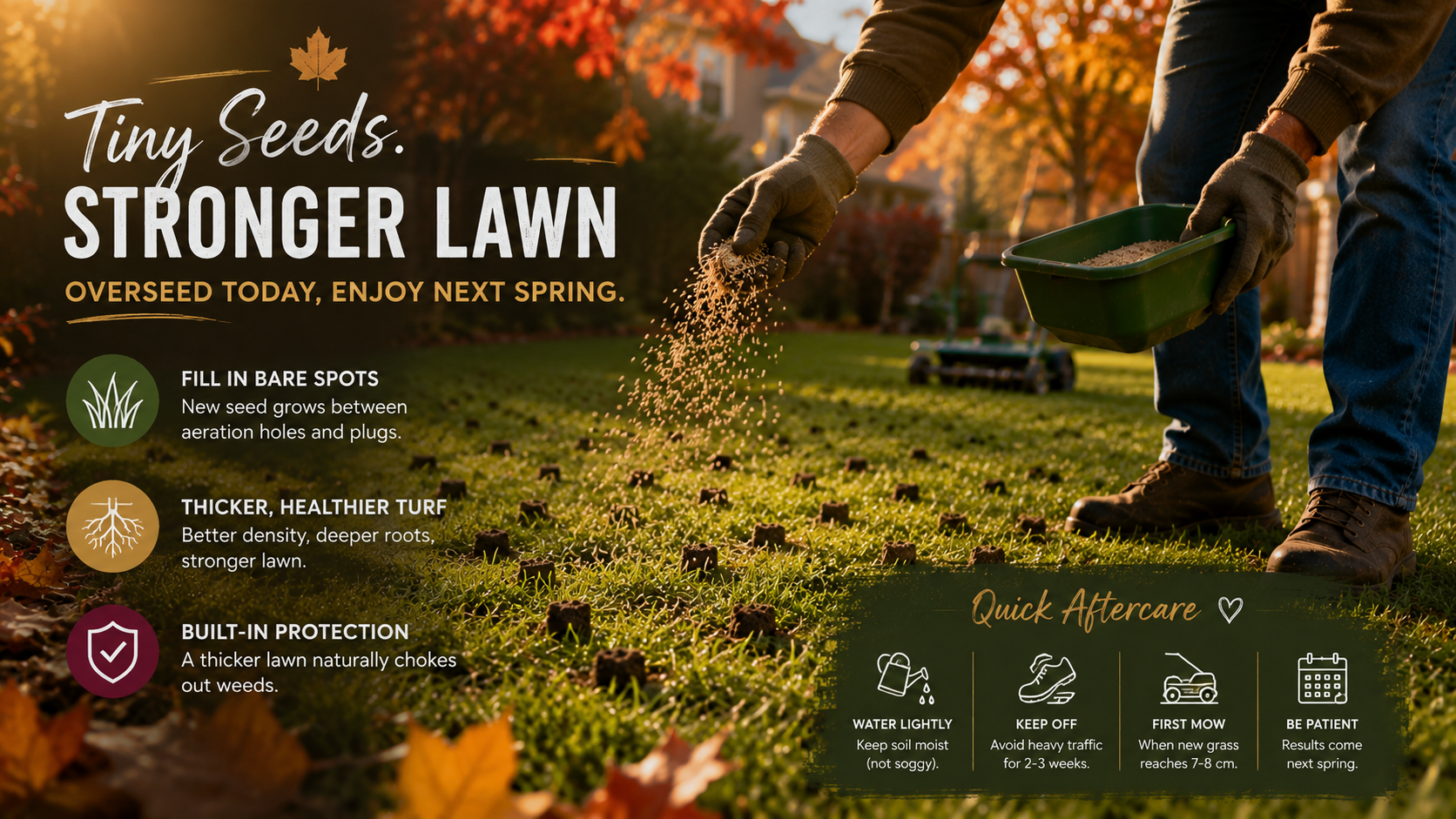
Pairing aeration with overseeding in the same afternoon is the highest-return move available to a Canadian homeowner in September. The open channels left by a core aerator give grass seed direct contact with soil instead of stranding it on top of existing turf. That contact alone can lift germination rates by 30 to 50 percent compared with seed broadcast onto unaerated ground. Follow with a fall fertilizer higher in potassium than nitrogen — it builds root reserves and winter hardiness instead of pushing top growth that frost just cuts back down.
Cost is where the two treatments diverge the most. Professional core aeration for a standard suburban lot typically runs $70 to $200 CAD. Renting a walk-behind aerator for a weekend costs $60 to $150 in most Canadian markets if you’d rather handle it yourself. Dethatching costs more for the same square footage. Professional power raking usually lands between $100 and $300 CAD, climbing toward $400 or higher for a large or badly matted lawn, since it takes longer and generates far more debris to haul away. That price gap is one more reason to confirm which problem you actually have before booking either service.
Aftercare determines how much of that investment actually sticks. Keep foot traffic light for the first one to two weeks after either treatment. Hold off on herbicides or heavy fertilizer applications until the lawn has had about a week to settle, too — products applied too soon can scorch grass that’s already under mild stress from the tines. Mow slightly higher than usual for the rest of the season; taller grass shades the soil, holds moisture better through the shoulder-season temperature swings, and gives any overseeded patches a better shot at establishing before the first hard frost.
DIY or Hire a Professional?
Renting equipment makes sense for a flat, average-sized suburban lot and a free Saturday; a quarter-acre lawn takes most homeowners under two hours with a rented core aerator. Hire a professional once the property is larger than about half an acre, has significant slope, or the thatch problem is severe enough that a rented power rake risks doing real damage in inexperienced hands. Either way, water the lawn two or three days beforehand — dry soil resists tines and blunts results on both treatments equally. Once the lawn is handled, it’s also the natural moment to start winter garden planning for the beds around it, before the ground locks up for the season.
The honest answer to “aerating or dethatching” is rarely either-or — it’s diagnose first, then treat. A lawn that gets a proper fall aeration most years, with dethatching reserved for the seasons it’s actually earned, spends less on lawn care over time. It also looks better doing it than one that gets both treatments blindly every September, whether the soil needed it or not.
A lawn keeps no secrets in spring — every root you fed in September shows up as the first green of April.
— NestDigest