In today’s housing market, the decision to move is no longer just about lifestyle—it is increasingly a financial trade-off shaped by interest rates, transaction costs, and capital efficiency. As these pressures intensify, a clear behavioral shift has emerged: homeowners are choosing to improve their existing homes rather than relocate. What was once a reactive decision has now become a deliberate strategy.
This shift—commonly framed as “improve, don’t move”—is not a temporary response to market conditions. It reflects a deeper recalibration of how households evaluate cost, risk, and value in residential real estate.
The Mortgage Lock-In Effect Is Reshaping Behavior
At the center of this trend is the mortgage lock-in effect. Millions of homeowners secured financing during periods of historically low interest rates. Moving today often means replacing that low-cost debt with significantly more expensive borrowing.
This creates a structural disincentive to move.
Recent market observations show that homeowners are increasingly reluctant to give up sub-3% or sub-4% mortgage rates, especially when new borrowing costs remain materially higher. As a result, many households are delaying home purchases and instead investing in their current properties.
The implications are significant. Housing mobility slows, listings remain constrained, and renovation activity absorbs the demand that would traditionally flow into home transactions.
The Real Cost of Moving vs Renovating
From a financial perspective, the comparison between moving and renovating has become increasingly asymmetrical.
Relocation involves:
- Agent commissions
- Closing costs
- Taxes and legal fees
- Moving expenses
- Higher ongoing mortgage payments
Collectively, these costs can easily exceed tens of thousands of dollars—often before any improvements are made to the new home.
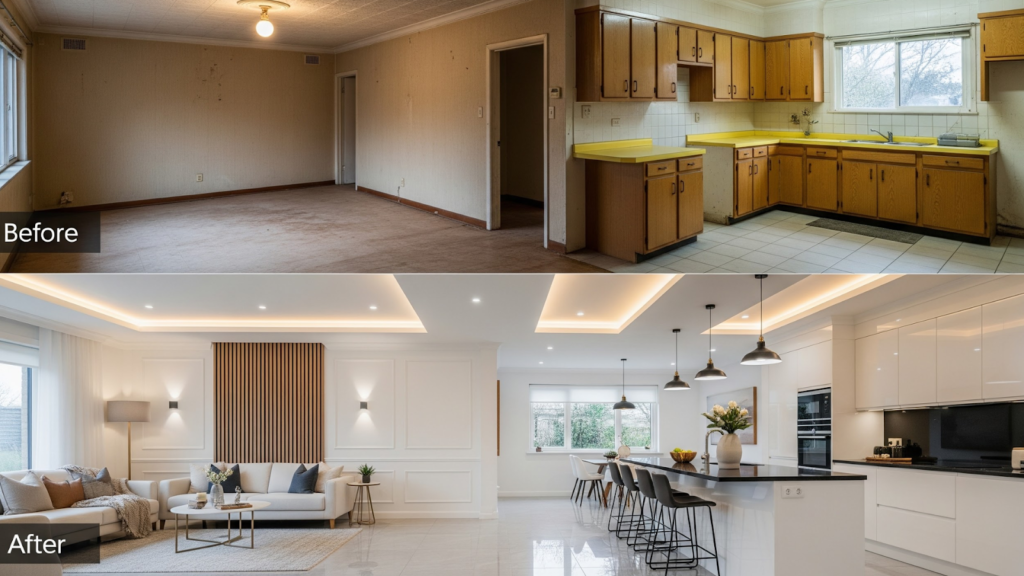
In contrast, renovation allows for controlled, phased capital deployment. Instead of committing a large lump sum into a new purchase, homeowners can allocate smaller amounts over time toward targeted improvements.
This is why the “improve, don’t move” strategy is gaining traction. It aligns with a more disciplined approach to capital allocation—prioritizing efficiency over scale.
Renovation Demand Is Holding—Even in a Slowing Market
What makes this trend particularly resilient is that it persists even as the broader housing market cools.
Industry forecasts suggest that total spending on home improvements and maintenance will still reach over $500 billion in 2026, despite a moderation in growth rates. This indicates that while large-scale projects may slow, overall renovation activity remains structurally strong.
At the same time, homeowners are becoming more selective. Rather than pursuing large, aspirational remodels, they are focusing on practical, high-impact upgrades that improve daily living.
This aligns directly with the rise of the micro-renovation economy outlined in the pillar article:
From Aspirational Renovation to Functional Investment
Another defining feature of the current cycle is a shift in intent. Renovation is no longer driven primarily by aspiration—it is driven by function.
Homeowners are asking:
- What improves daily usability?
- What reduces long-term costs?
- What adds lasting value?
Rather than pursuing “dream home” transformations, many are prioritizing:
- Maintenance and preventative upgrades
- Energy efficiency improvements
- Space optimization
This reflects a broader transition from consumption-driven renovation to investment-driven renovation.
The Psychology Behind Staying Put
Financial logic alone does not fully explain the strength of this trend. Behavioral factors play a critical role.
Homeowners are staying longer than originally planned—often by several years—due to affordability pressures and market uncertainty. Over time, this extended occupancy changes the relationship people have with their homes.
A house is no longer a temporary step—it becomes a long-term asset that must evolve with its occupants.
Renovation, in this context, becomes a way to:
- Regain control in uncertain conditions
- Improve quality of life without major disruption
- Reinforce emotional attachment to the home
This is why “improve, don’t move” resonates so strongly. It is not just financially rational—it is psychologically satisfying.
A Structural Shift in Housing Demand
The cumulative effect of these forces is a structural shift in housing demand.
Instead of:
- Trading up
- Relocating frequently
- Expanding through new purchases
Homeowners are increasingly:
- Extending the life cycle of existing homes
- Adapting space to new needs
- Investing incrementally over time
Even in markets where housing supply remains constrained, renovation is absorbing a significant portion of unmet demand. In some cases, homeowners are even expanding their current homes—adding space rather than seeking it elsewhere.
This reallocation of demand has long-term implications for pricing, inventory, and development patterns.
What This Means for Real Estate Strategy
For investors, developers, and operators, the “improve, don’t move” trend signals a shift in where value is created.
Traditional strategies centered on:
- Acquisition
- Turnover
- Large-scale repositioning
Are increasingly being complemented—or replaced—by:
- Incremental upgrades
- Unit-level improvements
- Tenant experience optimization
This favors:
- Lower capital intensity
- Faster return cycles
- Greater operational flexibility
In effect, real estate strategy is becoming more granular and execution-driven.
Conclusion: A Strategy, Not a Compromise
“Improve, don’t move” is often framed as a constraint-driven decision—something homeowners do because they cannot afford to move. But in reality, it is evolving into a proactive strategy.
It reflects a more sophisticated understanding of:
- Capital allocation
- Risk management
- Lifestyle optimization
In a market where mobility has become expensive and uncertain, improving offers a path that is both financially efficient and personally rewarding.
And as long as these conditions persist, the balance will continue to tilt—not toward movement, but toward optimization.
Next in the series: a closer look at high-impact, low-cost upgrades that deliver the strongest return—breaking down which small renovations actually add measurable value.