
Laundry Room Makeover on a Budget: The Weekend Version That Actually Changes How the Room Works
Most laundry articles picture a sunlit room with a window and a barn door. Yours is probably a corner of an unfinished basement or a closet off the hallway — and that’s exactly the room this guide is written for.

A laundry room makeover on a budget doesn’t start with a Pinterest board. It starts with the honest admission that this is the room in the house nobody plans for. The kitchen gets a designer, the bathroom gets a renovation loan, and the laundry area gets whatever was left over after the plumber ran the lines — a bare corner, a hollow-core door, a bulb on a pull chain. It’s also the room used almost every single day, which makes it the worst return on neglect in the entire house.
The reason it stays neglected is that most of the advice written about it assumes a dedicated room with a window, four finished walls, and square footage to spare. That’s not the laundry room most people in Ontario and across Canada actually have. Yours is either a raw corner of an unfinished basement, tucked next to the furnace and the sump pit, or a stacked closet off a hallway with a folding door and about 60 centimetres of depth to work with. Neither of those situations needs a renovation. Both of them need a weekend and a plan.
Start with an audit, not a shopping list. Stand in the space and name what’s actually failing you: is it that there’s nowhere flat to fold, that you can’t see a stain until it’s already dry and set, that everything gets damp and smells faintly of concrete, or that the shelf above the machines has become the place where things go to be forgotten? Most laundry rooms fail on two or three of these at once, and the fix for each one is specific — painting the walls a lighter colour won’t solve a missing work surface, and a new light fixture won’t solve a ventilation problem. Diagnosing correctly before spending anything is the difference between a $200 refresh that actually works and a $2,000 renovation that still doesn’t.
A room that works hard doesn’t have to look unfinished to prove it.
If your laundry lives in an unfinished basement corner, the good news is you can transform how it functions without framing a single wall. Paint the concrete floor with a proper floor-and-porch enamel in a light tone — it reflects what little light exists and instantly reads as intentional rather than incidental. A washable, moisture-tolerant rug or interlocking foam tile underfoot softens the space for standing and folding. Skip the idea of a door; a simple curtain on a tension rod does the job of visually closing off the area for a fraction of the cost and effort, and it won’t bind or warp the way an ill-fitting basement door eventually does. Freestanding wire or wood shelving on either side of the machines gives you vertical storage without touching the studs, and it can move with you if you ever do finish the space properly.
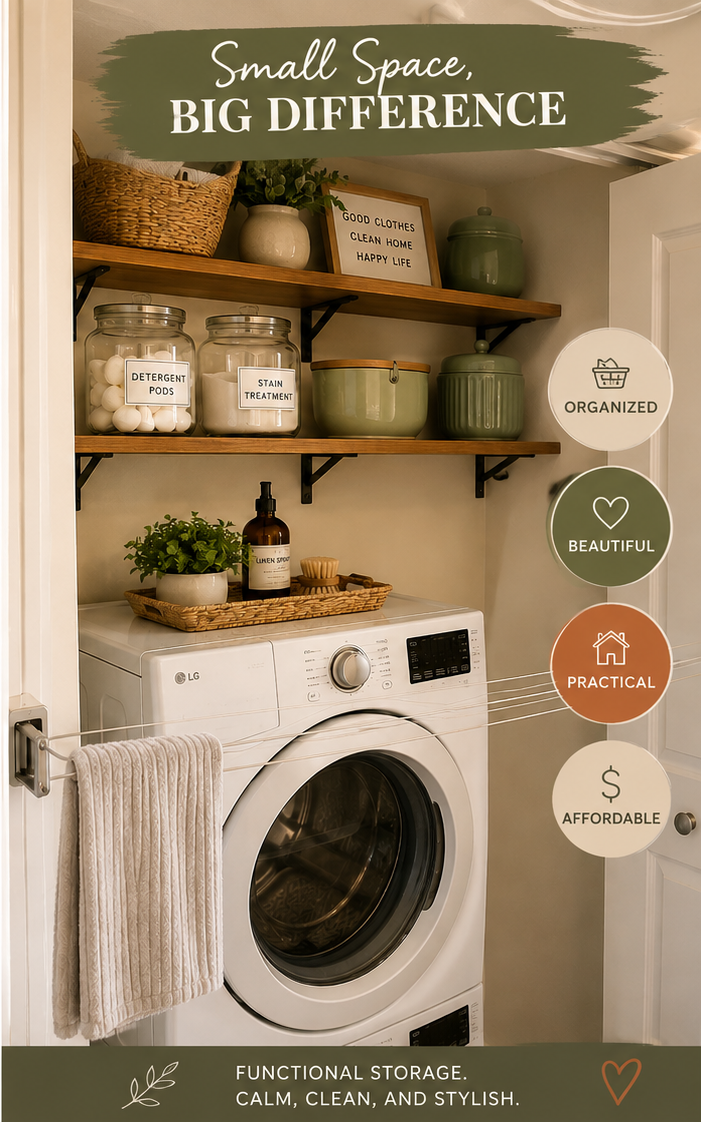
The laundry closet problem is different — it’s not about hiding an unfinished space, it’s about extracting function from a footprint that was designed for machines and nothing else. Most laundry closets run 32 to 36 inches wide and roughly 60 centimetres deep, which is enough for a stacked washer-dryer pair and almost nothing beside them. Swapping a hinged door for a bifold or pocket door reclaims the swing radius entirely — often the single biggest usable-space gain in the whole project, and it costs less than most people assume. Above the stack, shallow wall-mounted shelving (10 to 12 inches deep, not the 16-inch shelving meant for a pantry) keeps detergent and supplies reachable without eating into the walking clearance you need to actually load the machines.
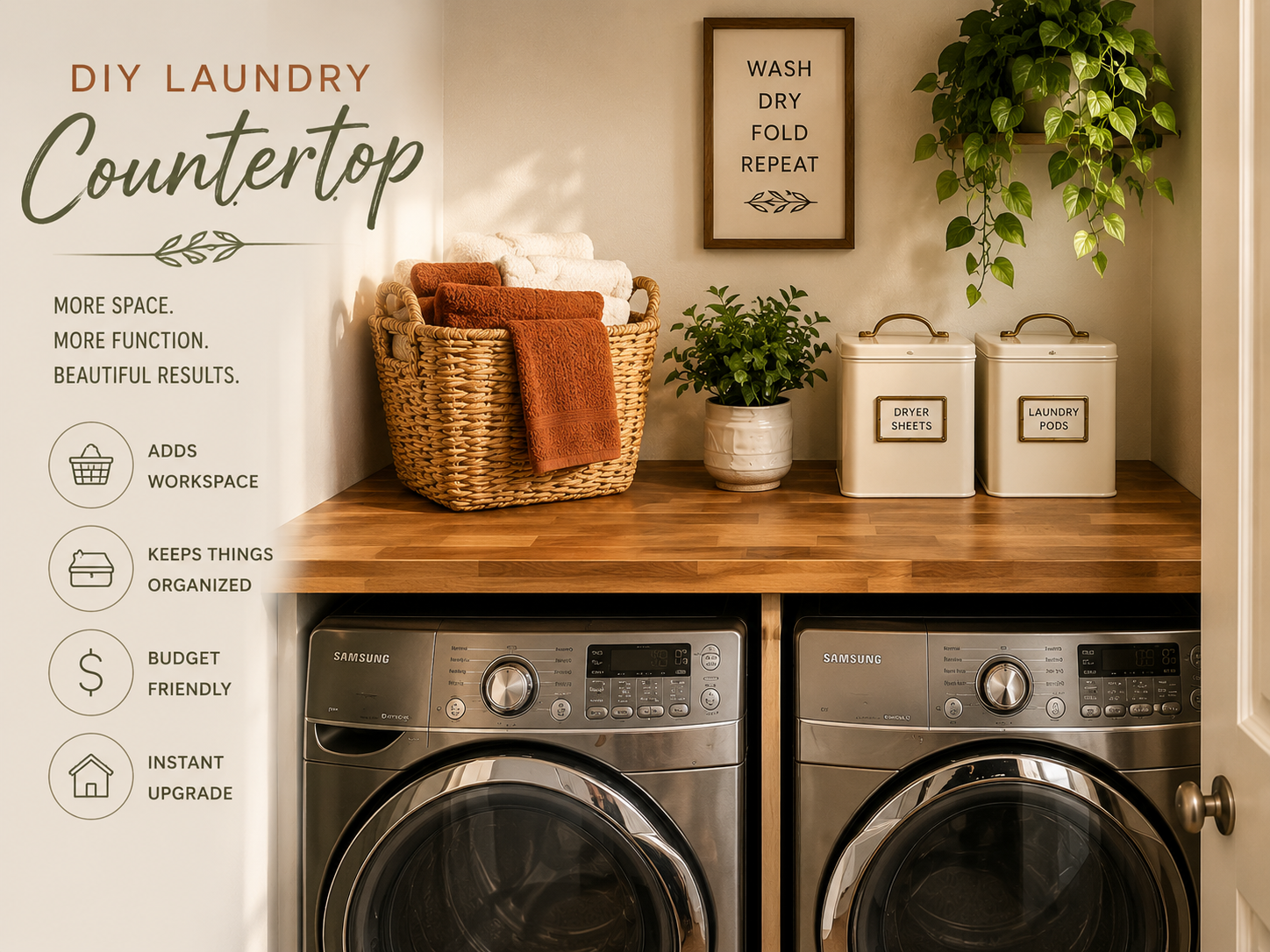
If there’s one change that outperforms everything else on this list, it’s a counter surface installed directly over the machines. Almost nobody has one, and almost everybody who gets one says the same thing afterward: it’s the difference between the laundry room being a room and being a hallway with appliances in it. A cleat-mounted or leg-supported countertop — laminate, butcher block, or a stone-look laminate that mimics quartz — turns the top of the washer and dryer into a folding surface, a staging area for hampers, and a spot to actually set down what you’re carrying instead of piling it on the floor. The trade detail most people miss: leave a genuine gap, not a tight fit, between the underside of the counter and the top of the machines, since front-load washers vibrate more than people expect on the spin cycle, and a counter fastened too snugly will rattle or crack a seam within a year. A basic laminate version runs $150 to $400 in materials for a standard-width installation; a stone-look or butcher block upgrade runs $400 to $900.
Lighting is the second-most underestimated fix, and it’s rarely about adding more of it — it’s about adding the right temperature of it. Most basement and closet laundry spaces are still lit by a single warm-toned bulb that was chosen for the price, not the job. That warm cast is exactly why you can’t see a coffee stain or a grass mark until the shirt has already gone through a full dry cycle and set the mark permanently. Swapping to a daylight-temperature LED in the 4000K to 5000K range, plus a slim LED strip mounted under the shelf directly above the machines, gives you actual working light where you’re sorting and treating stains — for under $60 in most cases.
Ventilation and dampness are the problems that don’t show up until they’ve already caused damage. A dryer vent run that’s too long, has too many bends, or hasn’t been cleaned in years restricts airflow, which lengthens drying time, raises your energy bill, and is a documented fire risk that most homeowners never think about until something goes wrong. In a basement specifically, add a compact dehumidifier sized to the square footage of the space, not the whole basement — running an oversized unit on a small area wastes electricity and won’t actually pull the corner-specific humidity you’re fighting. If the concrete floor stays consistently damp regardless of dehumidification, that’s no longer a laundry room project; it’s a foundation or grading issue worth a proper inspection before you spend another dollar on finishes.
Storage is where good intentions go to die, because open shelving without a system becomes a dumping ground within a month. The fix isn’t more storage — it’s zoned storage with a lid. Lidded bins for lint rollers, stain treatments, and dryer sheets keep the counter clear; a wall-mounted rod or retractable line handles hang-drying without permanently claiming floor space; and a single labelled bin for “odd socks and mystery buttons” acknowledges reality instead of pretending it away. The goal is that everything has one home, and putting it away takes the same three seconds as leaving it out.
Ordering the counter brackets, the LED strip, and the lidded storage bins separately means three separate delivery windows. Prime’s free two-day shipping means they land together, so you’re not staging a weekend project around whichever box shows up last.
Try Amazon Prime →This is a referral link — if you sign up, NestDigest may earn a small commission at no extra cost to you.
Budget realistically, and pick the tier that matches what’s actually broken, not what looks best in photos. The $200 version — paint, a curtain instead of a door, a daylight bulb swap, and a proper storage bin system — fixes the visual and organizational problems without touching plumbing, electrical, or carpentry, and it’s genuinely doable in a single weekend. The $700 version adds a moisture-tolerant floor surface and a basic laminate counter, which is where most of the functional transformation actually happens. The $2,000 version brings in a full stone-look counter, proper cabinetry instead of open shelving, and a dedicated ventilation or dehumidification upgrade — this is the tier worth considering if the space also needs to double as mudroom or pantry overflow, since managing humidity properly across the whole basement pays off in more rooms than just this one.
Concrete floor paint or a moisture-tolerant rug, a tension-rod curtain instead of a door, a daylight-temperature LED swap, and a lidded storage bin system. No tools beyond a paintbrush and a drill.
Everything in the $200 tier, plus a basic laminate countertop over the machines, an under-shelf LED strip, and a compact dehumidifier sized to the space.
A stone-look or butcher block counter, proper wall cabinetry in place of open shelving, upgraded dryer venting, and finished flooring throughout the zone.
None of these tiers require a permit or a contractor unless you’re moving plumbing or running new electrical — and that’s the actual differentiator worth remembering. The homes that get this room right aren’t the ones with the biggest laundry budgets. They’re the ones that stopped treating the space as an afterthought and gave it the one thing every other room in the house already has: a surface to work on, light that shows the truth, and a place for everything that isn’t the floor.
COMMON QUESTIONSHow much does a budget laundry room makeover cost?
A realistic weekend refresh runs $200 to $700 using paint, lighting, and organization changes to what’s already there. Adding a countertop and real storage typically brings the total to $1,500–$2,500. Full basement laundry conversions with framing and plumbing changes run considerably higher.
Can I put a countertop over my washer and dryer without hiring a contractor?
Yes, for most stacked or side-by-side setups. A cleat-mounted or leg-supported countertop is a manageable DIY project in a weekend, as long as you leave clearance for vibration and don’t fasten it directly to the machines.
What should I do about a damp basement laundry room?
Start with a small dehumidifier sized to the space, confirm the dryer vent run is short and clear, and add a moisture-tolerant floor surface. Persistent dampness after those three fixes usually points to a foundation or grading issue that needs a proper inspection.
What’s the single highest-impact change in a small laundry space?
A counter surface over the machines. It replaces the habit of folding on top of the dryer or hauling baskets elsewhere, and it’s the one change that makes the room function like a room instead of a utility closet.
The most honest room in a house is the one where the work actually happens.
— NestDigest