
Why One Handcrafted Piece Does More for a Room Than Ten Trend Buys
There’s a quiet confidence to a room built around one truly considered thing. Here’s why artisan home decor ideas almost always outperform a cart full of coordinated accessories — and how to find your one beautiful piece.
There’s a moment most of us have experienced: standing in the middle of a room we’ve decorated with real care, looking around at the layered shelves and the coordinated cushions and the accent pieces we chose on sale, and feeling — nothing. Not dissatisfied, exactly. Just untouched. The room is full, and somehow still empty.
That feeling has a specific cause. It’s not a styling failure. It’s a presence problem. And the best artisan home decor ideas aren’t really about committing to a particular aesthetic or chasing a trend cycle. They’re about finding one thing in a room that has genuine authority — something with weight and story and a quality the eye returns to. In 2026, the most compelling shift in interior design isn’t toward bold pattern or sculptural form (though both are having their moment). It’s subtler than that: a growing preference for spaces that feel collected rather than decorated, gathered rather than purchased.
Mass-produced home accessories are engineered to disappear. They coordinate. They don’t offend. They slot into a colour story and hold their place on a shelf without demanding a second look. That’s precisely the problem. A room full of things designed to be inoffensive ends up feeling like a stage set — technically correct and emotionally vacant. No amount of careful arrangement will fix that. You can’t style your way around the absence of something real.
A room full of things designed to be inoffensive ends up feeling like a stage set — technically correct and emotionally vacant.
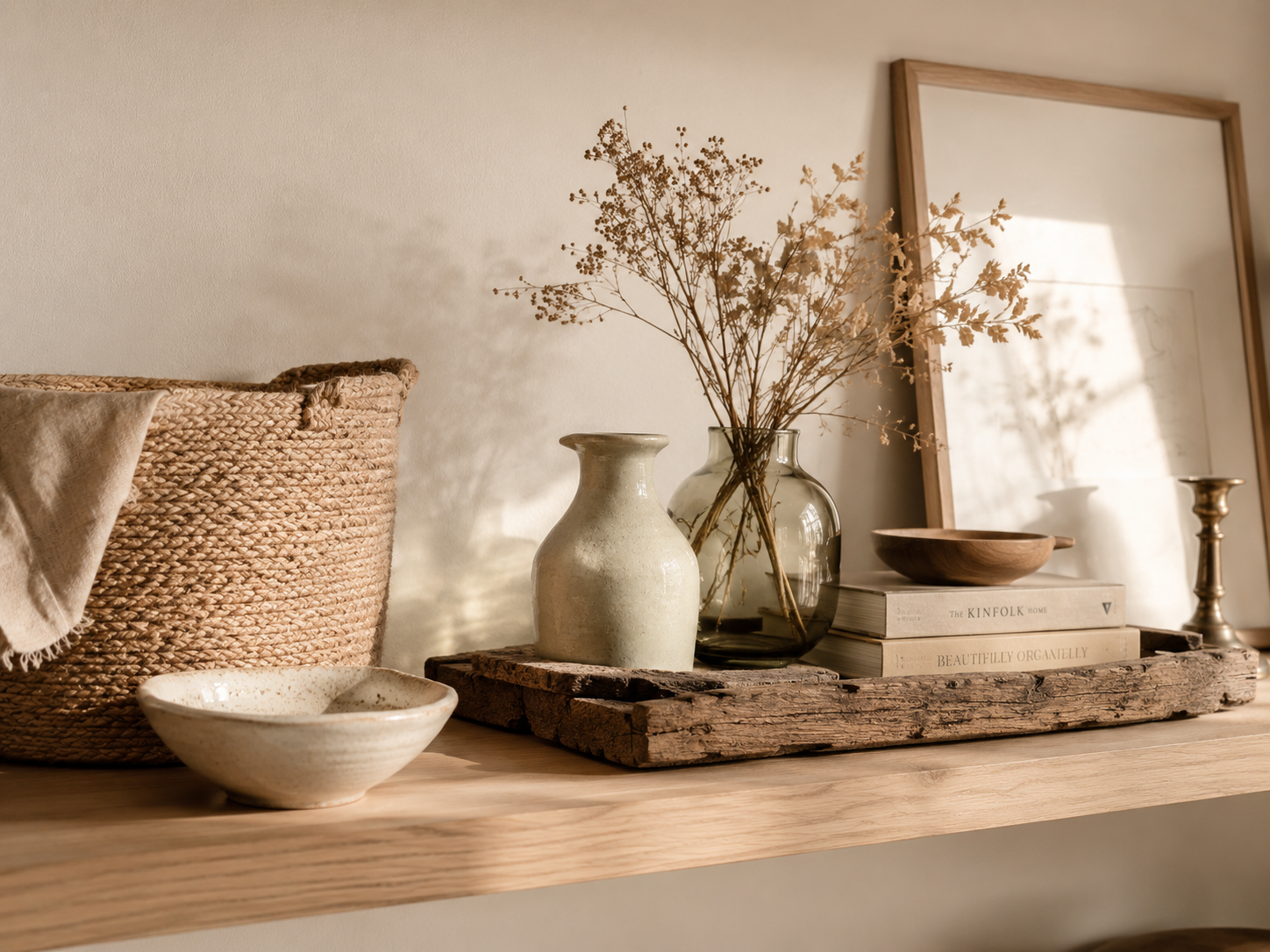
A handcrafted or naturally made piece operates on a different frequency. The slight irregularity in hand-thrown pottery. The uneven grain of reclaimed wood. The way natural fibres — jute, cotton, raw linen — catch light at different angles throughout the day. These qualities read as real to the eye even when we don’t consciously register why. There’s something in the human brain that responds to evidence of other human hands, to the marks that machine production eliminates. That’s the foundation of artisan home decor: not beauty as a category, but presence as a feeling.
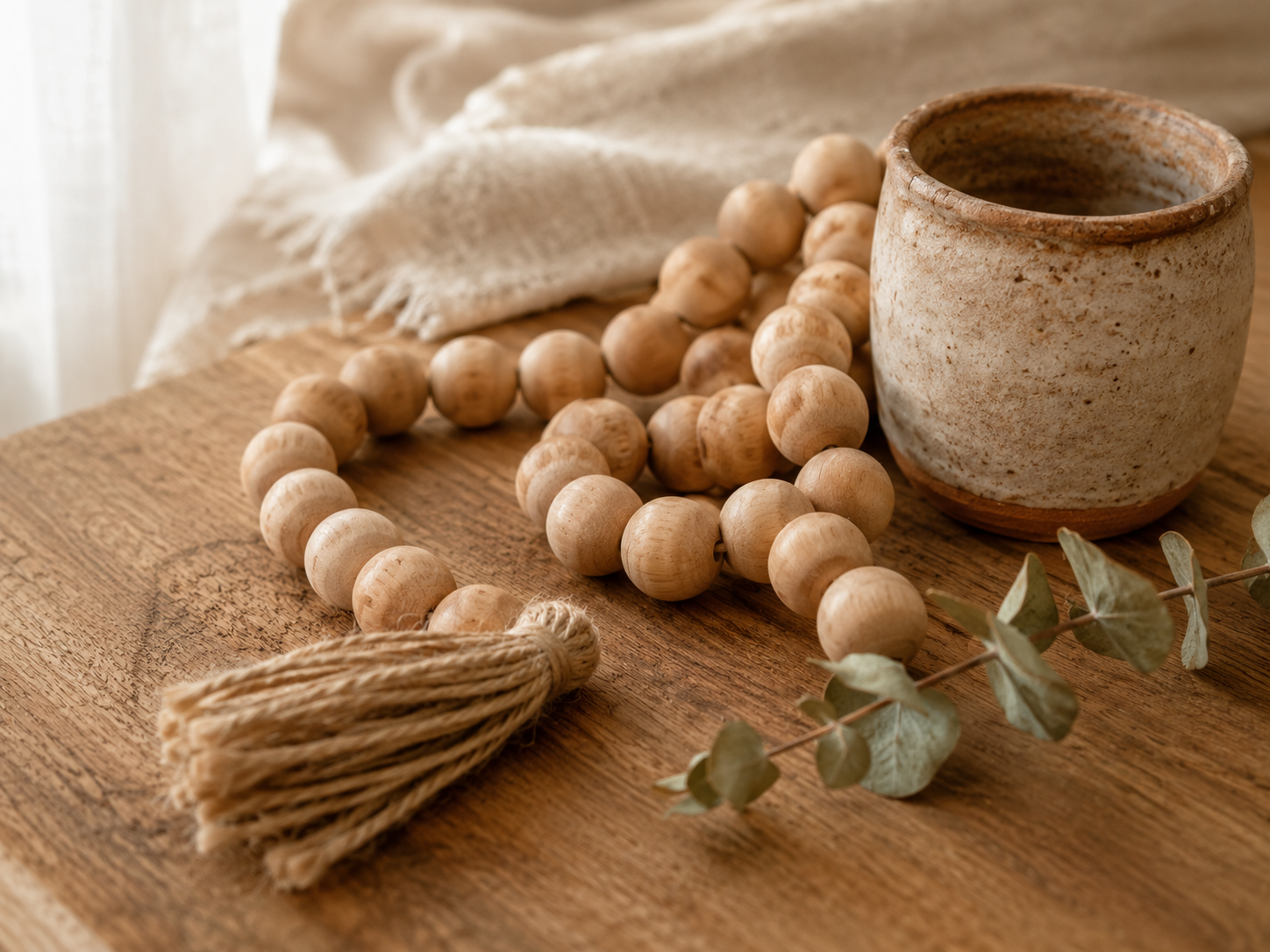
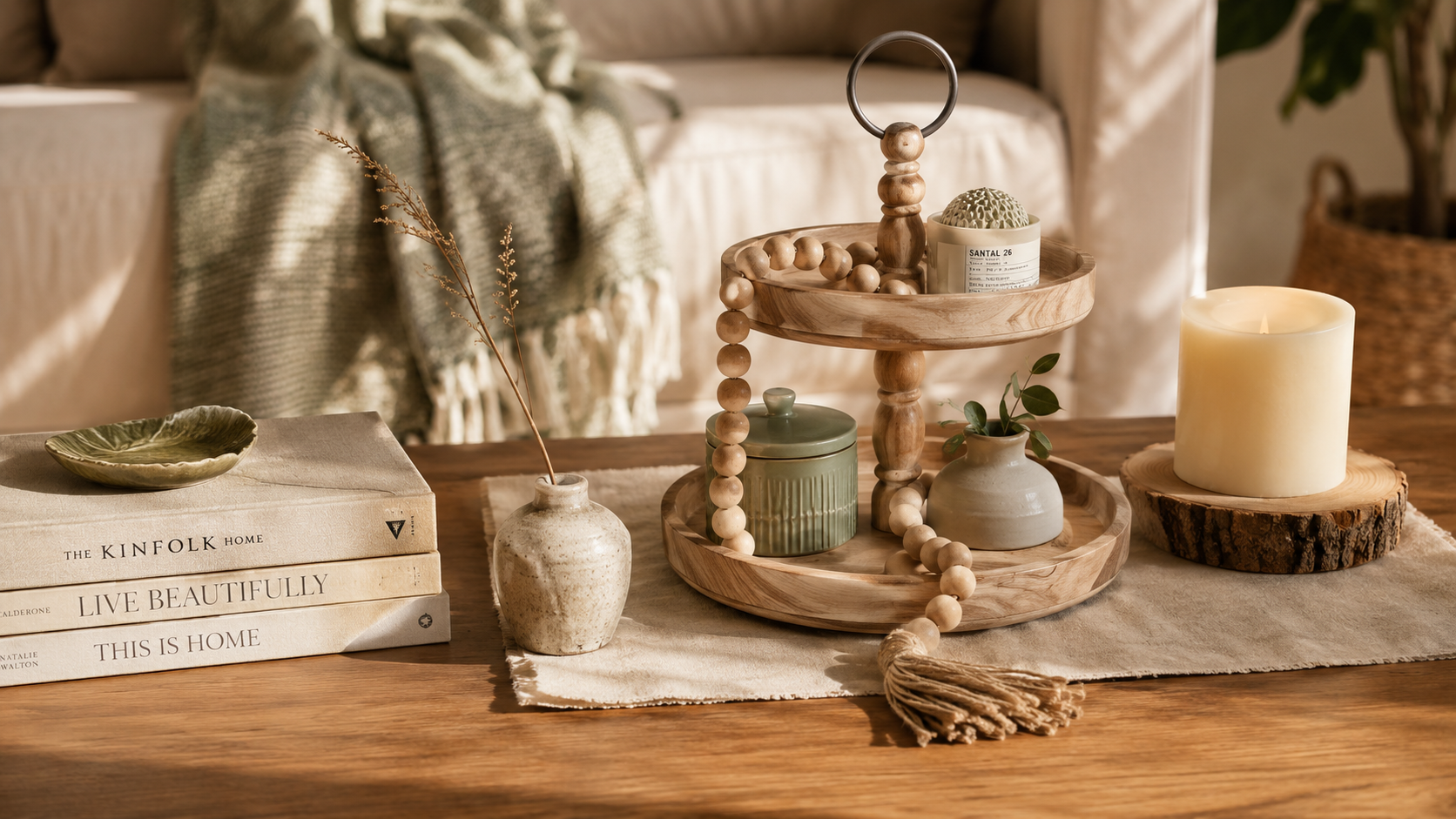
One of the most accessible entry points into this idea is a simple wood bead garland — and it’s worth taking seriously as a design tool rather than dismissing it as rustic kitsch. A strand of natural wooden beads, draped across a coffee table, looped around a candle holder, or anchored at the base of a styled tray, introduces handmade texture and warm organic tones without asking much of the space around it. The Syyflibb 58-inch wood bead garland — natural finish, cotton tassel, 58 inches long — is exactly this kind of piece. It works on tiered trays, draped over a vase grouping, along a mantle, or pooled softly behind a stack of linen-covered books. At its price point, it’s the rare find that looks like it cost considerably more. What makes it work is the same thing that makes all good artisan home decor work: it looks like something someone made, because it is.
Beyond garlands, the artisan home decor ideas with the most staying power tend to fall into a few reliable categories. A single piece of handmade ceramic — a low, wide bowl; a textured bud vase; a mug displayed as an object rather than used as one — brings the kind of warmth that a factory-produced version simply cannot replicate. Woven baskets made from natural jute, seagrass, or water hyacinth add both function and an organic softness that no amount of styled textile can achieve on its own. A small piece of reclaimed wood — a tray with its rough edges intact, a short shelf plank, even a thick cutting board used as a display surface — grounds a vignette in a way that makes everything arranged on or around it look more deliberate. None of these need to be expensive. They need to be considered.
The mistake most people make when they go looking for artisan home decor ideas is searching for a style to adopt wholesale. Farmhouse, Japandi, coastal grandmother — these are useful orientation points, but they can lead you toward buying a look instead of a feeling. A more useful question to ask, standing in front of any piece you’re considering: does this look like someone made it? Does it have a quality I couldn’t have predicted from ten feet away? Does it hold up under a long look, or does it fall apart one? If the answer to those questions is yes, you’re holding something worth bringing home. If it looks identical to six other versions on the same shelf, leave it. That piece was designed to be purchased, not to be kept.
The rooms that stay with us — the ones we photograph in someone else’s house, the ones we reconstruct in our minds long after leaving, the ones we’re always trying to recreate in our own spaces — almost never get there through abundance. They get there through one thing that earned its place. Find that thing. Give it room to breathe. Let everything else settle quietly around it, and watch what the space becomes.
The loveliest rooms are not decorated — they are gathered, slowly, the way a life is.
— NestDigest