Your Room Should Look Like
You Made a Decision
Dopamine decor, curated chaos, warm minimalism — the rules of room design have officially been rewritten. Here’s what it actually means to make a space that feels like you in 2026.
There was a moment — somewhere between the tenth all-grey Pinterest board and the second “agreeable greige” paint swatch — when an entire generation collectively looked at their living rooms and thought: this is not me at all.
For years, the dominant design language was restraint. Neutral walls. Matching furniture. Spaces that looked beautiful in listing photos and completely hollow to live in. It was the aesthetic of apology — rooms that tried not to offend anyone and, in doing so, inspired no one.
That era is over. And what’s replacing it is something far more interesting: rooms that are actually inhabited.
Millennials started it — slowly swapping out the grey for terracotta, the IKEA basics for thrifted finds, the sterile for the storied. Gen Z took it further, way further, turning their rooms into full expressions of self that wouldn’t look out of place in a gallery or on a For You page. Together, these two generations have fundamentally shifted what “home design” means. It’s no longer about impressing guests. It’s about feeling like yourself every time you walk through the door.
So what does that actually look like in 2026? It depends on who you are. But it always starts with one thing: a decision.
The vocabulary of interior design has completely changed. Where we once talked in terms of “styles” — modern, traditional, transitional — we now talk in aesthetics. And the difference matters. A style is a category. An aesthetic is a feeling. It’s a mood board, a vibe, a whole worldview expressed through the objects you choose to live among.
Right now, the aesthetics dominating North American living spaces fall into a few distinct but overlapping families — and understanding them is the key to figuring out which direction your room wants to go.
The rebellion against beige. Bold colour, joyful objects, mismatched pattern — chosen not because they coordinate, but because they feel good. Terracotta next to cobalt. A cherry-red velvet sofa in a room with mustard curtains. The goal is a serotonin boost every single morning.
Gallery walls floor to ceiling. Books stacked like sculpture. Collectibles, plants, vintage finds — every surface filled with intention. It looks abundant, but it’s deeply edited. Nothing is there by accident. Everything tells part of the story.
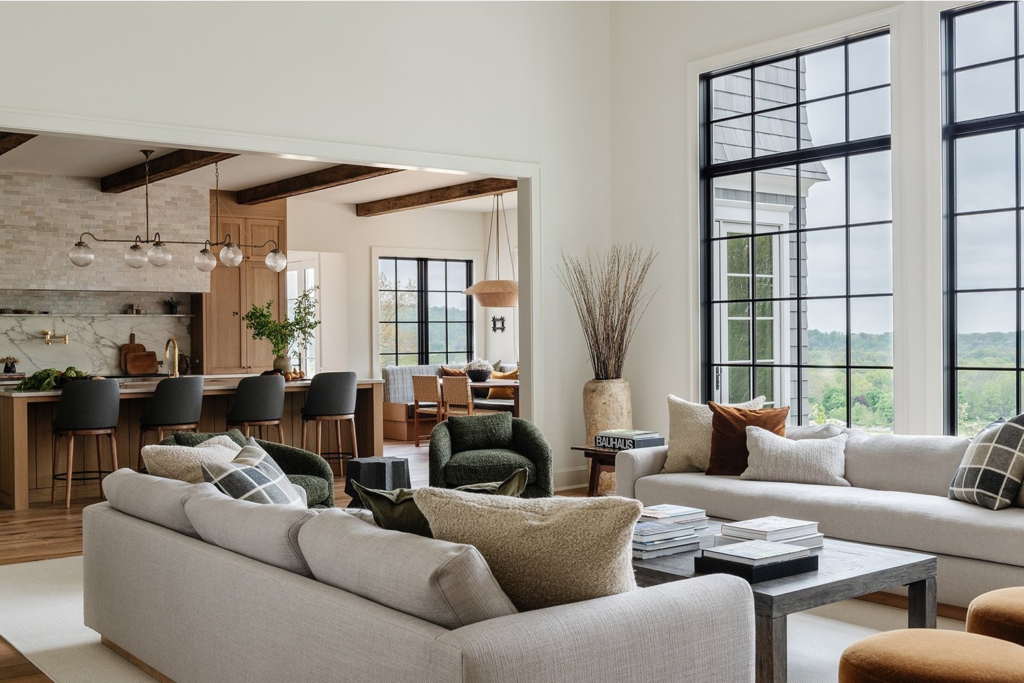
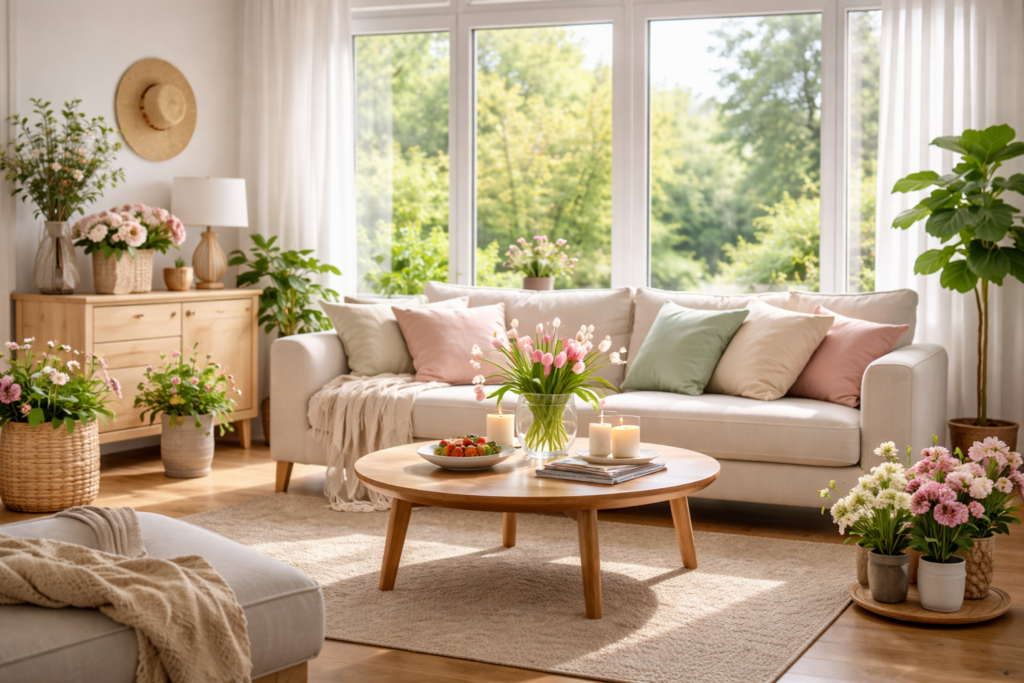
Minimalism finally grew up and got cozy. Japandi, wabi-sabi, quiet luxury — these are variations on the same idea: simplicity that breathes. Linen, walnut, handmade ceramics. Spaces that feel calm because they’re considered, not because they’re empty.
Deep forest greens. Burgundy velvet. Stacked books and candlelight. This is the aesthetic of the person who wants their room to feel like a Victorian library had a TikTok phase. Moody, intentional, completely unapologetic.
Y2K objects. Retro tech as decor. Childhood toys on open shelves, styled like art. This isn’t hoarding — it’s archaeology. Gen Z is treating memory as material, building rooms that feel like emotional time capsules.
Not just a plant in the corner. Full integration — indoor trees, limewash walls, exposed wood beams, stone accents. The goal is to bring the exhale-worthy feeling of being outside, inside. Nature isn’t decor here. It’s architecture.
The beautiful thing is that these don’t have to be mutually exclusive. The most interesting rooms in 2026 are the ones that sit at the intersection — the dark academia bedroom with a biophilic corner, the warm minimalist living room with one dopamine-charged wall. The blending is the point. It’s how you make something that doesn’t look like anyone else’s room.
Colour is the single most powerful tool in any room — and it’s also the thing most people get wrong by playing it too safe. The fear of commitment leads to the beige spiral: you pick a neutral, then another neutral to complement it, then a third to bridge them, and suddenly your room looks like a luxury hotel and feels like nothing.
In 2026, colour is being treated as a structural decision, not a finishing touch. The palette trending across Canada and the US right now tells you everything about the mood of the moment.
These are not accent colours. They’re room decisions. Terracotta on an entire wall — not a pillow. Cobalt as a ceiling colour — not a vase. The shift from “use colour sparingly” to “commit to the colour” is the biggest change in residential design in a decade.
The most sophisticated approach right now is tone-on-tone contrast — working within one colour family but varying the depth and material. A room done entirely in blues: navy velvet sofa, powder blue linen curtains, steel-blue-grey ceramic lamp. The contrast comes from material and saturation, not from introducing a new hue. It’s understated and wildly effective.
On the topic of contrast — the real rule
Contrast doesn’t mean opposite. It means tension. The best rooms create visual tension between elements — something heavy and something light, something smooth and something textured, something old and something new. That tension is what makes a room feel alive rather than assembled.
A rough limewash wall behind a sleek marble lamp table. A weathered vintage dresser under crisp, modern pendant lighting. A maximalist gallery wall in a room with otherwise spare furniture. These combinations work because the contrast is intentional, not accidental.
This is where the design conversation gets personal, and it’s where most advice falls flat. Because the truth is: no trend can tell you who you are. What trends can do is give you a language. And once you have the language, you can start to speak in your own accent.
The rooms that feel the most magnetic — the ones you walk into and immediately want to know the person who lives there — share a handful of qualities that have nothing to do with budget and everything to do with intention.
- They have a point of view. The person made choices. You can tell what they like and what they don’t. The room has an opinion.
- They have texture you want to touch. Boucle, linen, raw wood, handmade clay. Something in the room rewards the hand, not just the eye.
- They have lighting that does work. Not one overhead fixture that flattens everything. Layered light — warm, low, directional — that changes how the room feels at different times of day.
- They have things that don’t match perfectly. The thrifted find next to the new piece. The handmade next to the designed. Perfection reads as staging. Imperfection reads as life.
- They have exactly one thing that makes no logical sense — a vintage motorcycle helmet on a shelf, a neon sign in a very Japandi room — and it’s somehow the best part.
The checklist matters less than the principle behind it: your room should have evidence of a real person living in it. Not a mood board. A life.
Theory is fine. But most people reading this are standing in a room that doesn’t feel right, trying to figure out where to start. Here’s the honest answer: start with the thing that bothers you most, and fix that one thing well.
Not everything at once. Not a full renovation. One wall repainted in a colour you’ve been afraid of. One lamp replaced with something sculptural and warm. One piece of furniture moved to an unexpected corner. The room will tell you what it wants next.
If you’re paralyzed by the options — which is a completely reasonable response to scrolling through 47 aesthetics on Pinterest — try this instead: pull out three objects you genuinely love. Not things you think you should love. Things you actually do. Look at what they have in common. That’s your aesthetic. Build from there.
For renters across Canada and the US (which is most of us), the glow-up has to work around permanent changes. The good news is that 2026’s most effective design moves are almost entirely renter-friendly: peel-and-stick limewash wallpaper, removable paint panels, layered textiles, statement lighting swaps, and gallery walls assembled with picture rails or command strips. You don’t need to own the walls to own the space.
Every year there’s one trend that rises above the others — not because it’s the most visually dramatic, but because it’s the most fundamentally right. In 2026, that trend is designing for how a room feels, not just how it photographs.
Post-pandemic, people spent more time at home than any generation since before the industrial revolution. They noticed whether their spaces made them feel anything. A lot of people noticed the answer was no. The entire current wave of interior design — the dopamine decor, the curated chaos, the warmth-first minimalism, all of it — is the active response to that realisation.
Your room doesn’t need to be a set. It needs to be a place where you can actually breathe, actually work, actually rest, actually feel like yourself at the end of a hard day. That’s a higher bar than aesthetic perfection. It’s also more achievable, because it’s entirely personal.
“Rooms that feel right share one thing: someone, at some point, looked at the space and asked — what do I actually want this to feel like? The answer to that question is the whole design.”
So. What do you want your room to feel like?
Start there. Everything else follows.