
How to Plant Garlic in Fall: An Ontario October Planting Guide
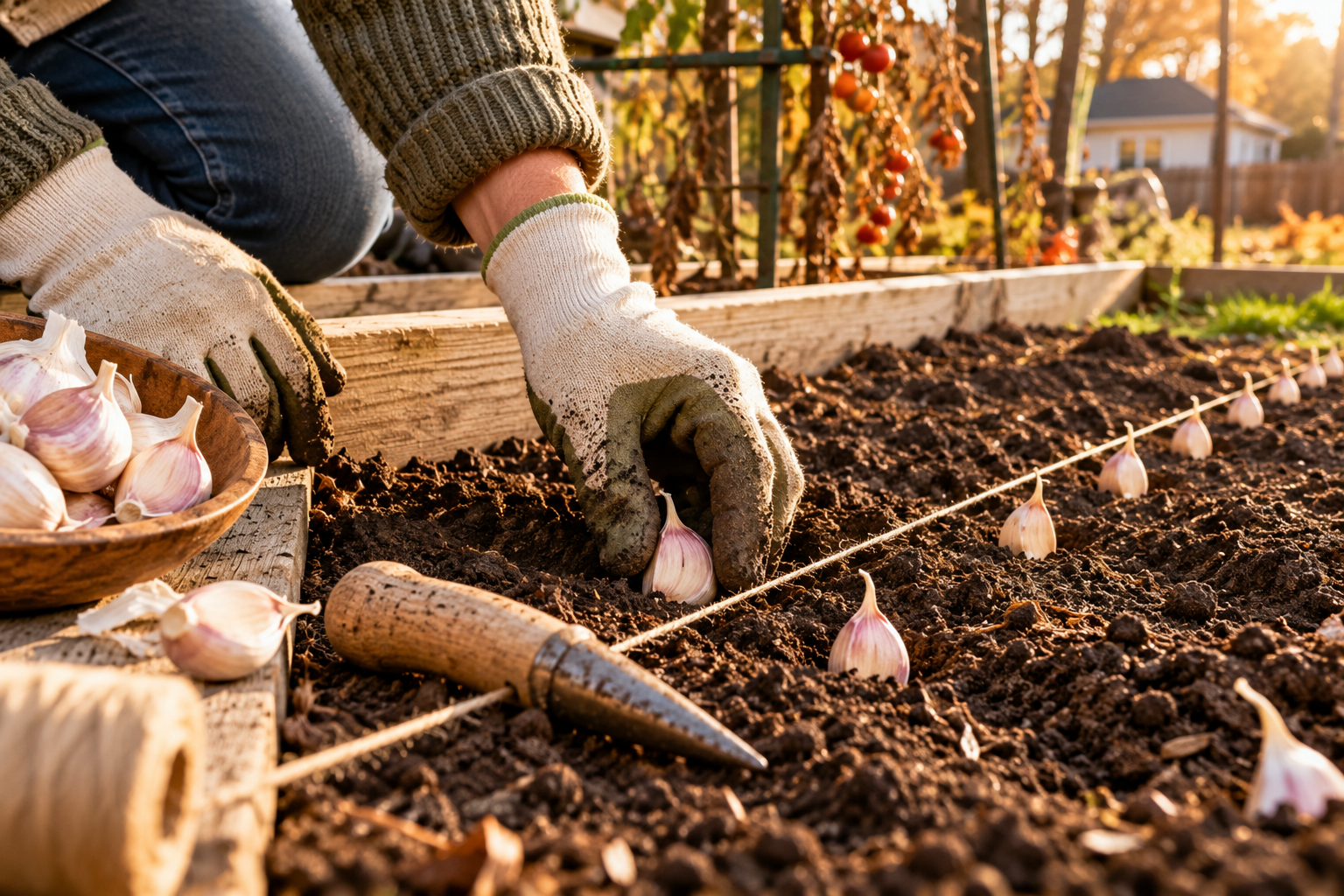
The short answer on how to plant garlic: split the bulb into cloves, set each clove pointed end up in a sunny, well-drained bed, and cover it with a few
of soil sometime between September and freeze-up. In cold-winter regions such as Ontario, planting garlic in fall is standard practice, and October is the traditional month for it, though new Ontario research suggests earlier planting often does better. No single date works across the province, because frost timing and soil conditions change between Windsor and Thunder Bay.
The goal is a strong root system before winter. Garlic planted early may produce leaves before freeze-up, but recent Ontario field trials suggest that some fall top growth doesn’t necessarily reduce winter survival or yield.
Garlic Planting at a Glance
| FactorWhat to doBest planting season | Fall, before the ground freezes. Garlic needs winter cold to form a proper bulb. | Typical Ontario planting period | September through October; October is the traditional month. Into early November in milder southern areas if the soil is still workable. | Sun | Full sun. | Soil | Fertile, well-drained, rich in organic matter; pH roughly 6 to 7.5. | Clove orientation | Pointed end up, flat root end down. | Planting depth | About 2.5–5 cm (1–2 in) of soil over the clove: at least 2.5 cm in heavy soil, around 5 cm in light soil. | Clove spacing | 10–15 cm (4–6 in) apart in the row. | Row spacing | At least 20 cm (8 in); 25–30 cm (10–12 in) is common and easier to weed. | Mulching | Yes, for Ontario winters: 10–15 cm (4–6 in) of loose, clean straw, or shredded leaves. | Approximate harvest | Mid-summer the following year, usually July into early August. |
|---|
When Is the Best Time to Plant Garlic?
Plant garlic in fall. October is the traditional and practical month across much of Ontario, but current Ontario research gives gardeners more room to plant earlier, in September. The bigger risk is waiting too long.
Garlic needs winter cold to start its growth cycle, which is why the Ontario Ministry of Agriculture treats it as a winter annual: planted in fall, harvested the following summer. The
calls timing critical in both directions. Cloves planted too late may not grow enough roots to be winter hardy, while cloves planted too early or too shallow can push shoots above ground that are then prone to winter injury.
The newest evidence leans toward earlier. From 2022 to 2025, provincial vegetable specialists ran a garlic planting-date trial at
, in southwestern Ontario, with seven planting dates from late August to early December. The later the garlic went in, the greater the risk of lost yield the following July. Planting around the first fall frost gave roots time to establish with little top growth. Planting a month or more earlier produced several leaves before winter, yet in the first two years the earliest plantings had the best winter survival and yields; a slight, statistically insignificant dip appeared in year three. The province’s August 2026 vegetable crop report now tells growers to consider September rather than October.
Keep the caveats in view. That was a commercial trial on one farm, and the advice is aimed at growers. Early planting also isn’t careless planting: the
links planting in warm soil to worse clove rot, and the trial’s authors ask whether stock was healthy and whether bulbs were cracked more than a week before planting when early plantings failed. If it’s already October, you haven’t missed anything; just don’t keep putting it off. Soil that drains slowly, such as heavy clay, benefits most from an early-September start, because it takes longer to dry out.
That also explains why a fixed “October 15” shouldn’t be treated as universal. One Ontario seed grower calls mid-October the usual target but accepts any day from early October until the ground freezes, and the research suggests that range can start earlier.
When to Plant Garlic in Ontario
In Ontario, plant garlic from September through October, into early November in milder southern areas if the soil is still workable. Northern gardeners should plant in September.
| Region (examples)Historical first-frost referencePractical NestDigest guidance (editorial)Southwestern Ontario (Windsor, London) | Zone A averages first frost around October 20; the |
|---|
| trial site averages October 13.September to late October works; the |
| trial supports starting in September. | Southern Ontario / GTA (Toronto, Kitchener-Waterloo) | Toronto Master Gardeners advise planting four to six weeks before the soil freezes, by the end of October in the GTA.Late September to mid-October is comfortable; treat the end of October as the later edge. | Central Ontario (Barrie) | No single figure. OMAFRA notes elevation, slope and nearness to water all shift local frost timing.Check your nearest station’s first-frost average and plant in September to early October. | Eastern Ontario (Ottawa) | The provincial |
|---|
| notes many Eastern Ontario growers mulch garlic for winter.Late September to mid-October, with mulch as part of the job. | Northern Ontario (Sudbury, Thunder Bay) | The shortest-season zones (E to I) average first frost between September 9 and September 26.Plant in September; don’t wait for October. Snow cover and mulch matter more here. |
|---|
The middle column is published data; the right column is editorial judgement built on it. I haven’t assigned individual cities to OMAFRA’s climate zones because the zone lines are approximate. Gardeners in the northern United States can use the same approach with their own first-frost date.
Choose the Right Garlic to Plant
Seed garlic is garlic grown and sold for planting: a named variety from a grower who knows its health history. It matters because garlic is propagated by cloning. Every clove is a copy of its parent, so any virus, nematode or rot travels with it. Ontario’s
says virtually all garlic carries latent viruses, and that diseased bulbs used for planting are the primary source of penicillium mould in planted cloves.
Buy from a local grower or reputable Canadian supplier; the Garlic Growers Association of Ontario and Seeds of Diversity’s Great Canadian Garlic Collection are the two resources OMAFA lists. Choose firm bulbs with intact skins and no soft spots, and keep them whole until planting day.
vs
Garlic
garlic grows a stiff central stem and sends up a flowering stalk called a scape in early summer.
garlic has no scape and a flexible neck. Variety choice deserves a guide of its own; this is the short version.
| TraitHardneckSoftneckCold tolerance | More winter hardyLess hardy; does better in mild climates | Scapes | Yes, in early summerNo (usually) | Cloves | Fewer (about 4–12), largerMore (about 8–12), smaller | Flavour | Varies by variety more than by type; often described as more robustGenerally milder | Storage at room temperature | Up to about 4 monthsUp to about 8 months | Ontario suitability | The usual choice for Ontario gardensGrown in Ontario, but a riskier bet through harsh winters |
|---|
The hardneck groups OMAFA lists for Ontario are Rocambole, Porcelain and Purple Stripe. Porcelain types produce large cloves and want the widest spacing.
groups grown in the province include Silverskin and Artichoke.
Can You Plant Grocery-Store Garlic?
It can sprout and grow, so it isn’t off-limits. You just can’t know its variety, health or winter hardiness.
Toronto Master Gardeners advise against it, noting that supermarket bulbs may have been treated to prevent sprouting and may not suit the Ontario climate. The deeper issue is disease: penicillium, nematodes and white rot all spread on infected planting stock, and white rot can persist in soil for decades. For a permanent vegetable garden, reputable seed garlic is the safer choice.
Where Should You Plant Garlic?
Choose a full-sun spot with good drainage where water never pools.
Drainage matters more than any other factor, because cloves sit in cold soil for months. Pooled water promotes fungal infections, and soils prone to excessive frost heaving, where freeze-thaw cycles push shallow plants up and out, are a poor choice. A bed that holds good snow cover and has some wind protection helps winter survival. In heavy, slow-draining ground, a raised bed is the easy fix.
Think about what grew there before. Don’t plant garlic where onions, leeks, shallots, chives or garlic grew in the last three to four years; the provincial
recommends a three-year rotation against bulb and stem nematode, and Toronto Master Gardeners suggest at least four. Planting garlic right after fall vegetable garden cleanup suits the calendar nicely: tomato and pepper beds are empty, and non-allium crops make good predecessors.
How to Prepare Soil for Planting Garlic
Garlic grows in a wide range of soils, but it rewards a little preparation.
- Loosen and enrich. Fork the bed over to about 15 cm (6 in) and work in compost. Ontario’s
- prefers soils high in organic matter, which hold moisture and nutrients and resist crusting.
- Clear the weeds. Garlic is a weak competitor, so pull perennial weeds now rather than in June.
- Skip guesswork on fertilizer. OMAFA says Ontario fertilizer recommendations for garlic aren’t fully determined and advises a soil test for phosphorus and potassium. Without one, compost is enough.
- Heavy clay: very heavy soils hinder bulb expansion, so lighten them with compost or plant in a raised bed.
- Light, sandy soil: it dries quickly and needs more attentive watering. Add compost and plant a little deeper.
- Finish level. Rake the surface smooth so depth and spacing are easy to judge.
How to Plant Garlic Step by Step
Break the bulb into cloves, plant each one pointed end up in loosened soil at the right depth and spacing, cover and firm, water only if the soil is dry, then mulch.
Step 1 — Separate the Garlic Bulb Into Cloves
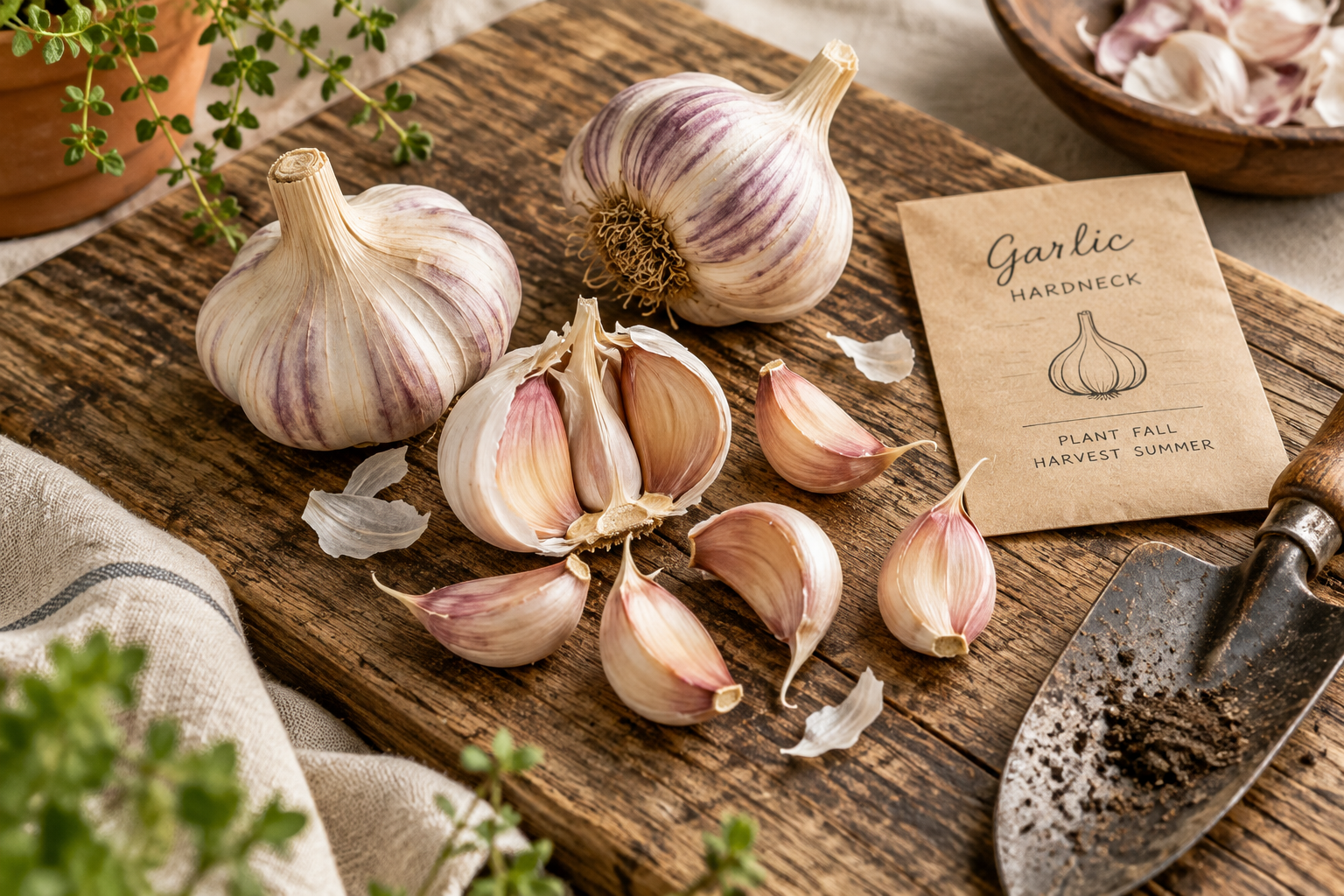
Do this shortly before planting, ideally the same day, and plant individual cloves, not the whole bulb. Dry bulbs break apart more easily than damp ones. Keep the papery skin on each clove and don’t tear the basal plate, the flat disc at the base where roots form; wounded cloves are especially vulnerable to penicillium mould. Plant only plump, firm cloves without nicks or soft spots, and keep the biggest for the garden and the smallest for the kitchen.
Step 2 — Place the Clove Pointed End Up
The pointed tip goes up and the flat root end goes down.
The tip is where the shoot will emerge; the basal plate is where roots grow. A clove planted upside down will still develop, but Ontario’s
says it often produces a curved shoot and a misshapen bulb. Sideways cloves usually recover too, according to one Ontario grower, though tip-up gives the most reliable result.
Step 3 — Plant Garlic at the Right Depth
Cover each clove with about 2.5–5 cm (1–2 in) of soil, measured from the clove’s tip to the surface: at least 2.5 cm in heavy soil, around 5 cm in light soil.
Too shallow, and the clove faces frost heaving and shoots exposed to winter weather. Deeper planting adds winter protection but has a cost: the shoot spends more energy pushing up, bulbs may come out smaller, and cloves in wet clay can rot. An Ontario seed grower working heavy clay calls anything past 7.5 cm excessive. Mark your trowel or dibber at the depth you want so every hole matches.
Step 4 — Space Garlic Cloves Properly
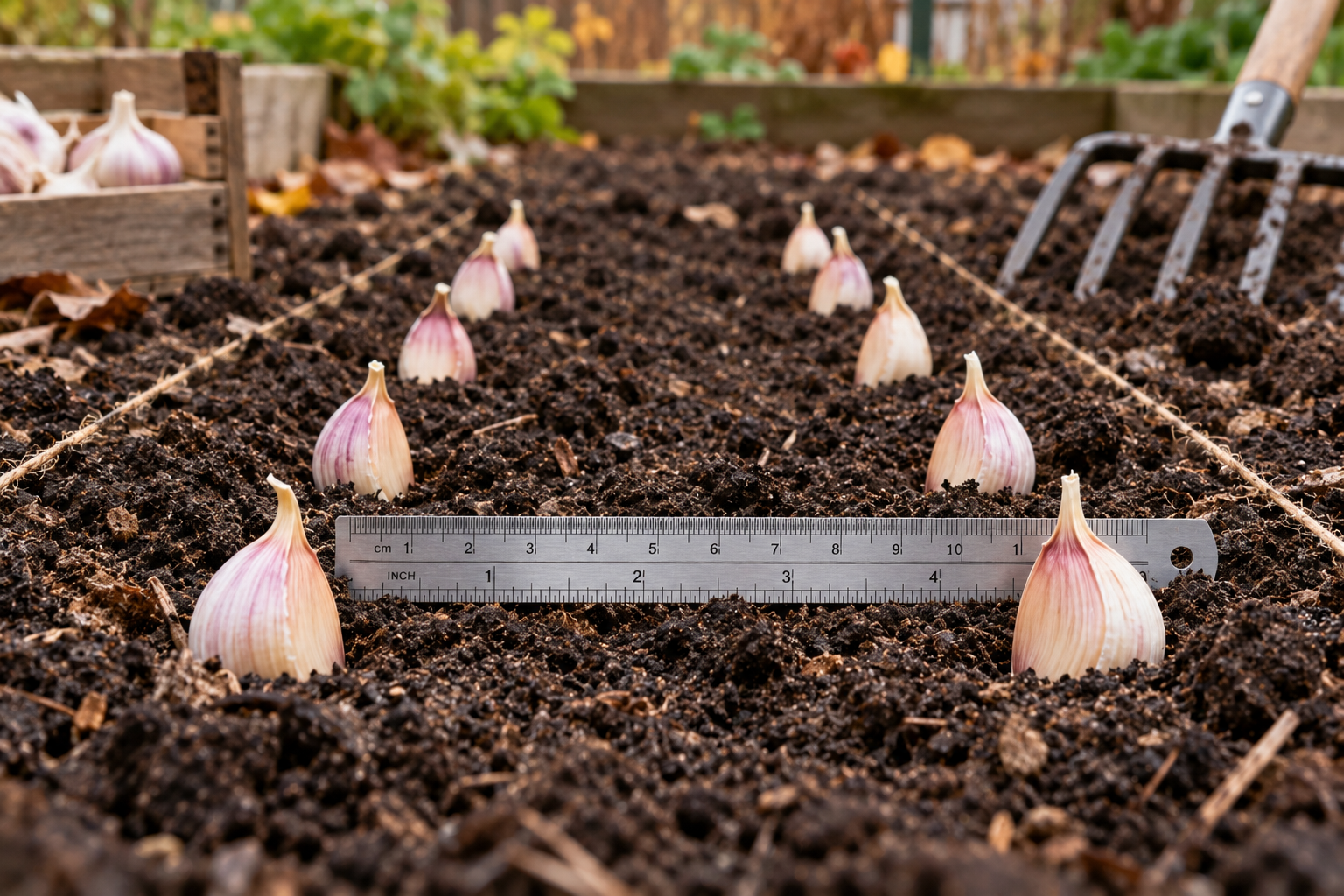
Plant cloves 10–15 cm (4–6 in) apart in rows at least 20 cm (8 in) apart.
Spacing trades plants per bed against size per bulb. The provincial
‘s commercial range is 7–12 cm in the row, from small-bulbed Artichoke at 7 cm to large-bulbed Porcelain at up to 12 cm. That range is built around machinery and yield per hectare; home gardeners hand-weed and tend to allow more room, and Toronto Master Gardeners suggest 13–15 cm. What looks generous in October often looks tight by June. The raised-bed numbers below show how spacing changes the count.
Step 5 — Cover the Cloves and Firm the Soil
Push loosened soil back over each clove, rake the bed level, then press down gently with your palm. You want good contact between soil and clove with no air pockets, not a compacted crust. Don’t walk on the bed afterwards.
Step 6 — Should You Water Garlic After Planting?
Only if the soil is dry.
If rain has fallen recently and the bed is moist, skip it. In a dry autumn, one thorough soak helps cloves start rooting, and Ontario’s
notes that high soil moisture appears to suppress clove decay. Stop short of saturating the soil, since sitting water causes fungal trouble.
Step 7 — Mulch the Garlic Bed
Yes. In Ontario winters, mulching garlic is worth the effort.
Mulch moderates soil temperature, protects roots and shoots from fluctuating cold, holds moisture and suppresses weeds. The provincial
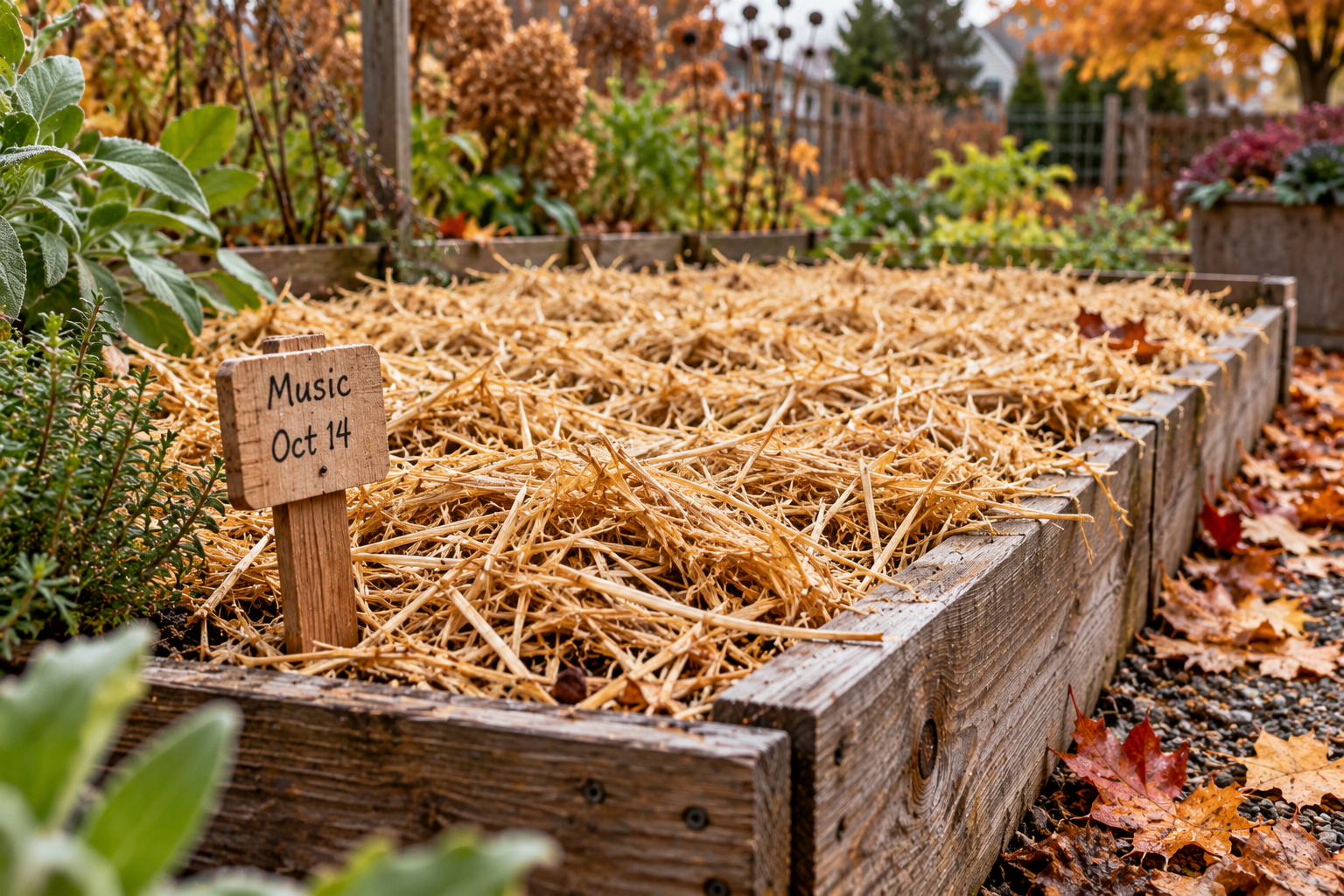
names straw as the most common choice, applied 10–15 cm (4–6 in) deep over the rows. Toronto Master Gardeners suggest chopped leaves or straw once the ground has frozen, while many growers mulch right after planting. Either works.
Use clean material, since mulch can carry weed seed or garlic pests. Chopped leaves from your own healthy yard are a good free option; our guide to using fallen leaves as garden mulch covers shredding. Skip whole, wet leaves: they mat into a dense layer that holds water against the cloves and can stop shoots breaking through in spring.
How Deep and How Far Apart Should You Plant Garlic?
Plant garlic with about 2.5–5 cm (1–2 in) of soil over each clove and 10–15 cm (4–6 in) between cloves, in rows at least 20 cm (8 in) apart.
| FactorPractical guidanceWhy it mattersClove orientation | Pointed end up, basal plate downA straight shoot and a well-formed bulb | Soil above clove | At least 2.5 cm in heavy soil; 2.5–5 cm in average soil; about 5 cm in light soilDeeper protects against frost heaving but can slow emergence, shrink bulbs and promote rot in wet clay | In-row spacing | 10–15 cm home beds (OMAFA commercial range: 7–12 cm)Closer means more plants and smaller bulbs; wider means room for large bulbs | Row spacing | At least 20 cm; 25–30 cm is commonRoom to weed without damaging shallow roots | Sun | Full sunLeaf area drives bulb size | Drainage | Well-drained; raised bed if heavyWet soil promotes fungal rot over winter | Mulch | 10–15 cm loose, clean straw or shredded leavesEvens out freeze-thaw swings and suppresses weeds |
|---|
Why Do Garlic Planting Depth Recommendations Differ?
Because clove size, soil, winter severity and goals differ. Toronto Master Gardeners suggest 7.5 cm (3 in). The Garlic Growers Association of Ontario scales depth to clove length, about three times the length in heavy soil and four times in loose soil. An Ontario grower on heavy clay uses 2.5–5 cm and finds 2.5 cm survives winter while 1 inch can winterkill on exposed ground without mulch. Deeper planting buys frost protection at the price of slower emergence and, potentially, yield. I’ve set the NestDigest range at 2.5–5 cm as a safe starting point for home beds, and leaned deeper only for light soils and exposed sites that you’ll mulch.
How Much Garlic Fits in a Raised Bed?
Using 15 cm between cloves and 25 cm between rows, with a 7.5 cm margin at the bed edge, a 1.2 × 1.2 m (4 × 4 ft) bed holds about 40 cloves and a 1.2 × 2.4 m (4 × 8 ft) bed about 80. Tighter spacing (10 cm by 20 cm) raises that to roughly 66 and 138, with smaller bulbs likely.
bulbs carry about 4–12 cloves each, so a 4 × 4 ft bed needs roughly 4–10 bulbs. This is NestDigest arithmetic, not a published yield figure.
| Spacing (in row × between rows)1.2 × 1.2 m (4 × 4 ft)1.2 × 2.4 m (4 × 8 ft)15 cm × 25 cm (6 × 10 in) | about 40 clovesabout 80 cloves | 10 cm × 20 cm (4 × 8 in) | about 66 clovesabout 138 cloves |
|---|
How to Tell When Your Garlic Planting Window Is Open
Instead of circling a date, check these signals. First-frost averages are a useful reference point, not a starting gun.
| SignalGreen lightCautionSeed stock | Firm, healthy bulbs, cracked into cloves just before planting.Soft, nicked or long-cracked cloves; fix this before worrying about the date. | First-frost date (reference) | Planting around it gave roots with little top growth in the |
|---|
| trial.Planting a month or more earlier brought leaves before winter; clean stock, drainage and mulch matter more. | Soil workability | Soil crumbles in your hand and a trowel slides in 8–10 cm without a fight.Soil is sticky, puddled or waterlogged. | Soil temperature | Soil has started to cool from summer highs.Still very warm: Ontario’s |
|---|
| links early planting in warm soil to worse clove rot. | Time before freeze-up | At least four to six weeks before you expect the soil to freeze.Fewer weeks: still plant if the soil is workable, but mulch well. | Ground | Unfrozen to planting depth.A frozen crust has formed; the window is effectively closed. |
|---|
A garlic bed planted a week late into well-drained soil does better than one planted on schedule into mud.
Can You Plant Garlic in November?
Yes. Garlic planted in early November can still succeed wherever the soil is workable, especially in milder southern areas, but each week later leaves less time for roots.
Late planting isn’t a failure, only a higher-risk choice. The provincial
warns that cloves planted too late may not root well enough to survive winter, and the
trial found yield risk climbing with delay. If you’re planting in November, use your largest, healthiest cloves, make sure the bed drains, and mulch generously as the ground begins to freeze. Spring planting remains a fallback, but it needs cold-stored seed garlic and generally gives smaller bulbs.
What Happens to Garlic Over Winter?
Planted on time, garlic roots in fall, slows to near dormancy as the ground cools, and spends the winter under snow and mulch. That cold exposure is part of the plan, not a threat. A well-rooted clove is built to overwinter, and it grows quickly once soil and air warm up. For the wider routine, see our winter garden planning guide.
- October–November: cloves root; leaf growth is minimal.
- December–March: dormancy; snow cover and mulch insulate the bed.
- March–April: green shoots push up through the mulch.
- May–June: leaf growth; hardnecks form scapes around late June.
- July–early August: leaves yellow and the bulbs are ready to lift.
What If Garlic Sprouts Before Winter?
A little fall growth doesn’t mean the crop has failed.
If shoots appear before winter, the leaf tips may burn in hard cold, but the clove underneath usually regrows in spring. Ontario’s
does warn that emerged shoots are prone to winter injury, so add a few extra
of straw over the sprouts. The
trial found something similar: plantings that put up several leaves before the freeze still overwintered well. Don’t dig up healthy garlic just because it’s green.
Common Garlic Planting Mistakes
- Planting too late. Roots stay thin and winter hardiness suffers; later is the bigger risk. Plant earlier, and mulch heavily if you’re late.
- Planting early without considering soil conditions. Warm late-summer soil can raise clove-rot risk, though Ontario trials show relatively early fall planting can overwinter well. Early isn’t the problem; poor seed, wet soil and warm-soil rot risk are. Use clean stock and a well-drained bed.
- Poorly drained soil. Cloves rot in cold, wet ground. Use a raised bed or a drier spot.
- Cloves upside down. Expect curved shoots and misshapen bulbs. Plant tip up.
- Damaging the basal plate. Wounds invite mould and rot. Separate cloves gently and discard damaged ones.
- Unhealthy planting stock. Disease travels with the clove. Buy seed garlic and reject soft or nicked cloves.
- Planting too shallow. Frost heaving pushes cloves up and exposes shoots. Keep at least 2.5 cm of soil above, about 5 cm in light soil, and mulch.
- Planting too deep. Shoots struggle to emerge, bulbs may be smaller, and clay-bound cloves can rot. Stay well under 7.5 cm.
- Crowding cloves. Small bulbs and hard weeding. Give 10–15 cm.
- Heavy mulch mats. Wet, compacted leaves block shoots and hold water. Use loose straw or shredded leaves.
- Assuming one date fits everywhere. Frost timing varies by region. Use soil, seed and freeze-up signals, not a calendar.
- Questionable planting material. Nematodes and white rot can persist in soil for years or decades. Use clean seed, rotate beds, and wash tools.
What Happens in Spring?
Shoots break through the mulch as soil warms. Pull back most of the mulch, though not all, keep the bed weeded, and water about 2.5 cm (1 in) a week through the growing season.
scapes, scape cutting and harvest timing each deserve their own guide; for the rest of spring prep, our early spring garden preparation guide picks up from here.
Fall Garlic Planting Checklist
Before planting
- Healthy seed garlic, kept whole
- Planting window open (frost, soil, time)
- Sunny site
- Good drainage
- Soil loosened, weeded, enriched with compost
During planting
- Separate cloves just before planting
- Keep papery skins on
- Point tips upward
- Correct depth for your soil
- 10–15 cm spacing, rows 20 cm or more apart
After planting
- Cover and firm the soil
- Water only if the soil is dry
- Mulch with clean, loose material
- Label the variety and record the planting date
- Clean your tools; see storing garden tools before winter
Successful garlic planting depends less on memorizing one October date and more on combining correct timing, healthy planting stock, good drainage, proper depth and spacing, and winter protection. Read your own soil and seed stock, plant with time to spare, and the bed takes care of the rest. For more fall yard projects, browse our outdoor living guides.
How this guide was put together: the timing, spacing, mulch and disease points come from the Ontario Ministry of Agriculture’s garlic
, its
planting-date trial and 2026 vegetable crop reports, Toronto Master Gardeners and Ontario garlic growers. Where sources differ, planting depth especially, I’ve said so and labelled my own reading. Frost dates are 50/50 averages, not forecasts.
Garlic asks very little: one clove, a few weeks of roots, and the patience to trust the dark.
— NestDigest