How to Store Garden Tools Properly Before Winter

The first hard frost doesn’t send a warning across most of Canada. It just arrives one night in October or November. By morning, the spade left leaning against the fence has a rime of ice on the blade — ice that won’t fully thaw until the ground does in April.
That’s the whole argument for doing this properly, instead of shoving everything into the shed and closing the door. Learning how to store garden tools before winter — really store them, not just stash them — makes a real difference. It’s the gap between pulling out a trowel in April that still holds an edge, and pulling out one that’s pitted with rust. It’s a handle that’s swollen and split instead of smooth. It’s a mower that won’t turn over because last September’s gas turned to varnish in the carburetor. In short: clean off soil and rust, sharpen and oil every blade and handle, stabilize or drain any gas-engine fuel and store batteries at a partial charge, then keep everything off the floor somewhere dry. None of that is dramatic on its own. All of it is avoidable, and all of it costs real money to fix or replace.
Start with dirt, because dirt does the most damage the fastest. Soil clinging to a spade or hoe holds moisture against the metal all winter. That’s exactly the condition rust needs. It also carries whatever fungal spores or bacteria were living in your beds this season — spores that survive a Canadian winter just fine and reintroduce themselves to your soil in spring. Hose off caked mud outdoors while there’s still a mild afternoon left to do it in. Work a wire brush or steel wool into anything that doesn’t come off with water. For tools that pruned or cut anything diseased this year, wipe the blades with rubbing alcohol before they go anywhere near the shed. It’s a step most people skip, and the one that actually keeps next year’s blight from being this year’s mistake.
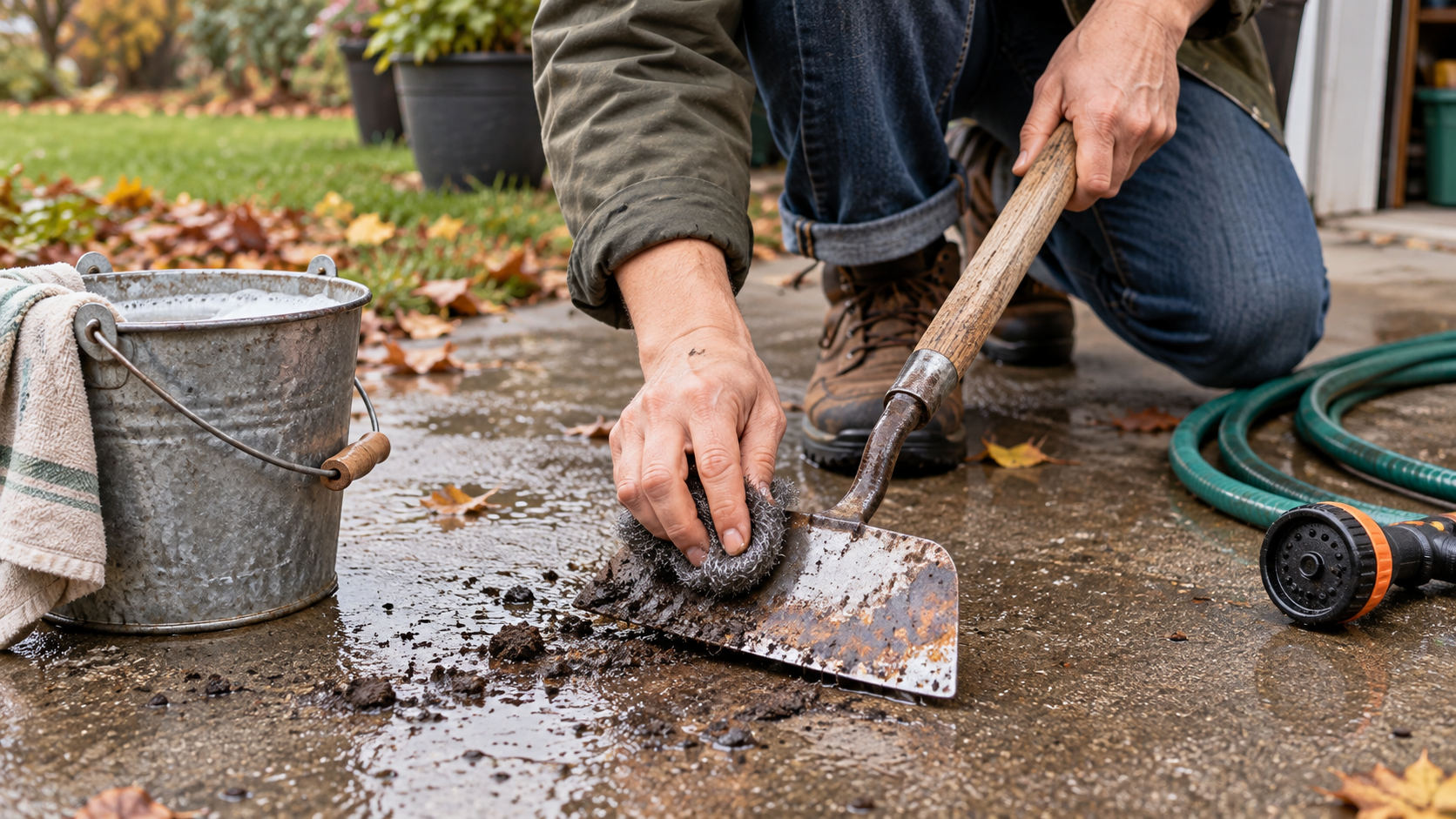
Once a tool is clean and fully dry, sharpen anything with an edge. Dry matters here — sealing moisture under a coat of oil just traps the very thing you’re trying to prevent. A flat file at roughly a 45-degree angle restores a spade or hoe faster than most people expect. A whetstone does the same job for pruners and loppers. Then comes oil. Boiled linseed oil worked into wooden handles with a rag keeps the wood from drying and splitting over a dry Canadian winter indoors. A light coat of oil on every bare metal surface keeps rust from forming. The trick I go back to every year, because it handles both jobs in one motion, is a five-gallon bucket filled with coarse sand and about a quart of oil stirred through it. Plunge the head of a clean spade or hoe into the sand a few times before you hang it up. The abrasive scrubs off any last residue while the oil coats every crevice a rag can’t reach.
Rinse off soil, scrub rust with steel wool, and sanitize any blade that touched diseased plant material this season.
File edges while the tool is fully dry, then coat wood with linseed oil and bare metal with a light protective oil.
Stabilize or drain gas-engine fuel, and store lithium-ion batteries at partial charge, away from the tool.
Hang tools rather than resting them on concrete, and move anything sensitive indoors if your winters run truly cold.
Hoses get forgotten more than any other single item, and they’re the cheapest thing on this list to ruin. Any water left inside a hose over a Canadian winter freezes and expands. It splits the interior lining in ways that don’t always show up until you turn the tap on again in May and watch it leak along its entire length. Drain it completely. Coil it loosely rather than looping it into tight kinks, and bring it inside. An unheated garage in Winnipeg or Thunder Bay isn’t meaningfully warmer than the yard once temperatures drop past minus 20.
Wheelbarrows and garden carts need a smaller version of the same care. Rinse off soil so it doesn’t sit against the metal tray all winter, and check the tire. A pneumatic wheelbarrow tire left fully inflated in a cold shed can develop a flat spot, or a slow crack in the sidewall, as the rubber contracts — so let a little air out before storage and top it back up again in spring. Tip the wheelbarrow onto its nose, or hang it on a wall hook if you have one, so the tray sheds moisture instead of collecting it like a shallow basin all winter.
Anything with a gas engine needs a different kind of attention, because the failure mode isn’t rust — it’s fuel. Today’s ethanol-blended gasoline starts breaking down in about a month, and left sitting in a mower or trimmer’s carburetor over five or six months of Canadian winter, it turns into a gummy varnish that clogs the tiny passages a small engine depends on. Briggs & Stratton recommends adding a fuel stabilizer to the tank and running the engine for a few minutes before storage so the treated fuel actually circulates through the carburetor, not just the tank — a step that matters more than the stabilizer itself. If you’d rather not deal with it at all, running the tank down to empty before the first real cold snap works just as well.
Battery-powered tools have quietly taken over a lot of Canadian sheds in the last few years, and most people winterize them exactly wrong. The instinct is to charge the battery fully before putting it away, on the theory that it’ll be ready to go the moment spring arrives. STIHL and most other manufacturers actually recommend the opposite. Store lithium-ion batteries at around 40 to 60 percent charge, separate from the tool, somewhere that won’t drop much below freezing. A battery left at full charge in a cold garage all winter degrades faster than one stored at a partial charge in a slightly warmer spot — the kind of detail that never shows up on the box, but shows up very clearly in a battery that holds half the runtime it used to by its third winter.
Small hand tools deserve their own container rather than a shared pile on a shelf. A bin or a bucket keeps trowels, hand forks, and secateurs from nicking each other’s edges. A few silica gel packets tucked in with them absorb the moisture that would otherwise start rust before you’ve even noticed. The same goes for foam kneeling pads and knee cushions — cold makes foam brittle, so a pad left outside all winter is often crumbling by spring, while the same pad stored in a tote lasts for years.
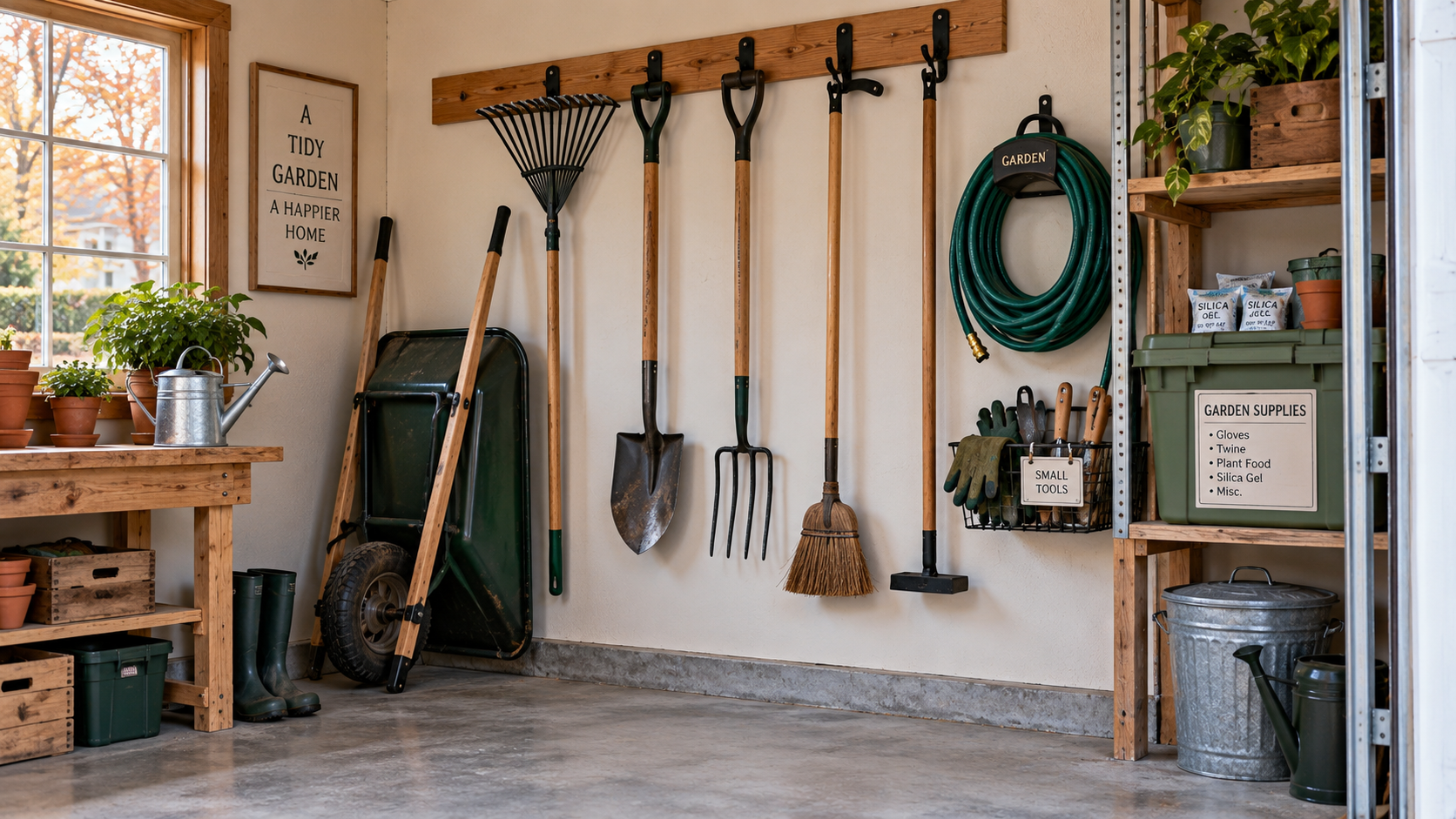
Where all of this ends up matters almost as much as how you prepared it. Clean, oiled tools left directly on a concrete shed floor will still pick up rust. Concrete goes through its own freeze-thaw cycling all winter, and it holds ground moisture against anything resting on it. Hang everything instead — a pegboard, a wall-mounted rack, or even a few sturdy nails — so nothing touches the floor. What counts as adequate shelter changes a lot depending on where in Canada you’re doing this. An uninsulated garage is genuinely fine for most tools in Victoria or coastal Nova Scotia, where winters rarely stay below freezing for long. That same garage in Regina, Winnipeg, or Thunder Bay will put tools through dozens of hard freeze-thaw cycles between November and March — exactly the stress that swells wood, pops rivets, and works rust into every seam. If your winters run genuinely cold, a small tote with a few silica gel packs for hand tools and hardware is worth the five minutes it takes to set up.
None of this is complicated, and none of it takes more than an afternoon — which is precisely why it’s so easy to skip. But a shed opened in April to tools that are clean, sharp, and ready is a completely different start to the season than one spent scraping rust and ordering replacements before you’ve even turned over the first bed. The tools don’t know it’s an investment. You will, the first time you don’t have to make one.
A tool cared for outlives the season it was bought for.
— NestDigest